Solvents quiz #1 Flashcards

Solvents quiz #1
Control buttons has been changed to "navigation" mode.
1/10
  • What is a polar aprotic solvent, and why are such solvents preferred for SN2 and E2 mechanisms in organic chemistry?
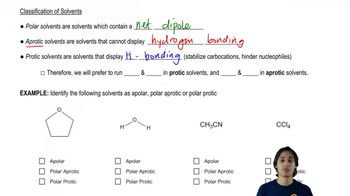
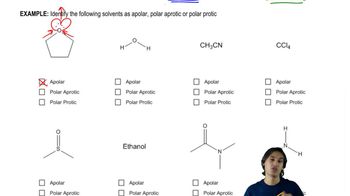
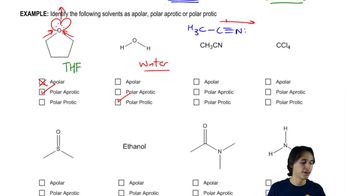
    A polar aprotic solvent is a solvent that has a net dipole (is polar) but cannot hydrogen bond (is aprotic). These solvents do not hinder nucleophiles, allowing them to react more freely, which makes polar aprotic solvents preferred for SN2 and E2 mechanisms.
  • Where are solvents typically indicated in a chemical reaction diagram?
    Solvents are usually shown at the bottom of the reaction arrow. This placement helps distinguish them from reagents, which are typically listed above the arrow.
  • What is the primary function of a solvent in an organic reaction?
    A solvent serves as an inert medium for the reaction to occur. It does not participate directly in the chemical transformation.
  • How do protic solvents affect nucleophiles in solution?
    Protic solvents slow down nucleophiles by hydrogen bonding to them. This interaction makes nucleophiles bulkier and less reactive.
  • Why are protic solvents beneficial for reactions involving carbocations?
    Protic solvents stabilize carbocations through hydrogen bonding. This stabilization makes it easier to generate carbocations during the reaction.
  • What property distinguishes polar solvents from nonpolar solvents?
    Polar solvents have a net dipole moment. This means their molecules possess an uneven distribution of charge.
  • What is the effect of solvent choice on the outcome of most written organic reactions?
    The solvent usually has a minor impact compared to nucleophiles and leaving groups. In many cases, its effect can be neglected in mechanistic studies.
  • Which types of mechanisms are favored by protic solvents and why?
    Protic solvents favor SN1 and E1 mechanisms because they stabilize carbocations. This stabilization facilitates the formation of intermediates required for these reactions.
  • What is the main criterion for classifying a solvent as protic?
    A protic solvent can hydrogen bond by donating hydrogen atoms, typically through oxygen, nitrogen, or fluorine. This ability to hydrogen bond is the defining feature.
  • How should students approach solvent information when analyzing reaction mechanisms in organic chemistry?
    Students should focus primarily on nucleophiles and leaving groups, as solvents rarely determine the reaction outcome. Solvent details are often ignored unless conceptually relevant.