Back

Sonogashira Coupling Reaction definitions

Control buttons has been changed to "navigation" mode.
1/15
  • Sonogashira Coupling Reaction

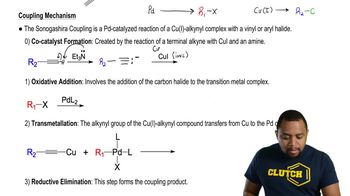
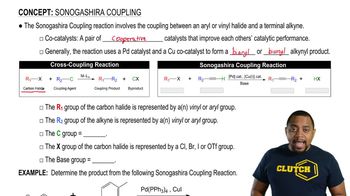
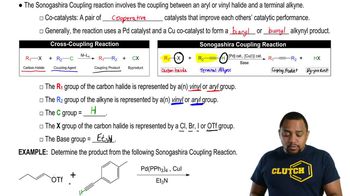
    A process joining an aryl or vinyl halide with a terminal alkyne using palladium and copper catalysts in four mechanistic steps.
  • Aryl Halide

    An aromatic ring bonded to a halogen, serving as a key reactant in cross-coupling reactions.
  • Vinyl Halide

    A molecule containing a halogen attached to an alkene carbon, acting as a coupling partner.
  • Terminal Alkyne

    A hydrocarbon with a carbon-carbon triple bond and a hydrogen on one end, providing a reactive site for coupling.
  • Palladium Catalyst

    A transition metal complex that enables oxidative addition and facilitates bond formation in the reaction.
  • Copper Co-catalyst

    A metal species that activates the terminal alkyne, enhancing the efficiency of the main catalyst.
  • Triethylamine

    A base used to deprotonate the terminal alkyne, generating a nucleophilic carbon for further reaction.
  • Oxidative Addition

    A mechanistic step where palladium inserts into the carbon-halogen bond, activating the halide for coupling.
  • Transmetalation

    A process where the alkyne group transfers from copper to palladium, enabling the formation of the new bond.
  • Reductive Elimination

    The final step where the coupled product forms and the palladium catalyst is regenerated for another cycle.
  • Cross Coupling Reaction

    A class of reactions where two different organic groups are joined via a metal-catalyzed process.
  • Leaving Group

    An atom or group, such as halide or triflate, that departs with a pair of electrons during bond formation.
  • Transition Metal Complex

    A coordination entity containing a central metal atom, such as palladium, surrounded by ligands.
  • Deprotonation

    The removal of a proton from a molecule, often making the remaining species more nucleophilic.
  • Ligand

    An ion or molecule bound to a central metal atom, influencing the reactivity and stability of the complex.