Organic Chemistry
My Course
Learn
Exam Prep
AI Tutor
Study Guides
Textbook Solutions
Flashcards
Explore
Try the app
My Course
Learn
Exam Prep
AI Tutor
Study Guides
Textbook Solutions
Flashcards
Explore
Try the app
Back
Sonogashira Coupling Reaction quiz
You can tap to flip the card.
What two types of organic halides can participate in the Sonogashira coupling reaction?
You can tap to flip the card.
👆
What two types of organic halides can participate in the Sonogashira coupling reaction?
Aryl halides and vinyl halides can participate in the Sonogashira coupling reaction.
Track progress
Control buttons has been changed to "navigation" mode.
1/15
Related flashcards
Related practice
Recommended videos
Sonogashira Coupling Reaction definitions
Sonogashira Coupling Reaction
15 Terms
Sonogashira Coupling Reaction
35. Transition Metals
3 problems
Topic

Ernest
27. Transition Metals
6 topics
14 problems
Chapter
Johnny
Guided course
05:05
Sonogashira Coupling Reaction
836
views
Guided course
02:54
Sonogashira Coupling Reaction
926
views
Guided course
02:11
Sonogashira Coupling Reaction Example 1
793
views
Terms in this set (15)
Hide definitions
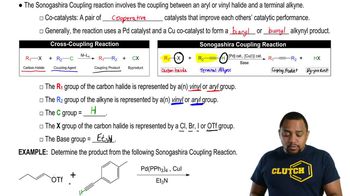
What two types of organic halides can participate in the Sonogashira coupling reaction?
Aryl halides and vinyl halides can participate in the Sonogashira coupling reaction.
What is the main catalyst used in the Sonogashira coupling reaction?
Palladium is the main catalyst used in the Sonogashira coupling reaction.
What role does copper play in the Sonogashira coupling reaction?
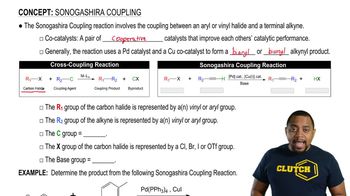
Copper acts as a co-catalyst, working cooperatively with palladium to enhance the reaction.
What type of alkyne is required for the Sonogashira coupling reaction?
A terminal alkyne, which has at least one hydrogen attached to a triple-bonded carbon, is required.
What is the typical base used in the Sonogashira coupling reaction?
Triethylamine is typically used as the base in the Sonogashira coupling reaction.
What is the purpose of the base in the Sonogashira reaction?
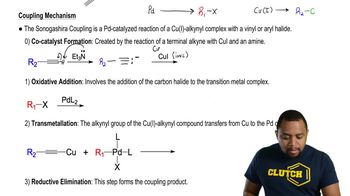
The base deprotonates the terminal alkyne, making the alkyne carbon negatively charged and ready to bind to copper.
What are the four main steps in the Sonogashira coupling mechanism?
The four main steps are preparation of the coupling agent (step zero), oxidative addition, transmetalation, and reductive elimination.
During which step does palladium attach to the halide group of the aryl or vinyl halide?
Palladium attaches to the halide group during the oxidative addition step.
What happens during the transmetalation step of the Sonogashira reaction?
The alkyne group, activated by copper, is transferred from copper to the palladium complex.
What is formed during the reductive elimination step of the Sonogashira reaction?
The coupled product, where the aryl/vinyl group is joined to the alkyne, is formed, and the palladium catalyst is regenerated.
What is unique about the Sonogashira coupling compared to other coupling reactions?
It uniquely uses both palladium and copper catalysts working cooperatively and includes a preparatory step (step zero).
What is the function of the copper catalyst in the preparation step (step zero)?
Copper binds to the deprotonated terminal alkyne, activating it for the coupling reaction.
Which leaving groups are commonly involved in the Sonogashira coupling reaction?
Common leaving groups are chlorine, bromine, iodine, or triflate.
What is the general product of the Sonogashira coupling reaction?
The general product is a molecule where an aryl or vinyl group is coupled to a terminal alkyne, forming a new carbon-carbon bond.
Why is regeneration of the palladium catalyst important in the Sonogashira reaction?
Regeneration allows the palladium catalyst to participate in additional reaction cycles, making the process catalytic.