Back

Step-Growth Polymers: Epoxy Resin definitions

Control buttons has been changed to "navigation" mode.
1/13
  • Epoxy Resin

    A thermosetting polymer formed by the reaction of epichlorohydrin and BPA, featuring strong covalent cross-links and high durability.
  • Bisphenol A

    An aromatic compound with two phenol groups, serving as a nucleophile in the formation of certain step-growth polymers.
  • Epichlorohydrin

    A molecule containing an epoxide ring, a methylene group, and a chlorine atom, acting as a key monomer in resin synthesis.
  • Epoxide Ring

    A three-membered cyclic ether highly strained and reactive, central to the polymerization process in resin formation.
  • Methylene Group

    A -CH2- unit that links functional groups, present in epichlorohydrin and crucial for connecting monomer units.
  • Chlorine

    A halogen atom bonded to the methylene group in epichlorohydrin, influencing the molecule's reactivity.
  • Nucleophilic Addition

    A reaction where an electron-rich species attacks an electron-deficient site, initiating polymer chain growth.
  • Addition Polymerization

    A process where monomers join without byproducts, often involving ring opening to form long chains.
  • Cross-Linking

    The formation of covalent bonds between polymer chains, resulting in a rigid, thermosetting network.
  • Thermosetting Polymer

    A material that becomes irreversibly hard upon curing due to extensive cross-linking.
  • Covalent Bonding

    A strong chemical connection involving shared electron pairs, providing stability to polymer structures.
  • Activation Energy

    The minimum energy required to initiate the polymerization process, typically high in thermosetting systems.
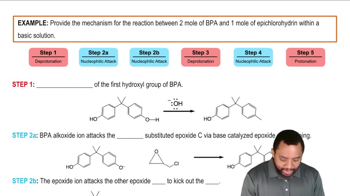
  • Protonation Step

    A stage in the mechanism where a proton is added, often finalizing the formation of the polymer chain.