Organic Chemistry
My Course
Learn
Exam Prep
AI Tutor
Study Guides
Textbook Solutions
Flashcards
Explore
Try the app
My Course
Learn
Exam Prep
AI Tutor
Study Guides
Textbook Solutions
Flashcards
Explore
Try the app
Back
Step-Growth Polymers: Epoxy Resin quiz
You can tap to flip the card.
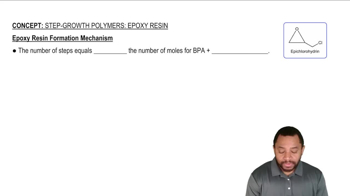
What is the formula for determining the number of steps in the epoxy resin formation mechanism?
You can tap to flip the card.
👆
What is the formula for determining the number of steps in the epoxy resin formation mechanism?
The number of steps equals twice the number of moles of BPA plus a protonation step.
Track progress
Control buttons has been changed to "navigation" mode.
1/15
Related flashcards
Recommended videos
Step-Growth Polymers: Epoxy Resin definitions
Step-Growth Polymers: Epoxy Resin
13 Terms
00:52
Step-Growth Polymers: Epoxy Resin Concept 1
681
views
4:30
Step-Growth Polymers: Epoxy Resin Example 1
699
views
Terms in this set (15)
Hide definitions
What is the formula for determining the number of steps in the epoxy resin formation mechanism?
The number of steps equals twice the number of moles of BPA plus a protonation step.
What is epichlorohydrin in the context of epoxy resin formation?
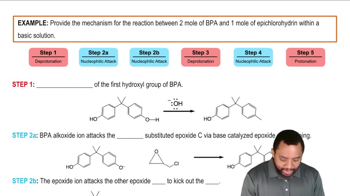
Epichlorohydrin is an epoxide ring attached to a methylene group (CH2) and a chlorine atom (Cl).
Which two key molecules are involved in the formation of epoxy resins?
The key molecules are epichlorohydrin and bisphenol A (BPA).
What role does BPA play in the epoxy resin formation mechanism?
BPA acts as a nucleophile that adds to epichlorohydrin during the polymerization process.
What type of polymerization is exemplified by epoxy resin formation?
Epoxy resin formation is an example of addition polymerization.
What happens to the epoxide ring during the polymerization process?
The epoxide ring opens, allowing for cross-linking and polymer formation.
What is the significance of the protonation step in the mechanism?
The protonation step is necessary to complete the reaction and is added to the total number of steps.
What type of polymer is formed as a result of epoxy resin polymerization?
A thermosetting polymer is formed, which is rigid and heat-resistant.
What kind of bonding characterizes the structure of epoxy resins?
Epoxy resins are characterized by strong covalent bonding.
Why do epoxy resins have high activation energy barriers?
The strong covalent bonds and cross-linked structure contribute to high activation energy barriers.
What is the function of epichlorohydrin in the formation of epoxy resins?
Epichlorohydrin provides the epoxide ring that reacts with BPA to form the polymer.
How does the number of moles of BPA affect the number of steps in the mechanism?
The number of steps increases proportionally with the number of moles of BPA, as each mole requires two steps.
What structural feature of epichlorohydrin is essential for its reactivity?
The presence of the epoxide ring is essential for its reactivity in polymerization.
What is the result of the cross-linking that occurs during epoxy resin formation?
Cross-linking results in a rigid, three-dimensional network that gives the polymer its strength.
What is the general outcome of the nucleophilic addition of BPA to epichlorohydrin?
The nucleophilic addition leads to the opening of the epoxide ring and the formation of the polymer chain.