Organic Chemistry
My Course
Learn
Exam Prep
AI Tutor
Study Guides
Textbook Solutions
Flashcards
Explore
Try the app
My Course
Learn
Exam Prep
AI Tutor
Study Guides
Textbook Solutions
Flashcards
Explore
Try the app
Back
Step-Growth Polymers: Polyurethane Mechanism definitions
You can tap to flip the card.
Polyurethane
You can tap to flip the card.
👆
Polyurethane
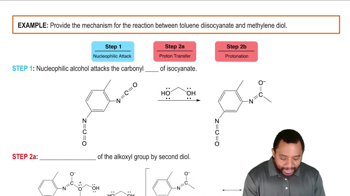
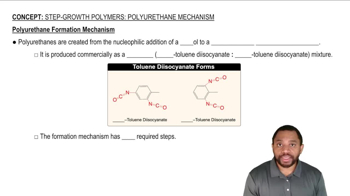
A polymer formed by linking diols and toluene diisocyanate through urethane bonds in a two-step nucleophilic addition process.
Track progress
Control buttons has been changed to "navigation" mode.
1/14
Related flashcards
Recommended videos
Step-Growth Polymers: Polyurethane Mechanism quiz
Step-Growth Polymers: Polyurethane Mechanism
15 Terms
3:05
Polyurethane Mechanism Example 1
619
views
1
rank
1:43
Polyurethane Mechanism Concept 1
619
views
Terms in this set (14)
Hide definitions
Polyurethane
A polymer formed by linking diols and toluene diisocyanate through urethane bonds in a two-step nucleophilic addition process.
Nucleophilic Addition
A reaction where an electron-rich species attacks an electron-deficient carbon, key in forming urethane linkages.
Diol
A molecule containing two hydroxyl groups, serving as a reactant in polyurethane synthesis.
Toluene Diisocyanate
An aromatic compound with two isocyanate groups, commonly used in an 80:20 mixture of 2,4 and 2,6 isomers.
2,4-Isomer
The major form of toluene diisocyanate, with isocyanate groups at positions 2 and 4 relative to the methyl group.
2,6-Isomer
A minor form of toluene diisocyanate, with isocyanate groups at positions 2 and 6 on the aromatic ring.
Isocyanate Group
A functional group with the structure –N=C=O, highly reactive toward nucleophiles like alcohols.
Urethane Linkage
A bond formed between an alcohol and an isocyanate group, connecting monomer units in polyurethanes.
Addition Polymer
A macromolecule created by sequential addition of monomers without loss of small molecules.
Methyl Group
A –CH3 substituent on toluene, designated as position 1 for isomer identification in diisocyanates.
Mechanism
A stepwise description of how reactants convert to products, here involving two stages for polyurethane formation.
Isomer Distribution
The relative proportions of different structural forms, such as the 80:20 ratio of 2,4 to 2,6 toluene diisocyanate.
Functional Group
A specific group of atoms within molecules responsible for characteristic reactions, such as isocyanate in this context.
Materials Science
A field focused on the properties and applications of substances like polyurethanes in various industries.