Organic Chemistry
My Course
Learn
Exam Prep
AI Tutor
Study Guides
Textbook Solutions
Flashcards
Explore
Try the app
My Course
Learn
Exam Prep
AI Tutor
Study Guides
Textbook Solutions
Flashcards
Explore
Try the app
Back
Step-Growth Polymers: Polyurethane Mechanism quiz
You can tap to flip the card.
What is the primary reactant used in the formation of polyurethanes?
You can tap to flip the card.
π
What is the primary reactant used in the formation of polyurethanes?
Polyurethanes are formed from the nucleophilic addition of a diol to toluene diisocyanate.
Track progress
Control buttons has been changed to "navigation" mode.
1/15
Related flashcards
Recommended videos
Step-Growth Polymers: Polyurethane Mechanism definitions
Step-Growth Polymers: Polyurethane Mechanism
14 Terms
3:05
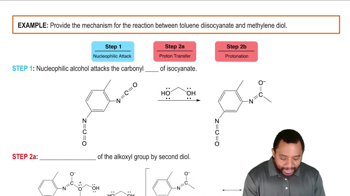
Polyurethane Mechanism Example 1
618
views
1
rank
1:43
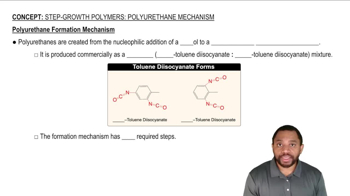
Polyurethane Mechanism Concept 1
619
views
Terms in this set (15)
Hide definitions
What is the primary reactant used in the formation of polyurethanes?
Polyurethanes are formed from the nucleophilic addition of a diol to toluene diisocyanate.
What is the typical isomer ratio of toluene diisocyanate used in polyurethane synthesis?
The typical mixture is 80% 2,4-toluene diisocyanate and 20% 2,6-toluene diisocyanate.
Which isomer of toluene diisocyanate is considered the default in reactions?
The 2,4-toluene diisocyanate is considered the default isomer in reactions.
Where are the isocyanate groups located in the 2,4-toluene diisocyanate isomer?
The isocyanate groups are at positions 2 and 4 on the toluene ring.
What is the position of the methyl group in toluene diisocyanate?
The methyl group is at position 1 on the toluene ring.
How many steps are involved in the mechanism of polyurethane formation?
The mechanism involves two steps.
What type of reaction mechanism forms polyurethanes?
Polyurethanes form via nucleophilic addition.
What functional group is attacked during polyurethane formation?
The isocyanate functional group is attacked during the reaction.
What linkage is formed in the polyurethane synthesis mechanism?
Urethane linkages are formed.
What is the minor isomer present in toluene diisocyanate mixtures?
The minor isomer is 2,6-toluene diisocyanate.
How are trace amounts of 2,5-toluene diisocyanate treated in reactions?
Trace amounts of 2,5-toluene diisocyanate are considered negligible and not important.
What must be specified if a reaction uses the 2,6 or 2,5 isomer of toluene diisocyanate?
The isomer must be explicitly stated in the question.
Why is understanding isomer distribution important in polyurethane synthesis?
It is essential for correctly synthesizing polyurethanes and predicting their properties.
What is the main application area for polyurethanes?
Polyurethanes are important addition polymers used in materials science and polymer chemistry.
What is the priority group when numbering the toluene ring in toluene diisocyanate?
The methyl group is the priority group and is assigned position 1.