Back

Step-Growth Polymers: Urethane definitions

Control buttons has been changed to "navigation" mode.
1/12
  • Urethane

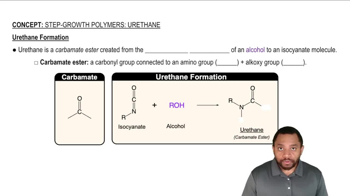
    A carbonate ester formed by combining an isocyanate and an alcohol through nucleophilic addition.
  • Carbamate Ester

    A molecule featuring a carbonyl bonded to both an amino group and an alkoxy group.
  • Nucleophilic Addition

    A reaction where an electron-rich species attacks an electron-deficient carbon, forming a new bond.
  • Isocyanate

    A functional group containing a carbon atom double-bonded to oxygen and nitrogen, highly reactive with alcohols.
  • Alcohol

    A compound with a hydroxyl group, serving as a nucleophile in reactions with isocyanates.
  • Carbonyl Group

    A functional group with a carbon atom double-bonded to oxygen, central to ester and amide structures.
  • Amino Group

    A nitrogen-containing group, often bonded to hydrogens or carbons, present in carbamate esters.
  • Alkoxy Group

    An oxygen atom bonded to a carbon chain, derived from alcohols and present in esters.
  • Polyurethane

    A polymer produced by linking multiple urethane units, widely used in foams and coatings.
  • Condensation Polymer

    A macromolecule formed by joining monomers with the loss of small molecules like water or alcohol.
  • Pi Bond

    A type of covalent bond formed by sideways overlap of p orbitals, often involved in reactivity of isocyanates.
  • Ester

    A compound with a carbonyl adjacent to an oxygen atom bonded to another carbon, key in urethane structure.