Back

Step-Growth Polymers: Urethane quiz

Control buttons has been changed to "navigation" mode.
1/15
  • What two types of molecules react to form a urethane?

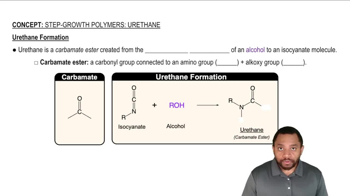
    An isocyanate reacts with an alcohol to form a urethane.
  • What type of reaction mechanism is involved in urethane formation?

    Urethane formation involves a nucleophilic addition reaction.
  • What is the functional group structure of a carbamate (urethane) ester?

    A carbamate ester has a carbonyl group bonded to an amino group (NR2) and an alkoxy group (OR).
  • During urethane formation, where does the hydrogen from the alcohol end up?

    The hydrogen from the alcohol attaches to the nitrogen atom of the isocyanate.
  • In urethane formation, where does the alkoxy (RO) portion of the alcohol go?

    The alkoxy (RO) portion bonds to the carbonyl carbon of the isocyanate.
  • What is the significance of isocyanates in urethane synthesis?

    Isocyanates are highly reactive with alcohols, making them essential for synthesizing urethanes and polyurethanes.
  • What is the general formula for the amino group in a carbamate ester?

    The amino group is represented as NR2, where R can be a carbon or hydrogen.
  • What is the general formula for the alkoxy group in a carbamate ester?

    The alkoxy group is represented as OR, where R must be a carbon.
  • What type of polymer is formed by the reaction of isocyanates with alcohols?

    Polyurethanes are formed by the reaction of isocyanates with alcohols.
  • What bond is formed between the alcohol and isocyanate during urethane synthesis?

    A new C–O bond is formed between the carbonyl carbon of the isocyanate and the alkoxy group from the alcohol.
  • What happens to the pi bond of the isocyanate during urethane formation?

    The pi bond of the isocyanate is broken to allow the alcohol to add to the molecule.
  • What is the simplest way to describe urethane formation without a detailed mechanism?

    An isocyanate reacts with an alcohol, transferring the alcohol's hydrogen to nitrogen and the RO group to the carbonyl carbon.
  • What is the role of the carbonyl group in urethane formation?

    The carbonyl group acts as the electrophilic center that the alcohol attacks during nucleophilic addition.
  • Why is urethane formation considered a condensation polymerization?

    Because it involves the combination of two molecules (isocyanate and alcohol) to form a larger molecule with the loss of a small molecule (often water or another small byproduct in related reactions).
  • What is the importance of urethane chemistry in industry?

    Urethane chemistry is crucial for producing polyurethanes, which are widely used in foams, coatings, and elastomers.