Back

Step-Growth Polymers quiz

Control buttons has been changed to "navigation" mode.
1/15
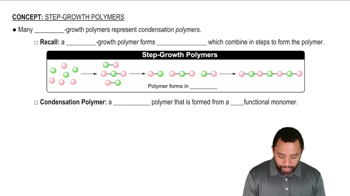
  • What is a step-growth polymer, and how does it form?

    A step-growth polymer forms when bifunctional monomers combine in steps, creating fragments like dimers and trimers that eventually link to form a polymer.
  • What distinguishes a condensation polymer from other step-growth polymers?

    A condensation polymer is a linear polymer formed from bifunctional monomers, typically with the loss of a small molecule such as water.
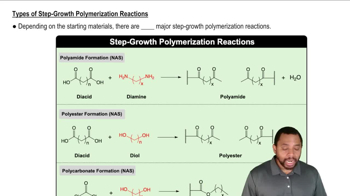
  • What is the main mechanism for the first three types of step-growth polymerization reactions?

    The first three types mainly proceed via nucleophilic acyl substitution mechanisms.
  • Which functional groups are commonly involved in step-growth polymerization?

    Common functional groups include carboxylic acids, alcohols, amines, diols, diamines, and isocyanates.
  • What small molecule is typically lost during the formation of polyamides and polyesters?

    Water is typically lost during the formation of both polyamides and polyesters.
  • What are the monomers used to form a polyamide?

    Polyamides are formed from a diacid and a diamine.
  • What are the monomers used to form a polyester?

    Polyesters are formed from a carboxylic acid and an alcohol.
  • What is the byproduct when phosgene reacts with a diol to form a polycarbonate?

    The byproduct is HCl (hydrogen chloride).
  • What is the typical structure of toluene diisocyanate used in polyurethane formation?

    Toluene diisocyanate is a benzene ring with a methyl group and two isocyanate groups attached.
  • What type of reaction mechanism is involved in polyurethane formation?

    Polyurethane formation involves an addition reaction mechanism.
  • What are the two main reactants in the formation of epoxy resin?

    Epoxy resin is formed from epichlorohydrin and Bisphenol A (BPA).
  • How are the first three step-growth polymerization reactions similar?

    They all follow nucleophilic acyl substitution mechanisms and involve carboxylic acid derivatives.
  • What is the role of bifunctional monomers in step-growth polymerization?

    Bifunctional monomers allow the formation of long polymer chains by reacting at both functional groups.
  • What is the difference in mechanism between the top three and bottom two step-growth polymerization reactions discussed?

    The top three use nucleophilic acyl substitution, while the bottom two use nucleophilic addition or SN2 mechanisms.
  • What is Bisphenol A (BPA), and how is it structurally characterized?

    Bisphenol A (BPA) consists of two phenol groups connected to the same carbon, which also has two methyl groups attached.