Back

Suzuki Reaction definitions

Control buttons has been changed to "navigation" mode.
1/15
  • Suzuki Reaction

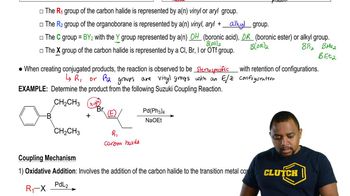
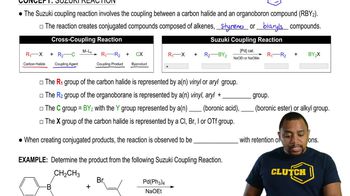
    A palladium-catalyzed process joining a carbon halide and organoboron compound to yield conjugated organic products.
  • Carbon Halide

    An organic molecule containing a carbon atom bonded to a halogen or triflate, serving as a key reactant.
  • Organoboron Compound

    A molecule featuring a boron atom bonded to organic groups, acting as a coupling partner.
  • Boronic Acid

    A type of organoboron compound with the structure BOH2, commonly used in coupling reactions.
  • Boronic Ester

    An organoboron compound where boron is bonded to two alkoxy groups, facilitating transmetalation.
  • Transition Metal Catalyst

    A metal complex, often palladium-based, that enables and accelerates the coupling process.
  • Ligand

    A molecule or ion bound to a central metal atom, stabilizing and modulating its reactivity.
  • Oxidative Addition

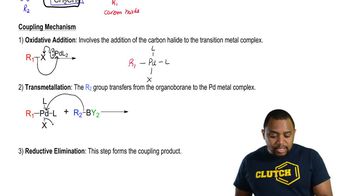
    A catalytic step where a carbon halide adds to a metal complex, increasing the metal's oxidation state.
  • Transmetalation

    A process where an organic group transfers from boron to palladium, exchanging partners with a halide.
  • Reductive Elimination

    A step forming the final product by coupling two organic groups and regenerating the catalyst.
  • Conjugated Compound

    A molecule with alternating single and multiple bonds, enhancing stability and electronic properties.
  • Leaving Group

    An atom or group, such as Cl, Br, I, or triflate, that departs from a molecule during a reaction.
  • Catalytic Cycle

    A repeating sequence of steps that regenerates the catalyst, allowing continuous product formation.
  • 18 Electron Rule

    A guideline stating that transition metal complexes are most stable with 18 valence electrons.
  • Byproduct

    A substance formed incidentally during the main reaction, such as BY2 or halide ions.