Back

Making Ethers - Alcohol Condensation definitions

Control buttons has been changed to "navigation" mode.
1/13
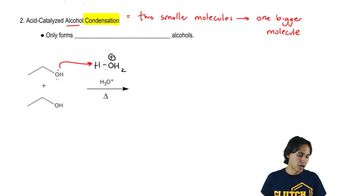
  • Acid-Catalyzed Alcohol Condensation

    A process where two alcohols combine in the presence of acid and heat to form an ether and water.
  • Condensation Reaction

    A transformation where two smaller molecules join to create a larger molecule, often releasing a small byproduct.
  • Protonated Alcohol

    An alcohol molecule that has gained a proton from an acid, making its oxygen positively charged.
  • Leaving Group

    An atom or group that departs from a molecule during a reaction, stabilizing the transition state.
  • SN2 Reaction

    A mechanism involving a single concerted step where a nucleophile attacks and a leaving group departs simultaneously.
  • Ether

    A compound featuring an oxygen atom bonded to two alkyl or aryl groups, often formed from alcohols.
  • Symmetrical Ether

    A molecule where both groups attached to the oxygen are identical, resulting from identical alcohols.
  • Asymmetrical Ether

    A molecule with two different groups attached to the oxygen, requiring different synthetic methods.
  • Williamson Ether Synthesis

    An alternative method for making ethers, especially useful for producing asymmetrical ethers.
  • Catalyst

    A substance that speeds up a reaction without being consumed, such as acid in this synthesis.
  • Deprotonation

    The removal of a proton from a molecule, often restoring neutrality or regenerating a catalyst.
  • Hydronium Ion

    A positively charged ion (H3O+) acting as the acid in the condensation process.
  • Formal Charge

    A calculated charge on an atom in a molecule, indicating electron distribution after bonding.