Back

Making Ethers - Alcohol Condensation quiz

Control buttons has been changed to "navigation" mode.
1/15
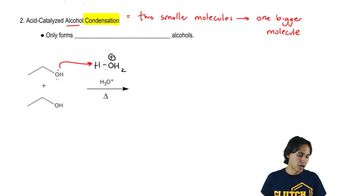
  • What is the definition of a condensation reaction in organic chemistry?

    A condensation reaction takes two smaller molecules and combines them into one larger molecule.
  • What is the starting material for acid-catalyzed alcohol condensation?

    The starting materials are two alcohol molecules.
  • What role does acid (H3O+) play in alcohol condensation to form ethers?

    The acid protonates one of the alcohols, making it a good leaving group.
  • What type of reaction occurs when the non-protonated alcohol attacks the protonated alcohol?

    An SN2 reaction occurs, where the non-protonated alcohol attacks the carbon and displaces the leaving group.
  • What is the leaving group in acid-catalyzed alcohol condensation?

    Water acts as the leaving group after the alcohol is protonated.
  • What is formed after the SN2 attack in acid-catalyzed alcohol condensation?

    An ether is formed, along with water as a byproduct.
  • Why is the acid catalyst not consumed in the alcohol condensation reaction?

    The acid is regenerated at the end of the reaction, so it acts as a catalyst and is not consumed.
  • What step regenerates the acid catalyst in the mechanism?

    Deprotonation of the newly formed ether by water regenerates the acid catalyst.
  • What type of ethers are primarily produced by acid-catalyzed alcohol condensation?

    Symmetrical ethers are primarily produced because the same alcohol reacts with itself.
  • Why does acid-catalyzed alcohol condensation mainly yield symmetrical ethers?

    Because there is an abundance of the same alcohol, both sides of the ether have identical R groups.
  • What method is recommended for synthesizing asymmetrical ethers?

    The Williamson ether synthesis is recommended for making asymmetrical ethers.
  • What is the main limitation of acid-catalyzed alcohol condensation?

    It mainly produces symmetrical ethers and is not suitable for making asymmetrical ethers.
  • What is the byproduct of acid-catalyzed alcohol condensation?

    Water is the byproduct of the reaction.
  • What happens to the formal charge on the newly formed ether during the reaction?

    The formal charge is resolved by deprotonation, restoring neutrality to the ether.
  • What is the overall outcome of acid-catalyzed alcohol condensation?

    Two alcohols combine to form an ether and water, with the acid catalyst regenerated.