Skip to main content
Organic Chemistry
My Course
Learn
Exam Prep
AI Tutor
Study Guides
Textbook Solutions
Flashcards
Explore
Try the app
My Course
Learn
Exam Prep
AI Tutor
Study Guides
Textbook Solutions
Flashcards
Explore
Try the app
Back
Synthetic Cheatsheet definitions
You can tap to flip the card.
Alkane Halogenation
You can tap to flip the card.
👆
Alkane Halogenation
Radical-based process introducing halogens to otherwise unreactive alkanes, enabling further functionalization.
Track progress
Control buttons has been changed to "navigation" mode.
1/15
Related flashcards
Related practice
Recommended videos
Synthetic Cheatsheet quiz
Synthetic Cheatsheet
15 Terms
Synthetic Cheatsheet
14. Synthetic Techniques
5 problems
Topic
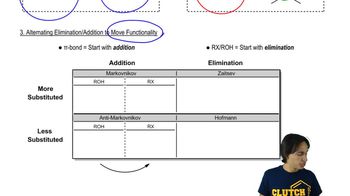
Moving Functionality
14. Synthetic Techniques
1 problem
Topic
Johnny
14. Synthetic Techniques
5 topics
13 problems
Chapter
Johnny
16:21
Review of Cheatsheet
2115
views
19
rank
13
comments
Terms in this set (15)
Hide definitions
Alkane Halogenation
Radical-based process introducing halogens to otherwise unreactive alkanes, enabling further functionalization.
Organometal
Molecule featuring a direct bond between carbon and a metal, often generating a strong nucleophile.
Alkylation
Formation of new carbon-carbon bonds by attaching an alkyl group, typically using organometals and alkyl halides.
Zaitsev Elimination
Reaction favoring double bond formation at the more substituted carbon, promoted by small, strong bases.
Hofmann Elimination
Reaction favoring double bond formation at the less substituted carbon, promoted by bulky bases.
Markovnikov Addition
Addition reaction where the new group attaches to the more substituted carbon of a double bond.
Anti-Markovnikov Addition
Addition reaction where the new group attaches to the less substituted carbon of a double bond.
Grignard
Organometallic reagent containing magnesium, used for forming carbon-carbon bonds via nucleophilic attack.
Alkyl Halide
Organic molecule with a halogen atom bonded to an sp3 carbon, serving as a common electrophile.
Sodium Alkynide
Strong nucleophile formed from a terminal alkyne and sodium, useful for chain extension in synthesis.
Hydroboration
Addition of boron and hydrogen across a double bond, yielding anti-Markovnikov alcohols after oxidation.
Radical Reaction
Mechanism involving species with unpaired electrons, crucial for selective halogenation and anti-Markovnikov additions.
Functional Group Migration
Strategy for relocating a functional group within a molecule using alternating elimination and addition steps.
Small Strong Base
Reagent like NaNH2 or NaH, favoring elimination towards more substituted positions in Zaitsev eliminations.
Bulky Base
Reagent such as LDA or t-Butoxide, favoring elimination towards less substituted positions in Hofmann eliminations.
 BackBack
 16:21
16:21