Back

t-Butyl Ether Protecting Groups definitions

Control buttons has been changed to "navigation" mode.
1/13
  • Tert-Butyl Ether

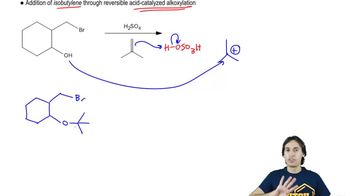
    A bulky ether group attached to oxygen, rendering alcohols unreactive during synthesis steps involving strong bases.
  • Protecting Group

    A temporary modification of a functional group to prevent unwanted reactions during multi-step synthesis.
  • Acid-Catalyzed Alkoxylation

    A process where an alcohol reacts with an alkene in the presence of acid to form an ether.
  • Isobutylene

    A four-carbon alkene with a double bond, commonly used to introduce tert-butyl groups onto alcohols.
  • Carbocation

    A positively charged carbon intermediate formed during the protonation of an alkene in ether synthesis.
  • Markovnikov Rule

    A principle stating that protonation occurs at the carbon yielding the most stable carbocation during addition reactions.
  • Deprotonation

    The removal of a proton (H⁺) from a molecule, often restoring neutrality after a reaction step.
  • Alkanide

    A strong base derived from an alkane, reactive with alcohols but unreactive with ethers.
  • Alkyl Halide

    An organic molecule containing a halogen atom bonded to an alkyl group, often used in SN2 reactions.
  • SN2 Reaction

    A bimolecular nucleophilic substitution where a nucleophile attacks an electrophile, displacing a leaving group in one step.
  • Deprotection

    The process of removing a protecting group to regenerate the original functional group, typically using mild acid.
  • Equilibrium

    A state in a reversible reaction where the forward and reverse processes occur at equal rates.
  • Sulfuric Acid

    A strong acid commonly used as a catalyst in the formation and removal of protecting groups.