Back

t-Butyl Ether Protecting Groups quiz

Control buttons has been changed to "navigation" mode.
1/15
  • What is the purpose of using a tert-butyl ether protecting group in organic synthesis?

    It converts alcohols into less reactive ethers, preventing unwanted reactions during intermediate steps.
  • What reaction is commonly used to form tert-butyl ethers from alcohols?

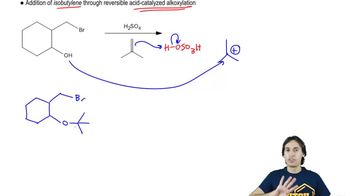
    Acid-catalyzed alkoxylation is used, involving an alcohol and isobutylene.
  • Why are ethers less reactive than alcohols in organic reactions?

    Ethers do not participate in as many reactions as alcohols, making them more stable and less reactive.
  • What molecule is used to react with alcohols to form tert-butyl ethers?

    Isobutylene, a four-carbon hydrocarbon with a double bond, is used.
  • What is the first step in the mechanism for tert-butyl ether formation?

    The double bond of isobutylene is protonated, forming a Markovnikov carbocation.
  • How does the alcohol participate in the tert-butyl ether formation mechanism?

    The alcohol attacks the carbocation formed from protonated isobutylene.
  • What is the role of the conjugate acid in the tert-butyl ether formation mechanism?

    It deprotonates the intermediate, stabilizing the molecule and forming the ether.
  • Why is the tert-butyl ether protecting group useful when strong bases like alkanides are present?

    The ether is unreactive to strong bases, so only other functional groups react, allowing selective synthesis.
  • What type of reaction can occur with an alkyl halide when a tert-butyl ether protecting group is present?

    An SN2 reaction can occur with the alkyl halide, while the ether remains protected.
  • What is the advantage of using protecting groups in organic synthesis?

    They allow selective reactions by protecting sensitive functional groups from unwanted interactions.
  • How is the tert-butyl ether protecting group removed after the desired reaction?

    It is removed by adding mild acid (e.g., H QSO4 and water), which deprotects the ether.
  • What does 'deprotect' mean in the context of protecting groups?

    Deprotect means removing the protecting group to restore the original functional group, such as an alcohol.
  • Is the protection and deprotection process reversible?

    Yes, the process is reversible and typically exists in equilibrium.
  • What is the sequence of steps when using a tert-butyl ether protecting group in synthesis?

    First, protect the alcohol; second, perform the desired reaction; third, deprotect using acid and water.
  • Why must you know when to use a protecting group in synthesis problems?

    Because synthesis often requires protecting sensitive groups to achieve the desired product without side reactions.