Control buttons has been changed to "navigation" mode.
1/10
Terms in this set (10)
Which types of compounds cannot be directly prepared by a Heck reaction, based on the requirements for the carbon halide and alkene components?
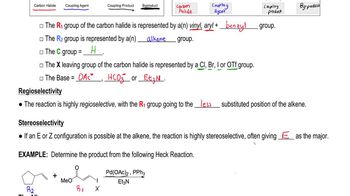
Compounds that cannot be directly prepared by a Heck reaction include those where the required carbon halide is not a vinyl, aryl, or benzyl halide, or where the alkene is highly substituted or lacks electron-withdrawing groups. The Heck reaction is most effective with non-substituted or mono-substituted alkenes containing electron-withdrawing groups, and with carbon halides that have good leaving groups such as chlorine, bromine, iodine, or triflate. Highly substituted alkenes or those without electron-withdrawing groups generally do not yield products efficiently in the Heck reaction.
Describe the product formed in a Heck reaction between a carbon halide and an alkene, including the typical regioselectivity and stereoselectivity observed.
The product of a Heck reaction is a more substituted alkene formed by coupling the R group of the carbon halide to the less substituted position of the alkene. The reaction is highly regioselective, favoring attachment of the R group to the less substituted carbon of the alkene. It is also stereoselective, typically producing the E-configured (trans) alkene when possible.
What is the role of the palladium catalyst in the Heck reaction mechanism?
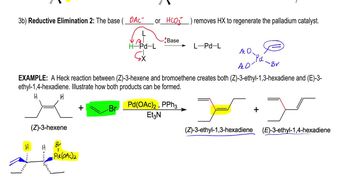
The palladium catalyst facilitates the oxidative addition of the carbon halide and participates in syn addition and reductive elimination steps. It is regenerated at the end of the catalytic cycle to enable further reaction cycles.
Which leaving groups are considered suitable for the carbon halide in the Heck reaction?
Suitable leaving groups for the carbon halide in the Heck reaction include chlorine, bromine, iodine, and triflate. These groups enable efficient oxidative addition to the palladium catalyst.
How does the substitution pattern of the alkene affect its reactivity in the Heck reaction?
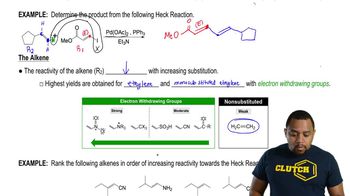
The reactivity of the alkene decreases as its substitution increases. Non-substituted or mono-substituted alkenes with electron-withdrawing groups show the highest reactivity and yields.
What is the significance of syn addition in the Heck reaction mechanism?
Syn addition refers to the simultaneous addition of the R group and palladium across the alkene's pi bond on the same side. This step replaces the traditional transmetalation step found in other cross-coupling reactions.
Why is the regeneration of the palladium catalyst important in the Heck reaction?
Regeneration of the palladium catalyst is essential to maintain the catalytic cycle and allow the reaction to proceed continuously. It also helps the catalyst achieve the preferred 18 or 16 electron configuration.
Which types of electron-withdrawing groups on the alkene increase its reactivity in the Heck reaction?
Electron-withdrawing groups such as carbonyls, nitriles, sulfonic acids, trihalomethyl, and quaternary ammonium increase alkene reactivity. The more strongly deactivating the group, the higher the reactivity toward the Heck reaction.
What are the typical bases used in the Heck reaction, and what is their function?
Typical bases include acetate ion, hydrogen carbonate (bicarbonate), and triethylamine. Their function is to remove the hydrogen atom during the elimination step, facilitating product formation and catalyst regeneration.
What are the two main driving forces that promote the Heck reaction to proceed?
The two main driving forces are the formation of a more conjugated alkene product and the tendency of the transition metal catalyst to achieve the 18 or 16 electron rule. These factors push the reaction forward and ensure efficient catalysis.