Back

Thiol Reactions definitions

Control buttons has been changed to "navigation" mode.
1/14
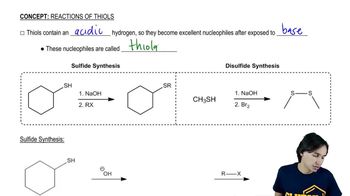
  • Thiol

    A molecule resembling an alcohol but with sulfur replacing oxygen, featuring a notably acidic hydrogen atom.
  • Sulfur

    An element larger than oxygen, leading to increased acidity and unique reactivity in organic compounds.
  • Alcohol

    A compound with an -OH group, structurally similar to thiols except for the presence of oxygen instead of sulfur.
  • Acidity

    A property enhanced by larger atomic size, making hydrogen atoms easier to remove from certain molecules.
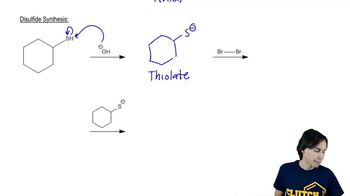
  • Thiolate

    A nucleophilic anion formed by deprotonating a thiol, characterized by a negative charge on sulfur.
  • Base

    A substance that removes an acidic hydrogen from a molecule, facilitating the formation of nucleophiles.
  • Nucleophile

    A species with a lone pair or negative charge, capable of attacking electrophilic centers in organic reactions.
  • Sulfide

    A compound analogous to an ether, but with sulfur replacing the oxygen atom in the linkage.
  • Ether

    A molecule with an oxygen atom connecting two alkyl groups, serving as a reference for sulfide structure.
  • SN2 Mechanism

    A reaction pathway involving a single concerted step with backside attack, leading to substitution at a saturated carbon.
  • Alkyl Halide

    A molecule containing a halogen attached to an alkyl group, serving as an electrophile in substitution reactions.
  • Disulfide

    A symmetrical molecule featuring two sulfur atoms bonded together, formed from thiolates and halogens.
  • Diatomic Halogen

    A molecule consisting of two identical halogen atoms, acting as an oxidant in disulfide synthesis.
  • Leaving Group

    An atom or group that departs with a pair of electrons during a substitution or elimination reaction.