Back

Thiol Reactions quiz

Control buttons has been changed to "navigation" mode.
1/15
  • What is the main structural difference between a thiol and an alcohol?

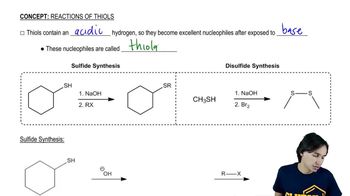
    A thiol has a sulfur atom in place of the oxygen atom found in an alcohol.
  • Why are thiols more acidic than alcohols?

    Thiols are more acidic because sulfur is larger than oxygen, making it easier to lose a proton.
  • What is formed when a thiol is deprotonated by a base?

    A thiolate ion is formed, which is a sulfur atom with a negative charge.
  • What type of reaction does a thiolate ion undergo with a primary or secondary alkyl halide?

    It undergoes an SN2 reaction to form a sulfide.
  • Why can't a thiolate ion perform an SN2 reaction with a tertiary alkyl halide?

    Tertiary alkyl halides are too sterically hindered for SN2 reactions to occur.
  • What is the sulfur analog of an ether called?

    It is called a sulfide.
  • What is the first step in both sulfide and disulfide synthesis from a thiol?

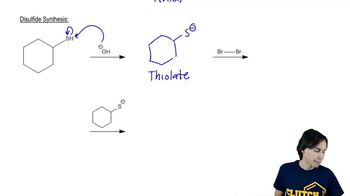
    The first step is deprotonation of the thiol by a base to form a thiolate ion.
  • What reagent is used to synthesize a disulfide from a thiolate ion?

    A diatomic halogen, such as Br2, is used.
  • Describe the initial interaction between a thiolate ion and a diatomic halogen in disulfide synthesis.

    The thiolate attacks one halogen atom, forming a sulfur-halogen intermediate and releasing a halide ion.
  • What happens after the sulfur-halogen intermediate is formed in disulfide synthesis?

    A second thiolate ion attacks the sulfur, displacing the halide and forming a disulfide.
  • What is the typical product of disulfide synthesis using the same thiolate twice?

    A symmetrical disulfide is formed.
  • What is the role of the base in thiol reactions?

    The base deprotonates the thiol, generating the nucleophilic thiolate ion.
  • What is the leaving group in the SN2 reaction between a thiolate and an alkyl halide?

    The halide ion (such as Br− or Cl−) is the leaving group.
  • Why are thiolate ions considered good nucleophiles?

    Thiolate ions are good nucleophiles because the negative charge on sulfur is less tightly held due to its larger size.
  • What is the main organic product when a thiolate reacts with Br2 and then with another thiolate?

    The main organic product is a disulfide, where two sulfur atoms are bonded together.