Back

Transesterification definitions

Control buttons has been changed to "navigation" mode.
1/14
  • Transesterification

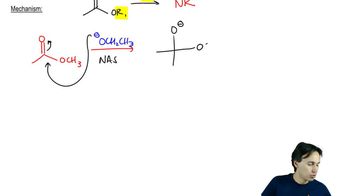
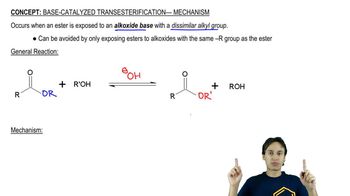
    Process where alkyl groups on an ester are exchanged with those from an alkoxide, often under basic conditions.
  • Ester

    Organic compound featuring a carbonyl group bonded to an alkoxy group, commonly involved in substitution reactions.
  • Alkoxide

    Negatively charged ion formed by deprotonating an alcohol, acts as a nucleophile in substitution reactions.
  • Alkyl Group

    Hydrocarbon fragment derived from an alkane by removing one hydrogen, often denoted as R or R'.
  • Base Catalysis

    Acceleration of a chemical reaction by a base, which increases nucleophilicity and facilitates group exchange.
  • Nucleophilic Acyl Substitution

    Reaction mechanism where a nucleophile replaces a leaving group on a carbonyl compound, forming new products.
  • Tetrahedral Intermediate

    Transient structure formed when a nucleophile attacks a carbonyl carbon, resulting in four substituents around the carbon.
  • Equilibrium

    State in which forward and reverse reactions occur at equal rates, leading to a constant mixture of products and reactants.
  • Product Mixture

    Resulting combination of different compounds formed when multiple possible substitutions occur during a reaction.
  • Methoxide

    Alkoxide ion derived from methanol, often used to avoid product complexity in methyl ester reactions.
  • Ethoxide

    Alkoxide ion derived from ethanol, can introduce product diversity if used with a methyl ester.
  • Leaving Group

    Atom or group that departs with a pair of electrons during a substitution, influencing the outcome of the reaction.
  • Consistency

    Maintaining identical alkyl groups in both ester and alkoxide to prevent formation of multiple ester products.
  • Substitution

    Replacement of one group in a molecule with another, central to the mechanism of transesterification.