Back

Transesterification quiz

Control buttons has been changed to "navigation" mode.
1/15
  • What is transesterification in organic chemistry?

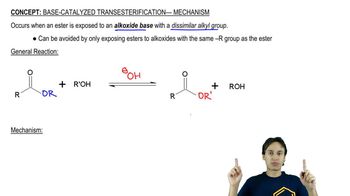
    Transesterification is the reaction where an ester reacts with an alkoxide, resulting in the exchange of alkyl groups between the ester and the alkoxide.
  • What happens when an ester is exposed to an alkoxide with a different alkyl group?

    A mixture of esters is formed, each containing different alkyl groups, which complicates the product mixture.
  • Why is it problematic to use an alkoxide with a different alkyl group than the ester?

    It leads to the formation of multiple ester products, making the reaction mixture complex and difficult to purify.
  • How can you avoid forming a mixture of esters during transesterification?

    By using an alkoxide with the same alkyl group as the ester, you prevent the formation of mixed products.
  • What is the result of transesterification when the ester and alkoxide have the same alkyl group?

    The reaction occurs but does not change the ester, making the process unnoticeable.
  • What is the key mechanistic step in base-catalyzed transesterification?

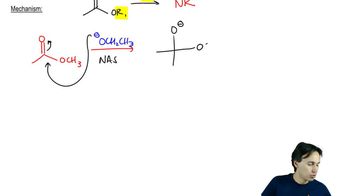
    The key step is nucleophilic acyl substitution, where the alkoxide attacks the ester, forming a tetrahedral intermediate.
  • What intermediate is formed during the transesterification mechanism?

    A tetrahedral intermediate is formed after the alkoxide attacks the ester carbonyl carbon.
  • What determines which alkoxide group is expelled in the transesterification mechanism?

    Either alkoxide group can be expelled, leading to the formation of different ester products.
  • What is the consequence of accidentally using ethoxide instead of methoxide with a methyl ester?

    Both ethyl and methyl esters will be produced, resulting in a mixture of products.
  • Why is consistency in the alkyl groups of the ester and alkoxide important?

    Consistency prevents the formation of mixed esters and simplifies the reaction outcome.
  • What type of reaction is transesterification classified as?

    Transesterification is a nucleophilic acyl substitution reaction.
  • What happens to the ester product if the R groups of the ester and alkoxide are identical?

    No observable change occurs in the ester product, even though the reaction takes place.
  • What is the main purpose of using an alkoxide with the same R group as the ester?

    It ensures that the ester structure remains unchanged and prevents product complexity.
  • What is the effect of equilibrium in base-catalyzed transesterification with different alkyl groups?

    Equilibrium causes continuous exchange of alkyl groups, resulting in a blend of esters with different alkyl groups.
  • What is the practical advice for performing transesterification reactions in the lab?

    Always use an alkoxide with the same alkyl group as the ester to avoid unwanted product mixtures.