Constitutional Isomers vs. Stereoisomers quiz #1 Flashcards

Constitutional Isomers vs. Stereoisomers quiz #1
Control buttons has been changed to "navigation" mode.
1/10
  • How do you determine the number of possible stereoisomers for a given compound?
    To determine the number of possible stereoisomers for a compound, first confirm that the compound has the same molecular formula and connectivity throughout. Then, identify all stereocenters (such as chiral centers or double bonds with cis/trans isomerism). The maximum number of stereoisomers is 2^n, where n is the number of stereocenters, though symmetry may reduce this number.
  • What criteria must a compound meet in order to have stereoisomers?
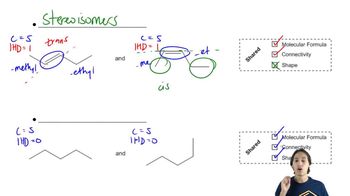
    A compound can have stereoisomers if it has the same molecular formula and connectivity as another compound, but differs in the spatial arrangement of its atoms (shape). This typically requires the presence of stereocenters, such as chiral centers or double bonds capable of cis/trans isomerism.
  • How can you determine if two structures represent the same stereoisomer?
    Two structures represent the same stereoisomer if they have the same molecular formula, the same connectivity, and the same spatial arrangement of atoms (shape). If the only difference is rotation around a single (sigma) bond, they are conformers, not different stereoisomers.
  • What is the difference between constitutional isomers and stereoisomers?
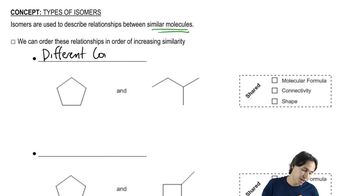
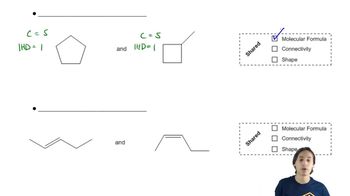
    Constitutional isomers have the same molecular formula but different connectivity of atoms, while stereoisomers have the same molecular formula and connectivity but differ in the spatial arrangement (shape) of their atoms.
  • What is the relationship between conformers and stereoisomers?
    Conformers are molecules with the same molecular formula and connectivity that differ only by rotation around a sigma bond and can freely interconvert. Stereoisomers, in contrast, have the same formula and connectivity but differ in fixed spatial arrangement and cannot interconvert by simple bond rotation.
  • What does an Index of Hydrogen Deficiency (IHD) of 1 indicate about a molecule's structure?
    An IHD of 1 means the molecule is missing two hydrogens compared to a saturated compound. This typically results from the presence of a ring or a double bond.
  • How does the presence of a ring or double bond affect the molecular formula of a compound?
    A ring or double bond reduces the number of hydrogens in the molecular formula compared to a fully saturated compound. This change is reflected in the IHD value.
  • Why are conformers considered the most similar among molecular relationships discussed?
    Conformers have the same molecular formula, connectivity, and shape, differing only by rotation around a sigma bond. This rotation does not create a new molecule, so they are essentially the same compound.
  • What is the significance of checking connectivity after confirming the molecular formula when analyzing isomers?
    Checking connectivity helps distinguish constitutional isomers, which have the same molecular formula but different atom connections. This step is crucial before considering differences in shape or stereochemistry.
  • How can cis/trans orientation around a double bond lead to stereoisomerism?
    Cis/trans orientation changes the spatial arrangement of groups attached to the double bond, resulting in different shapes. These differences create distinct stereoisomers that cannot interconvert by simple bond rotation.