How can you determine whether a compound is capable of having diastereomers based on the number of chiral centers it contains?
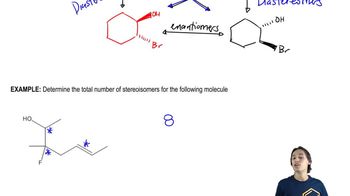
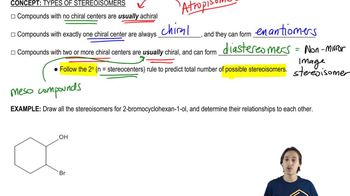
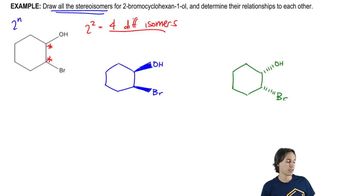
A compound can have diastereomers if it contains two or more chiral centers. Diastereomers are stereoisomers that are not mirror images of each other. Compounds with no chiral centers generally cannot have diastereomers (except for rare atropisomers), and compounds with exactly one chiral center can only have enantiomers, not diastereomers. Therefore, only compounds with two or more chiral centers (excluding meso compounds, which are achiral due to internal symmetry) can have diastereomers.
What is the exception to the rule that compounds with no chiral centers are always achiral?
Atropisomers are an exception because they can be chiral even without chiral centers. These molecules have unique structural features that allow for chirality.
What type of stereoisomer is formed when a compound has exactly one chiral center?
A compound with one chiral center always forms enantiomers. These are non-superimposable mirror images of each other.
Why are meso compounds considered exceptions among molecules with multiple chiral centers?
Meso compounds are achiral due to internal symmetry, even though they have two or more chiral centers. This symmetry prevents them from being chiral.
How does the '2 to the n rule' help predict the number of stereoisomers for a molecule?
The rule states that the number of possible stereoisomers is 2 raised to the power of the number of stereocenters (n). This calculation includes both chiral and trigonal centers.
What distinguishes diastereomers from enantiomers in terms of their relationship as stereoisomers?
Diastereomers are stereoisomers that are not mirror images of each other. Enantiomers, in contrast, are always mirror images.
Can a compound with two or more chiral centers form only enantiomers?
No, such compounds can form both enantiomers and diastereomers. Diastereomers arise when the stereoisomers are not mirror images.
What is a stereocenter and how does it relate to the calculation of stereoisomers?
A stereocenter can be a chiral center or a trigonal center, both of which affect stereoisomer count. The total number of stereoisomers is determined by counting all stereocenters.
Why might you not be asked to draw all possible stereoisomers for a molecule with many stereocenters?
The number of possible stereoisomers increases exponentially with more stereocenters, making it impractical to draw them all. For example, four stereocenters yield sixteen isomers.
What is the significance of mirror images in identifying enantiomers?
Enantiomers are defined as non-superimposable mirror images of each other. This property is key to distinguishing them from other stereoisomers.