How do you determine the relationship between two organic compounds in terms of isomerism?
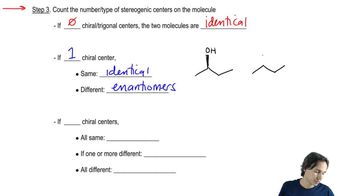
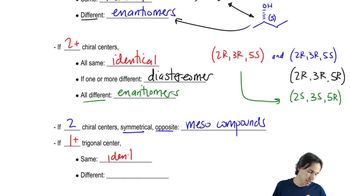
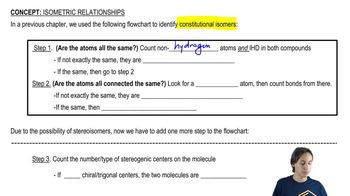
To determine the relationship between two organic compounds, first verify that they have the same atom count and connectivity. If not, they are different compounds or constitutional isomers. If both are the same, examine their stereochemistry: if there are no chiral or trigonal centers, the compounds are identical. If there is one chiral center, identical configurations mean the compounds are identical; opposite configurations mean they are enantiomers. For two or more chiral centers, if all configurations are the same, the compounds are identical; if all are opposite, they are enantiomers; if some are the same and some are different, they are diastereomers. Meso compounds are a special case where symmetrical opposite chiral centers result in a non-chiral, identical molecule. For trigonal centers (like cis/trans isomers), identical arrangements mean the compounds are identical, while different arrangements (cis vs. trans) make them diastereomers.
What is the first step in determining the relationship between two organic compounds?
The first step is to verify that all the atoms, especially non-hydrogen atoms, are the same in both compounds. If they are not, the compounds are different.
How does connectivity affect the classification of isomers?
If the connectivity of atoms is different between two compounds, they are constitutional isomers. Identical connectivity means you must check for stereochemistry next.
What is the relationship between two molecules with one chiral center if their configurations are opposite?
If the configurations are opposite at the single chiral center, the molecules are enantiomers. Enantiomers are non-superimposable mirror images.
How do you classify molecules with two or more chiral centers when only some centers differ?
If some chiral centers are the same and some are different, the molecules are diastereomers. Diastereomers are stereoisomers that are not mirror images.
What special case arises when two chiral centers are symmetrical and opposite in a molecule?
This situation results in a meso compound. Meso compounds are achiral despite having chiral centers due to internal symmetry.
How are cis and trans isomers of a double bond related in terms of stereoisomerism?
Cis and trans isomers of a double bond are diastereomers. They are not mirror images of each other.
When comparing molecules, why might you not need to assign R and S configurations?
If the molecules are not rotated and only differ by wedge or dash orientation, you can compare them directly without assigning R and S. This shortcut saves time in straightforward cases.
What must you do if the molecules you are comparing have been rotated in their drawings?
You must assign R and S configurations to each chiral center to accurately determine their relationship. Rotation can obscure direct comparison of stereochemistry.
Why is using a flowchart helpful when determining isomer relationships?
A flowchart provides a step-by-step method to systematically check atom count, connectivity, and stereochemistry. It helps avoid mistakes and ensures all criteria are considered.