Williamson Ether Synthesis quiz #1 Flashcards

Williamson Ether Synthesis quiz #1
Control buttons has been changed to "navigation" mode.
1/10
  • Which types of alkyl halides cannot be used in the Williamson ether synthesis to prepare ethers, and why?
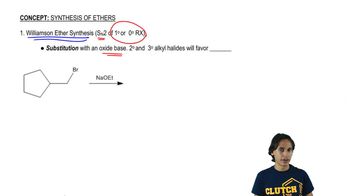
    Secondary and tertiary alkyl halides cannot be used in the Williamson ether synthesis because they are sterically hindered, which prevents the SN2 mechanism and instead favors E2 elimination.
  • What is the Williamson ether synthesis, and how is it classified among ether formation reactions?
    The Williamson ether synthesis is an SN2 reaction where a primary or methyl alkyl halide reacts with an oxide base to form an ether. It is classified as one of the main methods for ether formation in organic chemistry.
  • Can unsymmetrical ethers be synthesized using the Williamson ether synthesis method?
    Yes, unsymmetrical ethers can be synthesized using the Williamson ether synthesis by reacting different alkyl groups through an SN2 mechanism.
  • What is the most common method for synthesizing unsymmetrical ethers in Organic Chemistry 1?
    The most common method for synthesizing unsymmetrical ethers in Organic Chemistry 1 is the Williamson ether synthesis.
  • What role does the flowchart play in determining the reaction type for Williamson ether synthesis?
    The flowchart helps identify the reaction as SN2 based on the nucleophile's charge and the type of alkyl halide. Even if the reaction name is forgotten, the flowchart guides you to the correct mechanism.
  • Why are primary and methyl alkyl halides preferred in the Williamson ether synthesis mechanism?
    Primary and methyl alkyl halides are preferred because they provide a good backside for the SN2 attack. This minimizes steric hindrance and allows the reaction to proceed efficiently.
  • What happens mechanistically when a negatively charged nucleophile reacts with a primary alkyl halide in Williamson ether synthesis?
    The negatively charged nucleophile performs a backside attack, displacing the leaving group. This results in the formation of an ether functional group.
  • How does the Williamson ether synthesis mechanism illustrate the concept of a backside attack?
    The mechanism involves the nucleophile attacking from the side opposite the leaving group, characteristic of SN2 reactions. This leads to inversion of configuration at the carbon center.
  • What functional group is always produced as the final product in Williamson ether synthesis?
    The final product is always an ether functional group. This results from the nucleophile replacing the leaving group on the alkyl halide.
  • How can you determine if a nucleophile is suitable for the Williamson ether synthesis using the flowchart?
    You check if the nucleophile is negatively charged and not a bulky base. If these conditions are met and the alkyl halide is primary or methyl, the reaction proceeds via SN2.