Organic Chemistry
My Course
Learn
Exam Prep
AI Tutor
Study Guides
Textbook Solutions
Flashcards
Explore
Try the app
My Course
Learn
Exam Prep
AI Tutor
Study Guides
Textbook Solutions
Flashcards
Explore
Try the app
Back
Wittig Reaction definitions
You can tap to flip the card.
Wittig Reaction
You can tap to flip the card.
👆
Wittig Reaction
A transformation forming regiospecific alkenes by reacting a carbonyl compound with an ylide, allowing precise placement of R groups.
Track progress
Control buttons has been changed to "navigation" mode.
1/15
Related flashcards
Related practice
Recommended videos
Wittig Reaction quiz #1
Wittig Reaction
10 Terms
19. Aldehydes and Ketones:Nucleophilic Addition - Part 1 of 3
5 topics
14 problems
Chapter
Johnny
19. Aldehydes and Ketones:Nucleophilic Addition - Part 2 of 3
1 topic
13 problems
Chapter
Johnny
19. Aldehydes and Ketones:Nucleophilic Addition - Part 3 of 3
2 topics
13 problems
Chapter
Ernest
Guided course
15:39
Box-Out Method and Full-Mechanism
2396
views
19
rank
9
comments
Terms in this set (15)
Hide definitions
Wittig Reaction
A transformation forming regiospecific alkenes by reacting a carbonyl compound with an ylide, allowing precise placement of R groups.
Alkene
A hydrocarbon product with a carbon-carbon double bond, formed regiospecifically in this reaction from aldehydes or ketones.
Ylide
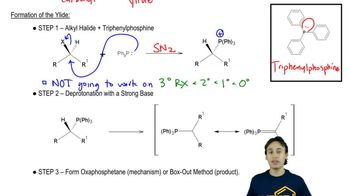
A neutral molecule with adjacent positive and negative charges, typically featuring phosphorus and carbon, crucial for this reaction.
Carbonyl Compound
A molecule containing a C=O group, such as an aldehyde or ketone, serving as a key reactant in this transformation.
Triphenylphosphine
A phosphorus compound with three phenyl groups, used to generate the ylide via SN2 reaction with an alkyl halide.
Alkyl Halide
An organic molecule containing a halogen atom bonded to an alkyl group, serving as a precursor for ylide formation.
Butyllithium
A strong organometallic base, commonly used to deprotonate the phosphorus compound, enabling ylide formation.
SN2 Reaction
A bimolecular nucleophilic substitution mechanism, essential for forming the phosphorus-carbon bond in ylide synthesis.
Betaine
A tetrahedral intermediate with non-adjacent charges, formed after nucleophilic addition of the ylide to the carbonyl.
Oxaphosphetane
A four-membered ring intermediate containing phosphorus and oxygen, formed during the rearrangement step before alkene formation.
Regiospecificity
The property allowing precise control over the position of substituents on the newly formed alkene.
Stereoisomer
A molecule differing in spatial arrangement, such as E and Z forms, which may both result since this reaction is not stereospecific.
Nucleophilic Addition
A step where a nucleophile attacks an electrophilic carbon, leading to the formation of a tetrahedral intermediate.
Resonance Structure
Alternative Lewis structures representing electron delocalization, important for depicting ylide and intermediate stability.
Organometallic Compound
A molecule containing a metal-carbon bond, such as butyllithium, often used as a strong base in organic synthesis.