Back

Wolff Kishner Reduction quiz

Control buttons has been changed to "navigation" mode.
1/15
  • What is the main purpose of the Wolff Kishner reduction?

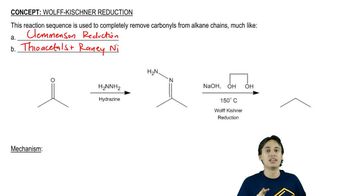
    The Wolff Kishner reduction is used to completely remove carbonyl groups by converting them into alkanes.
  • Which functional group is formed when hydrazine reacts with a carbonyl compound in the Wolff Kishner reduction?

    Hydrazine reacts with a carbonyl compound to form a hydrazone.
  • What are the typical reagents used in the Wolff Kishner reduction?

    The typical reagents are a strong base (such as NaOH or KOH), an alcohol like ethylene glycol, and heat.
  • What gas is evolved during the Wolff Kishner reduction?

    Nitrogen gas (N2) is evolved during the reaction.
  • What is the final organic product of the Wolff Kishner reduction?

    The final organic product is an alkane.
  • What is the role of the alcohol (e.g., ethylene glycol) in the Wolff Kishner reduction?

    The alcohol helps provide the correct conditions for the reaction but does not participate directly in the mechanism.
  • What is the starting material for the base-catalyzed step of the Wolff Kishner reduction?

    The starting material is a hydrazone, which is formed from the reaction of hydrazine with a carbonyl compound.
  • What is the key mechanistic feature of the Wolff Kishner reduction?

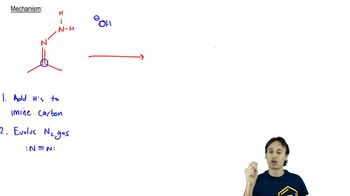
    The key feature is a base-catalyzed proton transfer that leads to the evolution of N2 gas and formation of an alkane.
  • How many hydrogen atoms are added to the carbonyl carbon during the Wolff Kishner reduction?

    Two hydrogen atoms are added to the carbonyl carbon, converting it into a methylene group in the alkane.
  • What is the intermediate formed after the first base-catalyzed proton transfer in the Wolff Kishner mechanism?

    The intermediate is a hydrazone with a double bond between the nitrogens and an extra hydrogen on the carbon.
  • What happens to the nitrogen atoms in the hydrazone during the Wolff Kishner reduction?

    They form a triple bond, resulting in the release of nitrogen gas (N2).
  • Why is heat required in the Wolff Kishner reduction?

    Heat is required to drive the reaction to completion and facilitate the loss of nitrogen gas.
  • What is the difference between the Wolff Kishner reduction and the Clemmensen reduction?

    Both remove carbonyl groups, but the Wolff Kishner uses basic conditions and hydrazine, while the Clemmensen uses acidic conditions and zinc amalgam.
  • Is it always necessary to memorize the detailed mechanism of the Wolff Kishner reduction?

    Usually, it is more important to recognize the reaction and know the reagents, unless your professor specifically requires the mechanism.
  • What is the atmospheric significance of the gas evolved in the Wolff Kishner reduction?

    The evolved gas is nitrogen (N2), which makes up about 78% of Earth's atmosphere.