Control buttons has been changed to "navigation" mode.
1/10
Terms in this set (10)
In an E2 dehydrohalogenation reaction, how do you determine the Zaitsev product?
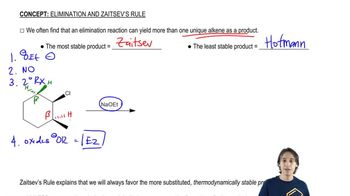
The Zaitsev product in an E2 dehydrohalogenation reaction is the alkene with the greatest number of alkyl (R) groups attached to the carbons of the double bond. According to Zaitsev's rule, this product is the most stable alkene formed and is favored under thermodynamic control.
According to Zaitsev's rule, how do you identify the most stable alkene among possible elimination products?
Using Zaitsev's rule, the most stable alkene is the one with the highest number of alkyl (R) groups attached to the carbons of the double bond. This increased substitution stabilizes the alkene, making it the major product in elimination reactions under thermodynamic control.
When should you apply Zaitsev's rule during an elimination reaction?
You should apply Zaitsev's rule whenever more than one unique alkene product is possible from an elimination reaction. This helps determine which product will be major and which will be minor.
What is the defining feature of the Hoffman product in elimination reactions?
The Hoffman product is the alkene with the fewest alkyl (R) groups attached to the double bond. It is less stable than the Zaitsev product.
How does the activation energy compare between the Zaitsev and Hoffman pathways in an energy diagram?
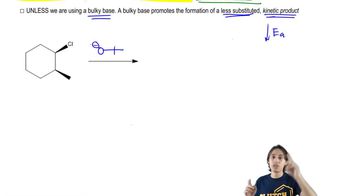
The Zaitsev pathway typically has a higher activation energy than the Hoffman pathway. This means the Hoffman product forms more easily under kinetic control.
What does thermodynamic control favor in elimination reactions?
Thermodynamic control favors the product with the lowest final free energy (delta G), which is the most stable alkene. This is usually the Zaitsev product.
What does kinetic control prioritize in the formation of elimination products?
Kinetic control prioritizes the product that forms through the pathway with the lowest activation energy. This often leads to the Hoffman product being favored.
Why is understanding the difference between thermodynamic and kinetic control important for organic chemistry?
Understanding this difference is crucial because it helps predict which product will be favored under different reaction conditions. This concept recurs in many organic reactions beyond elimination.
In an E2 reaction energy diagram, what does a single 'hump' represent?
A single 'hump' in the energy diagram represents the concerted transition state of the E2 reaction. This means all bond-breaking and bond-forming events occur simultaneously.
How does the spontaneity (delta G) of the Zaitsev product compare to the Hoffman product?
The Zaitsev product has a greater decrease in free energy (more negative delta G) compared to the Hoffman product. This makes the Zaitsev product more thermodynamically stable.