Back

Organic Chemistry: Alcohols and Thiols

Control buttons has been changed to "navigation" mode.
1/21
  • Classification of alcohols

    Primary (1°): —OH on a carbon bonded to one other carbon.
    Secondary (2°): —OH on a carbon bonded to two other carbons.
    Tertiary (3°): —OH on a carbon bonded to three other carbons.
  • Definition of diol and triol

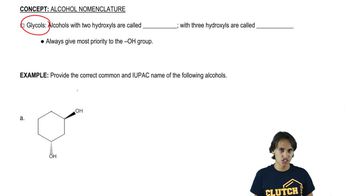
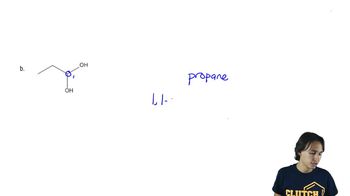
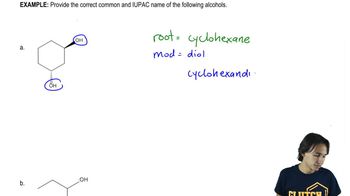
    Diol: Compound with two hydroxyl groups.
    Triol: Compound with three hydroxyl groups.
    Parent alkane name retains final -e for diols and triols.
  • What are glycols?

    Glycols are compounds with hydroxyl groups on adjacent carbons, commonly named from the alkene precursor.
  • Unsaturated alcohols

    Alcohols containing both —OH and C═C groups. The alkane infix changes from -an- to -en- to indicate the double bond.
  • Physical properties of alcohols: polarity and interactions

    Alcohols are polar and engage in dipole-dipole interactions and hydrogen bonding due to the —OH group.
  • Hydrogen bonding in alcohols

    Attractive interaction between a hydrogen bonded to O or N and another O or N atom, increasing boiling points significantly.
  • Boiling point comparison: ethanol vs dimethyl ether

    Ethanol has a higher boiling point (78°C) than dimethyl ether (-24°C) due to hydrogen bonding in ethanol.
  • Solubility of alcohols in water

    Alcohols are more soluble than alkanes/alkenes of similar size; solubility decreases with increasing hydrocarbon chain length.
  • SN1 reaction of 3° alcohol with HX: Step 1

    Protonation of the —OH group forms an oxonium ion, making it a better leaving group.
  • SN1 reaction of 3° alcohol with HX: Step 2

    Loss of water forms a stable 3° carbocation intermediate.
  • SN1 reaction of 3° alcohol with HX: Step 3

    Nucleophile (e.g., bromide ion) attacks the carbocation to form the substitution product.
  • SN2 reaction of 1° alcohol with HBr

    Protonation forms an oxonium ion, then nucleophile attacks simultaneously as the leaving group departs in a single step.
  • Acid-catalyzed dehydration of alcohols

    Elimination of water from adjacent carbons to form alkenes, often following Zaitsev's rule favoring more substituted alkenes.
  • Mechanism type for dehydration of 2° and 3° alcohols

    E1 mechanism involving carbocation formation as the rate-determining step, often with rearrangements.
  • Hydration-dehydration equilibrium

    Alkene hydration and alcohol dehydration are reversible reactions illustrating microscopic reversibility.
  • Oxidation of primary alcohols

    Primary alcohols oxidize to aldehydes or carboxylic acids depending on conditions.
  • Oxidation of secondary and tertiary alcohols

    Secondary alcohols oxidize to ketones; tertiary alcohols resist oxidation due to lack of hydrogen on the carbon bearing —OH.
  • Chromic acid oxidation

    Chromic acid (Jones reagent) oxidizes primary alcohols to carboxylic acids and secondary alcohols to ketones.
  • Pyridinium chlorochromate (PCC) oxidation

    PCC selectively oxidizes primary alcohols to aldehydes without further oxidation to acids.
  • Thiols: structure and bond angle

    Thiols contain a —SH group bonded to sp3 carbon; C—S—H bond angle is about 100.3°, indicating more p character in sulfur bonding orbitals.
  • Oxidation of thiols

    Thiols oxidize to disulfides (—S—S—) and can further oxidize to sulfinic and sulfonic acids.