 Back
BackOrganic Chemistry Fundamentals
 02:08
02:08
Terms in this set (22)
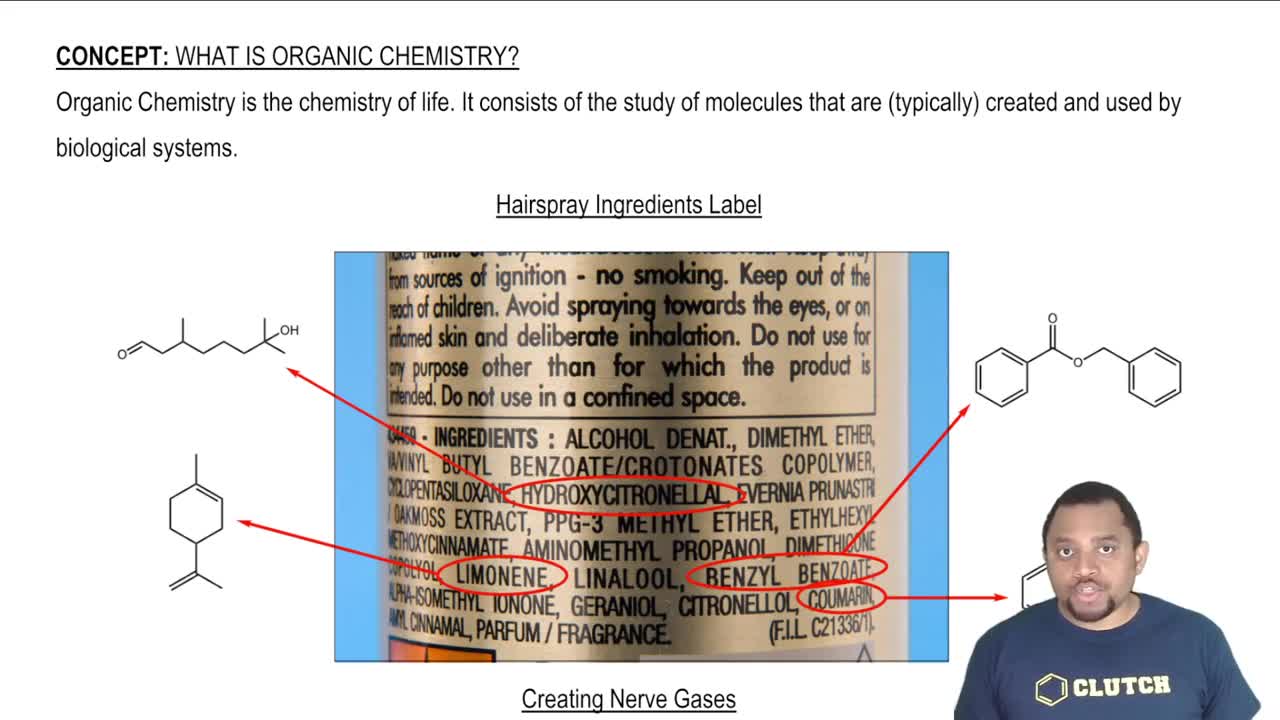
Organic Chemistry is the study of carbon compounds, their properties, structure, reactivity, preparation, and applications.
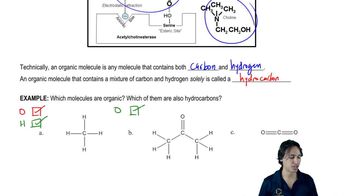
An organic compound must contain carbon and primarily have covalent bonds with elements like H, O, N, P, S, halogens, and some metals.
Friedrich Wöhler was the first to synthesize an organic compound (urea) from an inorganic source (ammonium cyanate) in 1828.
Hydrocarbons are classified as aliphatic (alkanes, alkenes, alkynes) and cyclic (cycloalkanes, cycloalkenes, aromatics).
Alkanes: \(C_nH_{2n+2}\), Alkenes: \(C_nH_{2n}\), Alkynes: \(C_nH_{2n-2}\).
Alkyl halides (RX) are hydrocarbons where one or more hydrogens are replaced by halogens (X = F, Cl, Br, I).
Heterocyclic compounds are cyclic compounds containing atoms other than carbon in the ring, such as N, O, S, or P.
Includes alcohols (R–OH), phenols (Ar–OH), ethers (R–O–R'), aldehydes (R–CHO), ketones (R–CO–R'), carboxylic acids (R–COOH), esters (R–COOR'), acid amides, and acid halides.
Families include thiols (R–SH), thioethers (R–S–R'), sulfinic acids (R–SO–OH), sulfonic acids (R–SO2–OH), disulfides (R–S–S–R'), and others.
Organic compounds containing metals with partly covalent or ionic bonds, e.g., Grignard reagents (R–Mg–X) and metal acetylides (M–C≡C).
A functional group is an atom or group of atoms responsible for the characteristic reactions of a compound class.
Molecular formula shows element types and counts; structural formula shows how atoms are bonded.
A representation of an atom or molecule showing valence electrons as dots around element symbols.
Atoms tend to gain, lose, or share electrons to have eight valence electrons, achieving noble gas configuration.
Formal charge = valence electrons - (nonbonding electrons + 1/2 bonding electrons); used to determine charge distribution in molecules.
Electronegativity is an atom's ability to attract electrons; it increases left to right across a period and bottom to top in a group.
Ionic bonds form by electron transfer; polar covalent bonds share electrons unequally; nonpolar covalent bonds share electrons equally.
A covalent bond formed by head-to-head overlap of atomic orbitals with electron density along the bond axis.
A covalent bond formed by sidewise overlap of p orbitals with electron density above and below the bond axis.
Higher bond order means shorter bond length and stronger bond strength (Triple > Double > Single).
Mixing of atomic orbitals to form new hybrid orbitals with different shapes and energies, e.g., sp3 (tetrahedral), sp2 (trigonal planar), sp (linear).
Valence Shell Electron Pair Repulsion theory predicts molecular shapes by minimizing repulsion between electron pairs around a central atom.