Skip to main content
Organic Chemistry
My Course
Learn
Exam Prep
AI Tutor
Study Guides
Textbook Solutions
Flashcards
Explore
Try the app
My Course
Learn
Exam Prep
AI Tutor
Study Guides
Textbook Solutions
Flashcards
Explore
Try the app
Back
Organic Chemistry: Stereochemistry and Functional Groups
You can tap to flip the card.
What are enantiomers?
You can tap to flip the card.
👆
What are enantiomers?
Enantiomers
are stereoisomers that are non-superimposable mirror images of each other.
Track progress
Control buttons has been changed to "navigation" mode.
1/20
Recommended videos
01:30
Assigning Degrees to Alkyl Halides
4798
views
50
rank
6
comments
01:49
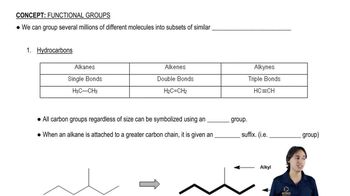
Why we need functional groups.
6641
views
92
rank
3
comments
03:08
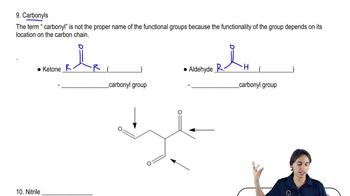
The difference between aldehydes and ketones.
4728
views
43
rank
9
comments
Terms in this set (20)
Hide definitions
What are enantiomers?
Enantiomers
are stereoisomers that are non-superimposable mirror images of each other.
How do you identify a chiral center?
A
chiral center
is a carbon atom bonded to four different groups.
What is the difference between enantiomers and diastereomers?
Enantiomers are mirror images, while
diastereomers
are stereoisomers that are not mirror images.
What is the Cahn-Ingold-Prelog (CIP) priority rule?
Assign priority to substituents based on atomic number; higher atomic number gets higher priority.
How do you assign R or S configuration to a chiral center?
Orient the lowest priority group away, then determine if the sequence 1-2-3 is clockwise (R) or counterclockwise (S).
What is a meso compound?
A
meso compound
has multiple chiral centers but is achiral due to an internal plane of symmetry.
What is the physical property difference between enantiomers?
Enantiomers have identical physical properties except for the direction they rotate plane-polarized light.
What is the physical property difference between diastereomers?
Diastereomers have different physical and chemical properties.
What is the significance of the Fischer projection in stereochemistry?
Fischer projections represent 3D stereochemistry in 2D, with horizontal lines as wedges and vertical lines as dashes.
How do you determine if a Fischer projection is R or S?
Assign priorities, then rotate the molecule to place the lowest priority group in the back before assigning R or S.
What is the difference between functional groups and positional isomers?
Functional group isomers differ in the type of functional group; positional isomers differ in the position of the same group.
What are diastereomers in cyclic compounds?
Diastereomers in cyclic compounds differ in the spatial arrangement of substituents, such as cis and trans isomers.
What is the rule for assigning priority when two atoms are the same?
Compare the next atoms along the chain until a difference is found to assign priority.
What is the importance of the lowest priority group orientation in CIP rules?
The lowest priority group must be oriented away from the observer to correctly assign R or S.
What is the difference between optical activity of enantiomers and meso compounds?
Enantiomers are optically active; meso compounds are optically inactive due to internal symmetry.
How do you identify diastereomers in molecules with multiple chiral centers?
Diastereomers differ at one or more chiral centers but are not mirror images.
What is the physical property used to distinguish enantiomers experimentally?
Enantiomers rotate plane-polarized light in opposite directions.
What is the difference between a racemic mixture and a pure enantiomer?
A racemic mixture contains equal amounts of enantiomers and is optically inactive; a pure enantiomer is optically active.
What is the role of functional groups in organic molecules?
Functional groups determine the chemical reactivity and properties of organic molecules.
How do you distinguish between different functional groups in organic chemistry?
By identifying characteristic atoms or bonds, such as hydroxyl, carbonyl, or amino groups.
 BackBack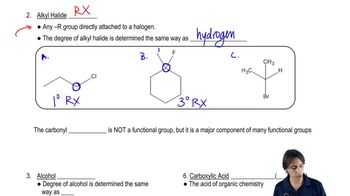
 01:30
01:30