 Back
BackOrganic Chemistry: Stereochemistry and Isomerism
 03:28
03:28
Terms in this set (24)
Stereochemistry is the branch of chemistry concerned with the three-dimensional aspects of molecules.
Isomers are compounds with the same molecular formula but different chemical structures.
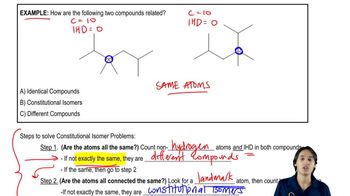
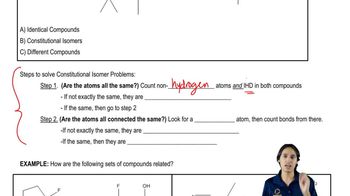
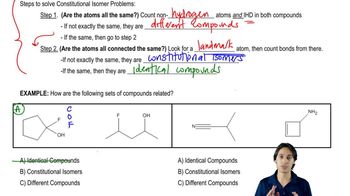
Isomers with the same molecular formula but different connectivity of atoms.
Isomers with the same molecular formula but different arrangements of the carbon chain.
Isomers with the same molecular formula but different positions of substituent groups.
Isomers with the same molecular formula but different functional groups due to different atom connectivity.
Isomers with the same molecular formula and connectivity but different spatial orientation of atoms.
Stereoisomers interconverted by rotation around a single bond; often called conformers.
Stereoisomers that differ in spatial arrangement and cannot be interconverted without breaking bonds.
Stereoisomers with different relative positions of groups around a rigid structure like a double bond or ring.
Cis: same groups on the same side; Trans: same groups on opposite sides of a double bond or ring.
Cis isomers generally have higher boiling points than trans isomers due to polarity.
Stereoisomers that are non-superposable mirror images of each other.
A molecule is chiral if it is not superposable on its mirror image; it has handedness.
A tetrahedral atom, usually carbon, bonded to four different groups causing chirality.
An imaginary plane dividing a molecule into two mirror-image halves.
A point in a molecule where identical components are equidistant on opposite sides along any axis.
Stereoisomers that are not mirror images; can be chiral or achiral and arise from multiple stereocenters.
A method to assign absolute configuration to chiral centers based on priority rules (Cahn-Ingold-Prelog system).
Atoms bonded to the chiral center are ranked by atomic number; higher atomic number = higher priority.
Number substituents 1-4 by priority, view with lowest priority at back, clockwise = R, counterclockwise = S.
An achiral compound with two or more chiral centers and an internal plane of symmetry, making it optically inactive.
Must have multiple stereocenters, an internal plane of symmetry, and stereochemistry that cancels out (R and S centers).
The maximum number is \(2^n\).