 Back
BackAcids and Bases in Organic Chemistry: Mechanisms, pKa, and Equilibria
Study Guide - Smart Notes
 Tailored notes based on your materials, expanded with key definitions, examples, and context.
Acids and Bases in Organic Chemistry
Introduction to Proton Transfers
Proton transfers are fundamental processes in organic chemistry, often occurring rapidly and playing a critical role in reaction mechanisms. Understanding the speed and nature of these transfers is essential for predicting reaction outcomes and designing synthetic pathways.
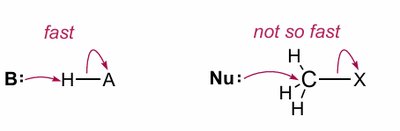
Proton transfers between acids and bases are typically very fast, especially compared to other types of bond-forming or bond-breaking steps.
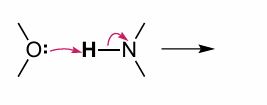
These transfers often proceed through initial hydrogen bond formation, but are commonly depicted as a single concerted step in reaction mechanisms.
In contrast, nucleophilic substitution at carbon centers is generally slower due to the higher activation energy required.
Mechanism and Geometry of Proton Transfers
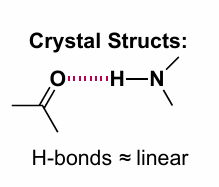
The geometry of proton transfers is crucial for their efficiency. Hydrogen bonds are typically linear, and proton transfer is favored when the participating atoms are aligned.
Proton transfers often begin with hydrogen bond formation, followed by the actual transfer.
Linear geometry is favored for efficient proton transfer, as seen in crystal structures and mechanistic studies.
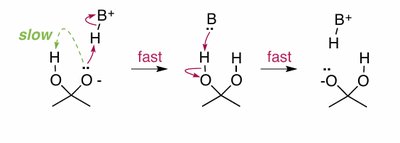
In tetrahedral intermediates, proton transfer may require two steps, especially if a five- or six-membered transition state is involved.

pKa, Acidity, and Basicity
Understanding pKa and Its Implications
The pKa value of a compound is a quantitative measure of its acidity. Lower pKa values indicate stronger acids, while higher pKa values correspond to stronger bases (and often better nucleophiles in organic chemistry).
pKa is defined as the negative logarithm of the acid dissociation constant:
Organic chemists often focus on the basicity and nucleophilicity of conjugate bases, as these properties drive many important reactions.
For example, the acetylide anion is much more nucleophilic than the hydronium ion, as reflected in their respective pKa values.

Using pKa Tables to Predict Trends
pKa tables allow chemists to compare the relative acidities and basicities of various functional groups, aiding in the prediction of reaction direction and feasibility.
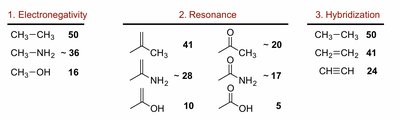
Acidity increases with the instability of the acid (H-A) and the stability of the conjugate base (A–).
Resonance stabilization, electronegativity, and hybridization all influence acidity and basicity.
For example, resonance stabilization by adjacent π bonds or carbonyl groups significantly lowers the pKa, making the compound more acidic.
Hybridization: Greater s-character in the atom bearing the negative charge increases acidity (e.g., alkynes are more acidic than alkenes or alkanes).
Factors Affecting Acidity and Basicity
Electronegativity: More electronegative atoms stabilize negative charge better, increasing acidity.
Resonance: Delocalization of charge through resonance stabilizes the conjugate base, lowering pKa.
Hybridization: More s-character (sp > sp2 > sp3) stabilizes negative charge, increasing acidity.
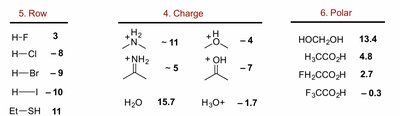
Inductive Effects: Electronegative atoms near the acidic proton increase acidity by stabilizing the conjugate base.
Charge: Positively charged acids are generally more acidic than their neutral counterparts.
Solvent Effects: Polar solvents can stabilize ions, affecting acidity and basicity.
Application of Acid-Base Equilibria in Organic Reactions
Estimating Equilibrium Constants Using pKa Values
Equilibrium constants for acid-base reactions can be estimated using the difference in pKa values between the acid and the conjugate acid of the base.
A large negative means the equilibrium favors the starting materials; a large positive value favors products.
Examples: Fisher Esterification and Protonation Mechanisms
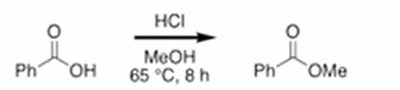
In reactions such as Fisher esterification, the identity of the acid responsible for protonating the carbonyl group can be ambiguous. Calculating equilibrium constants helps clarify which species are present in significant amounts.
Strong acids like HCl are more effective at protonating carbonyls, but their abundance may be lower than weaker acids like protonated methanol.
Mechanistic arrows often use a generic acid (HA) to represent the proton donor.
Calculating for competing protonation steps helps determine the dominant pathway.
Kinetics of Proton Transfers
Diffusion-Controlled Proton Transfers
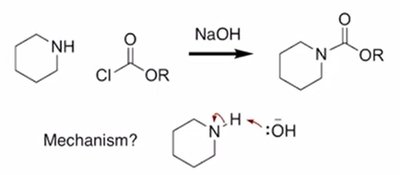
Proton transfers to and from heteroatoms (N, O, S) are typically extremely fast and reversible, especially when the difference in pKa values () exceeds 3 units.
When , proton transfer occurs at the diffusion-controlled limit—every collision results in a transfer.
Rate constants for these processes can exceed M–1 s–1.
Proton transfers are generally in equilibrium under these conditions.
Summary Table: Key Factors Affecting Acidity
Factor | Effect on Acidity | Example |
|---|---|---|
Electronegativity | Increases acidity with more electronegative atom | CH3OH (16) < CH3NH2 (36) |
Resonance | Stabilizes conjugate base, lowers pKa | Acetone (20) vs. Propene (41) |
Hybridization | More s-character, higher acidity | CH≡CH (24) < CH2=CH2 (41) |
Inductive Effect | Stabilizes anion, increases acidity | F3CCO2H (-0.3) |
Charge | Positive charge increases acidity | H3O+ (-1.7) |
Conclusion
Understanding acids and bases, their equilibria, and the factors influencing their reactivity is foundational for mastering organic chemistry. Mastery of pKa trends, proton transfer mechanisms, and equilibrium calculations enables chemists to predict and control organic reactions effectively.
