 Back
BackAddition and Related Reactions of Alkenes and Alkynes
Study Guide - Smart Notes
 Tailored notes based on your materials, expanded with key definitions, examples, and context.
Chapter 8: Reactions of Alkenes
8.1 Introduction to Addition Reactions
Addition reactions are fundamental transformations in organic chemistry, where two groups are added across a carbon–carbon π bond, typically found in alkenes. These reactions are the reverse of elimination reactions and are central to the functionalization of alkenes.
Mechanism: Understanding the stepwise process by which reactants are converted to products.
Regiochemistry: The orientation of the addition (which atom adds to which carbon).
Stereochemistry: The spatial arrangement of atoms in the product.
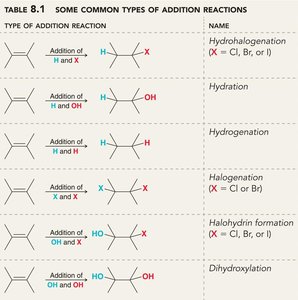
Key Point: The π bond in alkenes can act as a base or nucleophile, making it reactive toward electrophilic addition.
8.4 Addition vs. Elimination: A Thermodynamic Perspective
Addition and elimination reactions are often in equilibrium. The direction favored depends on temperature:
Low temperature: Favors addition (exothermic, forms more stable products).
High temperature: Favors elimination (entropy-driven, forms more molecules).
Example: The hydration of alkenes is reversible and can be controlled by adjusting acid concentration (Le Chatelier’s Principle).
8.5 Hydrohalogenation
Hydrohalogenation involves the addition of a hydrogen halide (H–X, where X = Cl, Br, or I) across an alkene.
Mechanism: The alkene acts as a base, accepting a proton to form a carbocation, which is then attacked by the halide ion.
Regiochemistry: Markovnikov’s rule applies: the halide adds to the more substituted carbon. Using peroxides switches to anti-Markovnikov addition (no carbocation, no rearrangement).
Stereochemistry: If a new stereocenter is formed, a mixture of enantiomers is expected.
Example: Addition of HBr to propene yields 2-bromopropane (Markovnikov) or 1-bromopropane (anti-Markovnikov, with peroxides).
8.6 Acid-Catalyzed Hydration
Hydration adds H and OH across a double bond using water and an acid catalyst (commonly H2SO4).
Mechanism: Follows the P.A.D. steps: Protonate, Attack, Deprotonate.
Regiochemistry: Markovnikov addition (OH to more substituted carbon).
Stereochemistry: Mixture due to planar carbocation intermediate.
Equilibrium: Controlled by acid concentration; concentrated acid favors elimination, dilute acid favors hydration.
8.7 Oxymercuration-Demercuration
This two-step process hydrates alkenes without carbocation rearrangement or equilibrium issues.
Step 1 (Oxymercuration): Mercury(II) acetate reacts with the alkene to form a mercurinium ion intermediate, which is attacked by water at the more substituted carbon (Markovnikov addition).
Step 2 (Demercuration): Sodium borohydride (NaBH4) replaces the mercury group with hydrogen. The reaction is not stereoselective.
Key Point: No rearrangement occurs due to the absence of a free carbocation.
8.8 Hydroboration-Oxidation
Hydroboration-oxidation adds H and OH across a double bond with anti-Markovnikov regioselectivity and syn stereochemistry.
Step 1 (Hydroboration): BH3 (in THF) adds across the alkene, with both H and B adding to the same face (syn addition). H adds to the more substituted carbon due to steric effects.
Step 2 (Oxidation): H2O2 and NaOH replace B with OH, retaining stereochemistry.
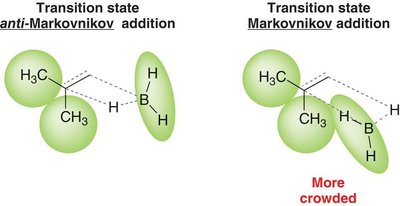
Key Point: The reaction yields syn addition products and is useful for preparing alcohols from alkenes.
8.9 Catalytic Hydrogenation
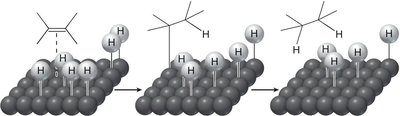
Hydrogenation reduces alkenes to alkanes by adding H2 across the double bond, using a metal catalyst (Pt, Pd, or Ni).
Mechanism: The alkene adsorbs onto the metal surface, and both hydrogens add to the same face (syn addition).
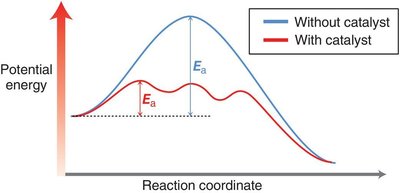
Key Point: Without a catalyst, the activation energy is too high for the reaction to proceed at a reasonable rate.
8.10 Halogenation and Halohydrin Formation
Halogenation adds X2 (Cl2 or Br2) across an alkene, forming vicinal dihalides. In a polar protic solvent, halohydrins are formed instead.
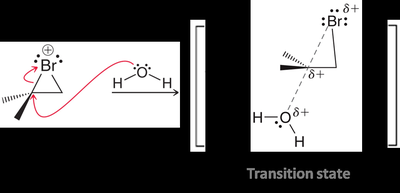
Mechanism: Proceeds via a halonium ion intermediate, followed by nucleophilic attack (anti addition).
Halohydrin Formation: The solvent (e.g., water) acts as the nucleophile, adding to the more substituted carbon (Markovnikov), followed by deprotonation.
8.11 Syn Dihydroxylation
Syn dihydroxylation adds two hydroxyl groups to the same face of an alkene, forming a diol.
Reagents: Osmium tetroxide (OsO4) or potassium permanganate (KMnO4) under basic conditions.
Key Point: Both methods yield syn diols, but OsO4 is more selective and less likely to over-oxidize.
8.12 Epoxidation and Anti Dihydroxylation
Epoxidation forms an epoxide from an alkene using a peroxyacid. Acid-catalyzed opening of the epoxide with water yields anti diols.
Epoxidation: A concerted reaction forming a three-membered ring (epoxide).
Anti Dihydroxylation: Acid-catalyzed ring opening adds OH groups to opposite faces (anti addition).
8.13 Ozonolysis
Ozonolysis cleaves alkenes completely, forming carbonyl compounds (aldehydes or ketones) depending on the substitution pattern of the alkene carbons.
Step 1: Ozone (O3) reacts with the alkene.
Step 2: Reductive workup (DMS or Zn/H2O) yields the final products.
Key Point: If a carbon is bonded to hydrogen, an aldehyde forms; if bonded to two carbons, a ketone forms.
Chapter 9: Reactions of Alkynes
9.1 Introduction to Alkynes
Alkynes, like alkenes, contain π bonds and undergo similar addition reactions. They can act as bases, nucleophiles, or acids.
9.9 Acidity of Acetylene and Terminal Alkynes
Terminal alkynes are more acidic than alkenes or alkanes. Sodium amide (NaNH2) is commonly used to deprotonate terminal alkynes, forming alkynide ions.
9.3 Preparation of Alkynes
Alkynes can be synthesized from dihalides (vicinal or geminal) using excess strong base (e.g., NaNH2), followed by neutralization with water.
9.4 Hydrohalogenation of Alkynes
Hydrohalogenation adds HX (X = Cl, Br, I) to alkynes, following Markovnikov’s rule. With peroxides, anti-Markovnikov addition occurs. Addition can be controlled by the number of equivalents used.
9.5 Halogenation of Alkynes
Halogenation adds X2 (Cl2 or Br2) to alkynes, yielding both syn and anti products. With excess halogen, tetrahalides are formed.
9.6 Hydration of Alkynes
Hydration of alkynes can be achieved by two methods:
Acid-Catalyzed Hydration: Uses H2SO4, H2O, and HgSO4 to give Markovnikov addition, forming a ketone via an enol intermediate (tautomerization).
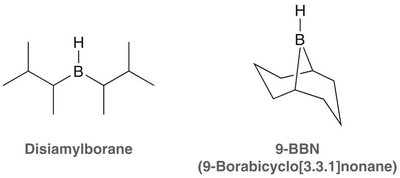
Hydroboration-Oxidation: Uses dialkyl borane (e.g., disiamylborane or 9-BBN), followed by H2O2 and NaOH, to give anti-Markovnikov addition, forming an aldehyde via an enol intermediate.
Tautomers: Enols and ketones/aldehydes are constitutional isomers that interconvert rapidly.
9.7 Reduction of Alkynes
Alkynes can be reduced to alkanes or alkenes:
Complete Reduction: H2 with metal catalyst (Pt, Pd, Ni) yields alkanes.
Partial Reduction: Lindlar’s catalyst (Pd/CaCO3, poisoned) yields cis-alkenes; Na in NH3 yields trans-alkenes.
9.8 Ozonolysis of Alkynes
Ozonolysis cleaves alkynes to carboxylic acids. For terminal alkynes, one product is carbon dioxide due to the formation and decomposition of carbonic acid.
9.10 Alkylation of Terminal Alkynes
Terminal alkynes can be deprotonated to form alkynide ions, which are strong nucleophiles and can react with alkyl halides to form new C–C bonds. This is a valuable method for chain elongation in synthesis.
Acetylene (C2H2): Can undergo two successive alkylations.
Key Point: Alkynide ions are strong nucleophiles but are not typically used for elimination reactions.
