 Back
BackAdvanced Organic Chemistry: Reactivity, Synthesis, and Heterocycles
Study Guide - Smart Notes
 Tailored notes based on your materials, expanded with key definitions, examples, and context.
Reactivity of Carbonyl Compounds
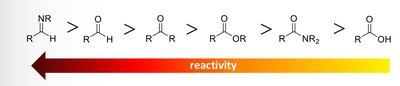
Relative Reactivity of Carbonyl Derivatives
The reactivity of carbonyl compounds toward nucleophilic attack varies significantly depending on the nature of the substituents attached to the carbonyl carbon. This order is crucial for predicting the outcome of nucleophilic acyl substitution reactions.
Acyl chlorides are the most reactive due to the excellent leaving ability of the chloride ion and the strong electron-withdrawing effect.
Anhydrides are also highly reactive, followed by aldehydes and ketones.
Esters and amides are less reactive due to resonance stabilization and poorer leaving groups.
Carboxylic acids are the least reactive among common derivatives.
Example: In multi-step synthesis, the choice of carbonyl derivative is critical for selective transformations.
Reduction of Carbonyl Compounds: DIBAL-H Applications
Selective Reductions with DIBAL-H
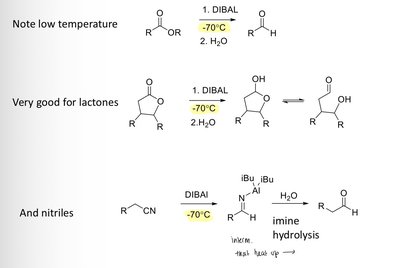
Diisobutylaluminum hydride (DIBAL-H) is a selective reducing agent, especially useful for the partial reduction of esters, lactones, and nitriles to aldehydes under controlled conditions (typically at -70°C).
Esters to Aldehydes: DIBAL-H reduces esters to aldehydes at low temperatures, preventing over-reduction to alcohols.
Lactones: DIBAL-H is particularly effective for reducing lactones to the corresponding hydroxyaldehydes.
Nitriles: DIBAL-H reduces nitriles to imines, which are then hydrolyzed to aldehydes.
Example: The reduction of a nitrile to an aldehyde via imine hydrolysis is a key transformation in organic synthesis.
Protecting Groups in Organic Synthesis
Purpose and Selection of Protecting Groups
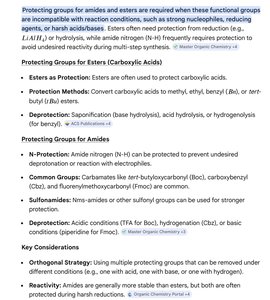
Protecting groups are essential in multi-step synthesis to temporarily mask functional groups that would otherwise react under the conditions required for other transformations. The ideal protecting group is easily introduced and removed in high yield and is stable under the reaction conditions used for other steps.
Esters are commonly used to protect carboxylic acids.
Amides can be protected using groups such as Boc, Cbz, or sulfonamides.
Selection depends on the stability of the protecting group under the planned reaction conditions.
Example: Protecting a carboxylic acid as a methyl ester during a Grignard reaction, then hydrolyzing back to the acid.
Oxidation of Organic Functional Groups
Comparison of OsO4 and KMnO4/NaOH
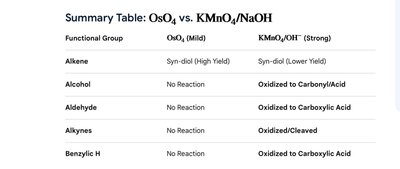
Different oxidizing agents have distinct selectivities and outcomes when applied to organic functional groups:
OsO4 (mild): Converts alkenes to syn-diols with high yield; does not oxidize alcohols, aldehydes, or benzylic hydrogens.
KMnO4/NaOH (strong): Oxidizes alkenes to syn-diols (lower yield), alcohols and aldehydes to carboxylic acids, and cleaves alkynes.
Functional Group | OsO4 (Mild) | KMnO4/OH- (Strong) |
|---|---|---|
Alkene | Syn-diol (High Yield) | Syn-diol (Lower Yield) |
Alcohol | No Reaction | Oxidized to Carbonyl/Acid |
Aldehyde | No Reaction | Oxidized to Carboxylic Acid |
Alkyne | No Reaction | Oxidized/Cleaved |
Benzylic H | No Reaction | Oxidized to Carboxylic Acid |
Enolate Chemistry and C–C Bond Formation
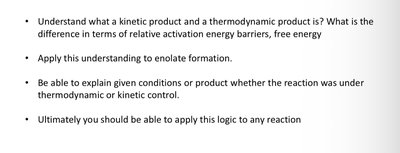
Thermodynamic vs. Kinetic Enolate Formation
Enolates are key intermediates in carbon–carbon bond-forming reactions. The conditions of enolate formation determine whether the kinetic or thermodynamic enolate is favored:
Kinetic enolate: Formed rapidly under low temperature and with strong, non-nucleophilic bases (e.g., LDA). Less substituted, less stable, but forms faster.
Thermodynamic enolate: Formed under higher temperature and with weaker bases. More substituted, more stable, but forms slower.
Example: Alkylation of a ketone can yield different products depending on whether kinetic or thermodynamic control is used.
Double Bond Formation and Stereochemistry
Elimination and Olefination Reactions
Double bonds can be formed via elimination (E1, E2) or olefination reactions (Wittig, Horner-Wadsworth-Emmons, Julia). The stereochemical outcome (E/Z or cis/trans) is influenced by the reaction mechanism and conditions.
E1/E2 eliminations: E2 is stereospecific, requiring anti-periplanar geometry; E1 is not stereospecific.
Wittig reaction: Converts carbonyls to alkenes; the stereochemistry depends on the ylide and reaction conditions.
Julia and Horner-Wadsworth-Emmons reactions: Alternative olefination methods with distinct stereochemical outcomes.
Heterocyclic Compounds
Aromatic Heterocycles: Structure and Reactivity
Aromatic heterocycles contain at least one heteroatom (N, O, S) in a conjugated ring system, contributing to the delocalized π-system. Their reactivity is influenced by the nature and position of the heteroatom(s).
Pyridine: Aromaticity due to N atom; acts as a base or nucleophile; undergoes nucleophilic aromatic substitution more readily than electrophilic substitution.
Indole: Benzofused pyrrole; undergoes electrophilic substitution at C3; synthesized via Fischer indole synthesis.
Pyrrole, Furan, Thiophene: Highly nucleophilic; undergo electrophilic substitution at the 2-position; furan is most reactive, thiophene least.
Quinolines/Isoquinolines: Benzo-fused pyridines; combine reactivity of benzene and pyridine.
Diazines: Pyridine derivatives with two nitrogens; nucleophilic substitution is easier, electrophilic substitution is difficult.
Biological Importance of Heterocycles
Many nucleic acid bases (adenine, guanine, cytosine, thymine, uracil) are diazines or related heterocycles, highlighting their significance in biochemistry.
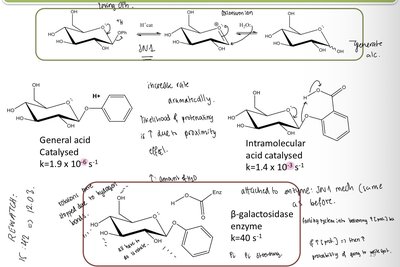
Bioorganic Chemistry: Metabolic Pathways
Primary and Secondary Metabolism
Primary metabolism involves essential pathways for cell survival (anabolism and catabolism). Secondary metabolism produces small molecules not essential for survival but important for adaptation and signaling.
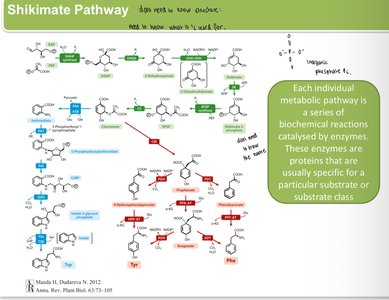
Shikimate Pathway
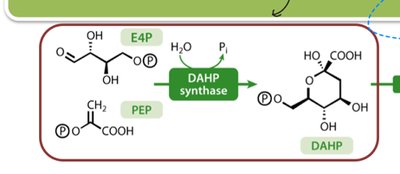
The shikimate pathway is a central metabolic route for the biosynthesis of aromatic amino acids and other aromatic compounds in plants and microorganisms. It involves a series of enzyme-catalyzed reactions, starting from phosphoenolpyruvate (PEP) and erythrose-4-phosphate (E4P).
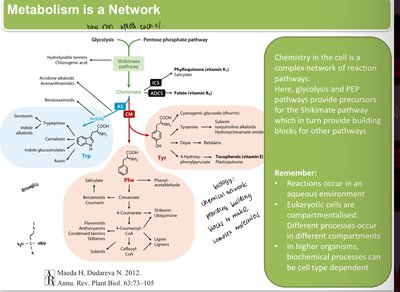
Metabolism as a Network
Metabolic pathways are interconnected, forming a complex network. Pathways such as glycolysis and the pentose phosphate pathway provide precursors for the shikimate pathway, which in turn supplies building blocks for other biosynthetic routes.
Summary of Key Concepts
Understand the order of reactivity of carbonyl compounds and its synthetic implications.
Apply selective reduction strategies (e.g., DIBAL-H) for functional group interconversions.
Choose and use protecting groups appropriately in multi-step synthesis.
Distinguish between kinetic and thermodynamic control in enolate chemistry and double bond formation.
Recognize the structure, reactivity, and biological importance of aromatic heterocycles.
Appreciate the role of metabolic pathways in the biosynthesis of complex molecules.
