Back
BackAdvanced Organometallic Chemistry: Structure, Bonding, and Reactivity of Transition Metal Complexes
Study Guide - Smart Notes
 Tailored notes based on your materials, expanded with key definitions, examples, and context.
Metallocenes and Molecular Orbitals
Electronic Structure of Metallocenes
Metallocenes are a class of organometallic compounds consisting of a transition metal sandwiched between two cyclopentadienyl (Cp) ligands. Their electronic structure can be understood using molecular orbital (MO) theory, which explains the bonding and electron distribution in these complexes.
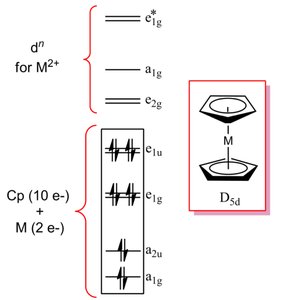
MO Diagram: The interaction between the metal d orbitals and the π orbitals of the Cp ligands leads to the formation of bonding, non-bonding, and antibonding molecular orbitals.
Electron Counting: The Cp ligands contribute 10 electrons, and the metal center provides its valence electrons (commonly 2 for M2+), filling the available MOs according to the 18-electron rule for stability.
Symmetry: The D5d point group symmetry is typical for metallocenes, influencing the splitting and energy levels of the MOs.
Trends in Metallocene Bonding and Structure
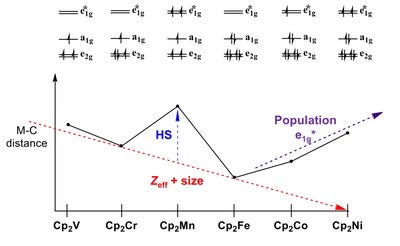
The properties of metallocenes vary across the transition series due to changes in effective nuclear charge (Zeff), metal size, and electron population in key orbitals.
M–C Bond Distance: The bond length between the metal and Cp ligands is influenced by the metal's identity, with a general trend of decreasing bond length as Zeff increases, then increasing as antibonding orbitals are populated.
High-Spin (HS) vs. Low-Spin (LS): The electron configuration (e.g., population of e1g*) affects magnetic properties and bond distances.
Bonding in Transition Metal Complexes
σ-Donation and π-Backdonation
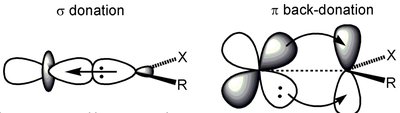
Ligand-to-metal σ-donation and metal-to-ligand π-backdonation are fundamental bonding interactions in organometallic chemistry.
σ-Donation: A ligand donates a pair of electrons from a filled orbital (usually a lone pair) into an empty metal orbital, forming a σ bond.
π-Backdonation: The metal donates electron density from a filled d orbital into an empty π* (antibonding) orbital of the ligand, strengthening the metal-ligand bond and weakening the ligand's internal bond (e.g., C=O in CO ligands).
Metal Carbenes: Fischer and Schrock Types
Bonding and Electronic Structure
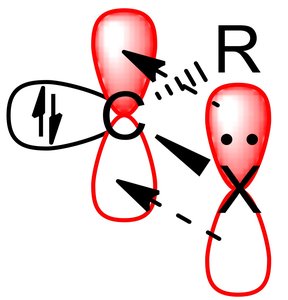
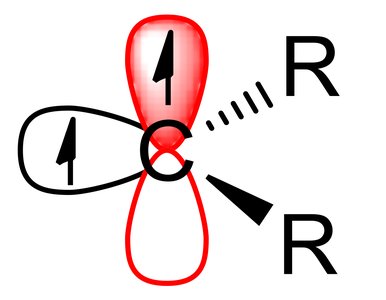
Metal carbenes are complexes where a metal is double-bonded to a carbon atom. They are classified as Fischer (singlet, electrophilic) or Schrock (triplet, nucleophilic) carbenes based on their electronic structure and reactivity.
Fischer Carbenes: Typically have heteroatom substituents (e.g., OR, NR2), are stabilized by π-acceptor ligands, and exhibit singlet ground states.
Schrock Carbenes: Usually have alkyl or aryl substituents, are stabilized by electron-rich metals, and exhibit triplet ground states.
Bonding: Involves both σ-donation from the carbene carbon to the metal and π-backdonation from the metal to the carbene carbon.
Synthesis of Metal Carbenes
Common synthetic routes include nucleophilic addition to metal carbonyls (Fischer carbenes), deprotonation of metal alkyls, and hydride abstraction.
General Strategy: Nucleophilic attack on a coordinated CO ligand followed by electrophilic trapping yields a carbene complex.

Organometallic Reaction Mechanisms
β-Hydride Elimination
β-Hydride elimination is a key decomposition pathway for transition metal alkyl complexes, requiring a β-hydrogen and a vacant coordination site on the metal.
Mechanism: The β-hydrogen is transferred from the alkyl group to the metal, forming a metal hydride and an alkene.
Prevention: Bulky alkyl groups or the absence of β-hydrogens can stabilize the complex against this pathway.

Metal–Ligand Multiple Bonding
π-Backbonding in Metal–Carbonyl Complexes
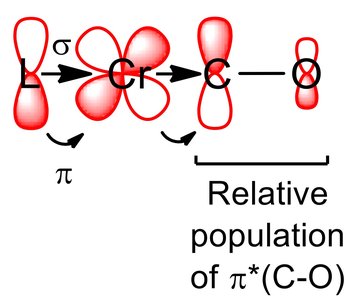
Transition metal carbonyl complexes exhibit strong π-backbonding, where electron density from the metal is donated into the π* orbital of CO, weakening the C–O bond and strengthening the M–C bond.
Relative Population: The extent of π* population in CO can be probed by spectroscopic methods (e.g., IR), with lower C–O stretching frequencies indicating stronger backbonding.
Olefin Metathesis and Polymerization
Mechanism of Olefin Metathesis
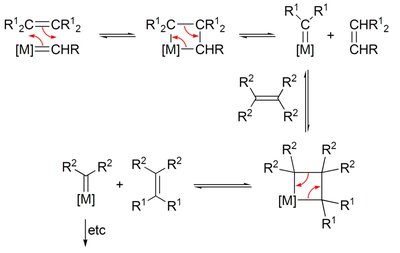
Olefin metathesis is a catalytic process involving the redistribution of alkene fragments via metal carbene intermediates. The reaction proceeds through a series of [2+2] cycloadditions and cycloreversions involving metallacyclobutane intermediates.
Key Steps: Formation of a metallacyclobutane, cycloreversion to new alkene and carbene species, and propagation through repeated cycles.
Ring-Opening Metathesis Polymerization (ROMP)
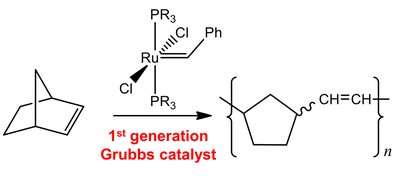
ROMP is a variant of olefin metathesis used to produce polymers from cyclic olefins, driven by the relief of ring strain. Grubbs catalysts are commonly used for this transformation.
Initiation: The catalyst forms a metal carbene that reacts with the cyclic olefin, opening the ring and propagating the polymer chain.
Applications: Synthesis of specialty polymers such as poly(norbornene).
Summary Table: Mechanisms of Ligand Substitution
The mechanism of ligand substitution in transition metal complexes can be associative, dissociative, or interchange, each with distinct kinetic and mechanistic features.
Associative Mechanism (↑ CN) | Interchange Mechanism (= CN) | Dissociative Mechanism (↓ CN) |
|---|---|---|
Associative activation (Aa): RDS = Association (k1); detectable intermediate ✓ | Interchange activation (Ia): Rate depends on Y; no detectable intermediate ✗ | Dissociative activation (Da): RDS = Association (k2); detectable intermediate ✓ |
Associative dissociation (Ad): RDS = Dissociation (k3); detectable intermediate ✓ | Interchange dissociation (Id): Rate does not depend on Y; no detectable intermediate ✗ | Dissociative dissociation (Dd): RDS = Dissociation (k4); detectable intermediate ✓ |