 Back
BackAlcohols and Phenols: Structure, Properties, Synthesis, and Reactions
Study Guide - Smart Notes
 Tailored notes based on your materials, expanded with key definitions, examples, and context.
Alcohols and Phenols
Overview of Alcohols and Phenols
Alcohols are organic compounds characterized by the presence of a hydroxyl group (–OH) attached to a saturated carbon atom. Phenols are a subclass where the hydroxyl group is directly bonded to an aromatic benzene ring. Both functional groups are prevalent in natural and synthetic compounds, playing key roles in biological systems and industrial applications.
Alcohols: Contain a hydroxyl group attached to an sp3 hybridized carbon.
Phenols: Contain a hydroxyl group attached directly to a benzene ring.
Hydroxyl groups are common in natural products and pharmaceuticals.
Nomenclature of Alcohols and Phenols
Systematic Naming of Alcohols
Alcohols are named using IUPAC rules, similar to alkanes, with modifications to account for the hydroxyl group:
Identify the longest carbon chain containing the –OH group (parent chain).
Number the chain to give the –OH group the lowest possible locant.
Name and number substituents, listing them alphabetically before the parent name.
The –OH locant is placed before the parent name or just before the -ol suffix.
For cyclic alcohols, the carbon bearing the –OH is always carbon 1.
Common names are sometimes used (e.g., isopropanol for 2-propanol).
Classification: Alcohols are classified as primary (1º), secondary (2º), or tertiary (3º) based on the number of carbon atoms bonded to the carbon bearing the –OH group.
Phenols: When the –OH group is attached to a benzene ring, the parent name is phenol.
Physical Properties of Alcohols
Boiling Point and Hydrogen Bonding
The presence of the hydroxyl group significantly affects the physical properties of alcohols, especially their boiling points. Alcohols can form strong hydrogen bonds, leading to much higher boiling points compared to similar alkanes or alkyl halides.
Hydrogen bonding increases the boiling point of alcohols.
Alcohols with short carbon chains (≤3 carbons) are miscible with water due to hydrogen bonding.
Longer-chain alcohols become less soluble in water as the hydrophobic alkyl group dominates.
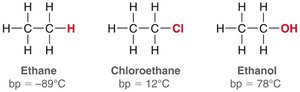
Example: Ethanol (bp = 78°C) has a much higher boiling point than ethane (bp = -89°C) or chloroethane (bp = 12°C) due to hydrogen bonding.
Anti-Bacterial Properties
The effectiveness of alcohols as anti-bacterial agents depends on the balance between hydrophilic (–OH) and hydrophobic (alkyl) regions. Alcohols must be sufficiently water-soluble to penetrate aqueous environments but also hydrophobic enough to disrupt microbial membranes.
Hexylresorcinol is an example of an alcohol with both hydrophilic and hydrophobic regions, used as an antibacterial and antifungal agent.
Acidity of Alcohols and Phenols
Alkoxides and Deprotonation
Alcohols can act as weak acids, losing a proton to form alkoxide ions. A strong base (e.g., NaH, Na, K, or Li) is required for deprotonation.
Alkoxide: The conjugate base of an alcohol.
Phenols are much more acidic than alcohols due to resonance stabilization of the phenoxide ion.
Factors Affecting Acidity
Resonance: Stabilizes the conjugate base (especially in phenols).
Induction: Electron-withdrawing groups increase acidity by stabilizing the negative charge.
Solvation: Poor solvation of bulky alkoxides (e.g., tert-butoxide) decreases acidity.
Sterics: Steric hindrance can reduce solvation and stability of the conjugate base.
Preparation of Alcohols
From Alkyl Halides
Alcohols can be synthesized from alkyl halides via nucleophilic substitution (SN1 or SN2), depending on the substrate.
From Alkenes
Alcohols can be prepared from alkenes through addition reactions:
Acid-catalyzed hydration: Markovnikov addition of water across the double bond.
Hydroboration-oxidation: Anti-Markovnikov addition of water.
By Reduction of Carbonyl Compounds
Alcohols can be synthesized by reducing carbonyl compounds (aldehydes, ketones, esters, carboxylic acids) using hydride reagents.
NaBH4 (Sodium borohydride): Reduces aldehydes and ketones.
LiAlH4 (Lithium aluminum hydride): More reactive; reduces aldehydes, ketones, esters, and carboxylic acids.
Catalytic hydrogenation: Less selective; reduces both carbonyls and alkenes.
Reduction involves the addition of hydride (H−) to the carbonyl carbon, followed by protonation.
Preparation of Diols
Naming and Synthesis
Diols (glycols) are compounds with two hydroxyl groups. They are named by retaining the "e" in the alkane name and adding the suffix "diol." Diols can be prepared by reduction of diketones or by dihydroxylation of alkenes.
Grignard Reagents in Alcohol Synthesis
Formation and Reactivity
Grignard reagents (RMgX) are formed by reacting alkyl halides with magnesium in anhydrous ether. The carbon in the Grignard reagent acts as a strong nucleophile and base, attacking carbonyl groups to form alcohols with new C–C bonds.
Grignard reagents must be protected from water and alcohols, as they react readily with protic solvents.
Protection of Alcohols
Protecting Groups in Synthesis
Alcohols can interfere with reactions such as Grignard additions due to their acidity. To prevent unwanted side reactions, alcohols are often protected using a three-step process: (1) protect the alcohol, (2) perform the desired reaction, (3) remove the protecting group.

Trimethylsilyl (TMS) group: Common protecting group for alcohols; introduced in the presence of a base.
Protection occurs via an SN2 mechanism at silicon.
Deprotection is achieved with acid (H3O+) or fluoride ions (e.g., TBAF).
Reactions of Alcohols
Conversion to Alkyl Halides
3º alcohols: React with HX via SN1 mechanism.
1º and 2º alcohols: React with SOCl2 or PBr3 via SN2 mechanism.
Alcohols can be converted to tosylates (good leaving groups) for further substitution.
Elimination Reactions
Alcohols can undergo elimination (E1 or E2) to form alkenes, especially under acidic conditions.
E1 elimination favors more substituted (Zaitsev) alkenes; E2 can favor less substituted (Hofmann) alkenes with bulky bases.
Oxidation of Alcohols
General Principles
Alcohols can be oxidized to carbonyl compounds:
1º alcohols: Oxidized to aldehydes (PCC, Swern, DMP) or further to carboxylic acids (chromic acid).
2º alcohols: Oxidized to ketones.
3º alcohols: Generally do not undergo oxidation (no α-hydrogen).
Common oxidizing agents include chromic acid, PCC, Swern oxidation (DMSO/oxalyl chloride), and Dess-Martin periodinane (DMP).
Biological Redox Reactions
NADH and NAD+ in Metabolism
Nature uses complex redox agents such as NADH (reducing agent) and NAD+ (oxidizing agent) for selective transformations, including the reduction of carbonyls to alcohols and vice versa. These interconversions are central to cellular metabolism.
Oxidation of Phenols
Quinones and Cellular Respiration
Phenols are readily oxidized to quinones, which can be reduced to hydroquinones. This redox cycling is important in biological processes such as cellular respiration, where ubiquinones catalyze the conversion of oxygen to water.
Synthesis Strategies
Functional Group Interconversions
Organic synthesis often involves changing the carbon skeleton or interconverting functional groups. Alcohols, aldehydes, ketones, carboxylic acids, and their derivatives can be grouped by oxidation state and transformed using the reactions discussed above. The Grignard reaction is a key method for forming new C–C bonds, and multi-step syntheses may be required for certain transformations.
