 Back
BackAlcohols and Phenols: Structure, Properties, Synthesis, and Reactions
Study Guide - Smart Notes
 Tailored notes based on your materials, expanded with key definitions, examples, and context.
Alcohols and Phenols
Structural Features and Classification
Alcohols and phenols are important classes of organic compounds characterized by the presence of a hydroxyl group (–OH). Their structural features and classification are fundamental to understanding their chemical behavior and applications.
Alcohols: Compounds where the –OH group is bonded to a saturated, sp3-hybridized carbon atom.
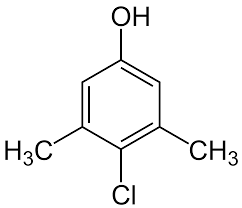
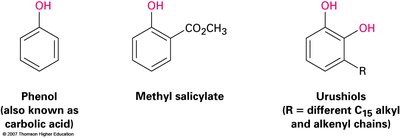
Phenols: Compounds where the –OH group is bonded to an aromatic ring.
Enols: Compounds where the –OH group is bonded to a vinylic, sp2-hybridized carbon.

Alcohols are classified as primary (1°), secondary (2°), or tertiary (3°) based on the number of organic groups attached to the hydroxyl-bearing carbon.
Nomenclature of Alcohols and Phenols
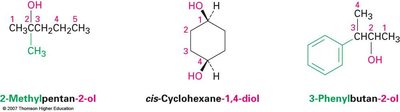
The IUPAC system is used to name alcohols and phenols, ensuring clarity and consistency in chemical communication.
Select the longest carbon chain containing the hydroxyl group.
Replace the –e ending of the parent alkane with –ol.
Number the chain from the end nearest the hydroxyl group.
Identify substituents and their positions, listing them alphabetically.
Physical Properties of Alcohols and Phenols
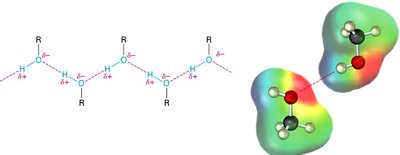
Alcohols and phenols exhibit unique physical properties due to the polar nature of the O—H bond and their ability to form hydrogen bonds.
The O—H bond is polar, allowing hydrogen bonding with water and other alcohols.
Hydrophilicity is conferred by the O—H group, affecting solubility in water.
Water solubility decreases as the ratio of non-polar to polar structures increases.
Alcohols and phenols have higher boiling points than expected due to hydrogen bonding.
Conversion to salts increases water solubility via ion-dipole interactions.
Chemical Properties: Acidity and Basicity
Alcohols and phenols are both weakly acidic and weakly basic, with their acid strength influenced by structural factors.
As weak acids, they do not react with weak bases like amines or bicarbonate ion.
As weak bases, they are reversibly protonated by strong acids to yield oxonium ions (ROH2+).
They react with alkali metals and strong bases such as sodium hydride (NaH).
Acidity of Alcohols and Phenols
Acid strength depends on the O—H bond strength and the stability of the conjugate base.
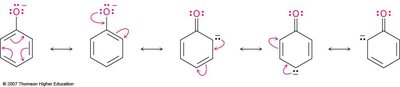
Phenols are more acidic than alcohols due to resonance stabilization of the phenoxide anion.
Electron-withdrawing substituents increase acidity; electron-donating substituents decrease acidity.
Industrial and Pharmaceutical Importance
Alcohols and phenols are widely used in industry and pharmaceuticals.
Methanol: Used industrially, but toxic to humans.
Phenols: Used as disinfectants and intermediates in synthesis.
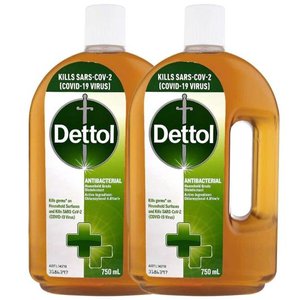
Phenolic compounds are found in products like Dettol and TCP, serving as antiseptics.

Synthesis of Alcohols
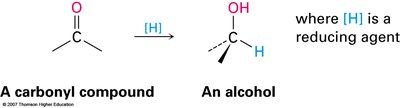
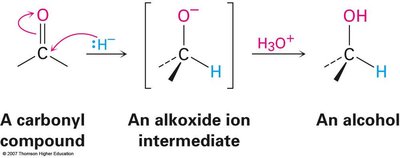
Alcohols are synthesized by several methods, with reduction of carbonyl compounds being the most common.
Reduction of aldehydes yields primary alcohols.
Reduction of ketones yields secondary alcohols.
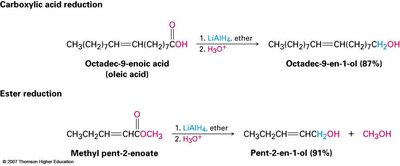
Reduction of carboxylic acids and esters yields primary alcohols (usually with LiAlH4).

Mechanism of Carbonyl Reduction
The reduction mechanism involves nucleophilic addition of a hydride ion to the electrophilic carbonyl carbon, followed by protonation.
The initial product is an alkoxide ion, which is protonated to yield the alcohol.
Reactions of Alcohols
Alcohols undergo a variety of reactions, including dehydration, conversion to alkyl halides, oxidation, esterification, and ether formation.
Dehydration: Produces alkenes.
Conversion to Alkyl Halides: Primary and secondary alcohols are converted using SOCl2 or PCl5.
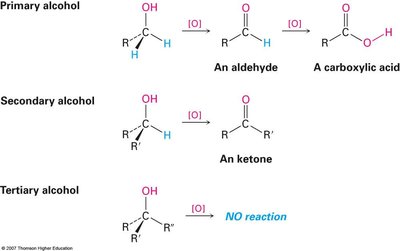
Oxidation: Primary alcohols yield aldehydes or carboxylic acids; secondary alcohols yield ketones; tertiary alcohols are resistant to oxidation.
Esterification: Alcohols react with carboxylic acids to form esters.
Ether Formation: Alcohols react with alkyl halides to form ethers.
Functional Group Interconversions (FGI)
Alcohols can be interconverted with other functional groups, such as carbonyl compounds, through oxidation and reduction reactions.
Oxidation of alcohols with K2Cr2O7 and H2SO4 produces aldehydes, ketones, or carboxylic acids depending on the alcohol type and reaction conditions.
Summary Table: Classification and Properties of Alcohols and Phenols
Compound | Structure | Acidity | Industrial Use |
|---|---|---|---|
Alcohol | R-OH | Weak acid | Solvent, fuel, pharmaceuticals |
Phenol | Ar-OH | Stronger acid (resonance stabilized) | Disinfectant, synthesis intermediate |
Enol | R2C=CR-OH | Variable | Intermediates in reactions |
Key Equations
Reduction of carbonyl compounds:
Oxidation of primary alcohols:
Oxidation of secondary alcohols:
Additional info:
Phenols with electron-withdrawing groups (e.g., nitro) are more acidic due to increased stabilization of the phenoxide ion.
Alcohols and phenols are essential in drug design due to their solubility and reactivity.
