 Back
BackAlcohols and Thiols: Structure, Properties, Nomenclature, and Synthesis
Study Guide - Smart Notes
 Tailored notes based on your materials, expanded with key definitions, examples, and context.
Alcohols: Structure, Classification, and Nomenclature
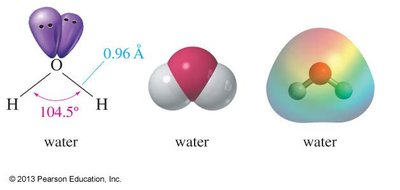
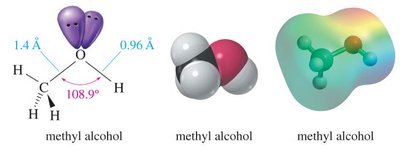
Structure of Water and Methanol
Alcohols are organic compounds containing a hydroxyl (–OH) group bonded to a saturated carbon atom. The structure of water and methanol illustrates the tetrahedral geometry around oxygen due to sp3 hybridization.
Water (H2O): The H–O–H bond angle is 104.5°.
Methanol (CH3OH): The C–O–H bond angle is 108.9°.
Classification of Alcohols
Alcohols are classified based on the number of carbon atoms attached to the carbon bearing the –OH group:
Primary (1°) Alcohol: The –OH group is attached to a carbon bonded to only one other carbon.
Secondary (2°) Alcohol: The –OH group is attached to a carbon bonded to two other carbons.
Tertiary (3°) Alcohol: The –OH group is attached to a carbon bonded to three other carbons.
Aromatic Alcohol (Phenol): The –OH group is bonded directly to a benzene ring.

IUPAC Nomenclature of Alcohols
The systematic naming of alcohols follows these steps:
Identify the longest carbon chain containing the –OH group.
Replace the –e ending of the parent alkane with –ol.
Number the chain to give the –OH group the lowest possible number.
Name and number all substituents, listing them alphabetically.
Example: 2-methylpropan-2-ol
Naming Alcohols with Multiple Functional Groups
When other functional groups are present, the –OH group may be named as a "hydroxy" substituent if a higher-priority group is present (e.g., carboxylic acid).
Naming Diols and Glycols
Alcohols with two –OH groups are called diols. The positions of both –OH groups are indicated by numbers, and the suffix –diol is used.
Vicinal diols (glycols): Diols with –OH groups on adjacent carbons.
Naming Phenols
Phenols are named assuming the –OH group is on carbon 1. Common prefixes for disubstituted phenols are ortho- (1,2-), meta- (1,3-), and para- (1,4-).
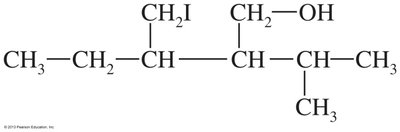
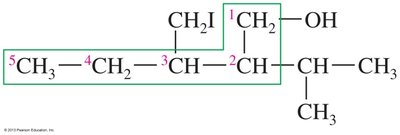
Example of Systematic Naming
To name a complex alcohol, select the longest chain containing the –OH group and number it to give the –OH the lowest possible number.
Physical Properties of Alcohols
Hydrogen Bonding and Boiling Points
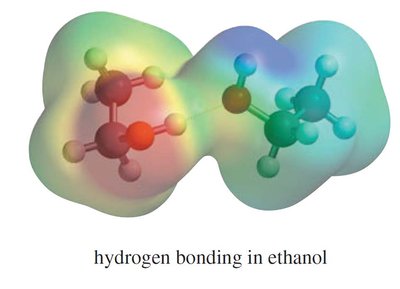
Alcohols have higher boiling points than alkanes and ethers of similar molecular weight due to hydrogen bonding between –OH groups.

Physical Properties Table
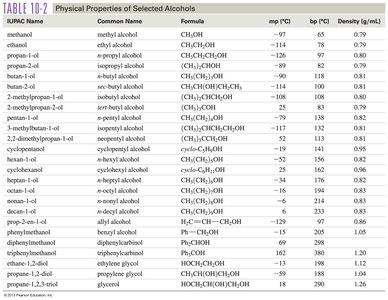
The table below summarizes the melting points, boiling points, and densities of selected alcohols.
IUPAC Name | Common Name | Formula | mp (°C) | bp (°C) | Density (g/mL) |
|---|---|---|---|---|---|
methanol | methyl alcohol | CH3OH | -97 | 65 | 0.79 |
ethanol | ethyl alcohol | CH3CH2OH | -114 | 78 | 0.79 |
propan-1-ol | n-propyl alcohol | CH3CH2CH2OH | -127 | 97 | 0.80 |
propan-2-ol | isopropyl alcohol | (CH3)2CHOH | -89 | 82 | 0.79 |
Solubility in Water
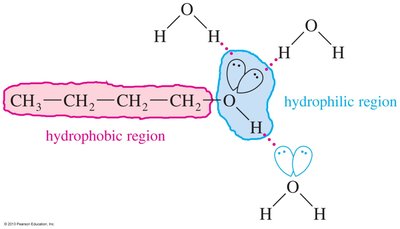
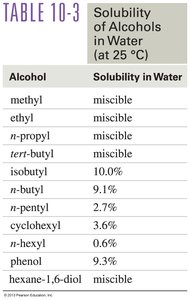
Small alcohols are miscible with water due to hydrogen bonding. As the alkyl chain length increases, solubility decreases.
Alcohol | Solubility in Water |
|---|---|
methyl | miscible |
ethyl | miscible |
n-propyl | miscible |
tert-butyl | miscible |
isobutyl | 10.0% |
n-butyl | 9.1% |
n-pentyl | 2.7% |
cyclohexyl | 3.6% |
n-hexyl | 0.6% |
phenol | 9.3% |
hexane-1,6-diol | miscible |
Preparation and Industrial Uses of Alcohols
Methanol
Methanol (wood alcohol) is produced industrially from synthesis gas (CO and H2) and is used as a solvent and fuel. It is toxic in small quantities.



Ethanol
Ethanol is produced by fermentation of sugars and starches or by hydration of ethylene. It is used as a solvent, in alcoholic beverages, and as a fuel additive (gasohol).



Acidity and Reactivity of Alcohols
Acidity of Alcohols
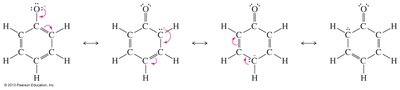
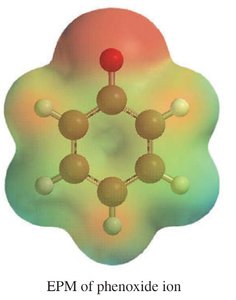
The acidity of alcohols (pKa ≈ 15.5–18) is slightly less than water. Acidity decreases with increasing alkyl substitution but increases with electron-withdrawing groups. Phenol is much more acidic than cyclohexanol due to resonance stabilization of the phenoxide ion.
Formation of Alkoxide and Phenoxide Ions
Alcohols react with active metals (e.g., Na, K) to form alkoxide ions, which are strong bases. Phenol forms phenoxide ion, stabilized by resonance.



Synthesis of Alcohols
Nucleophilic Substitution (SN2)
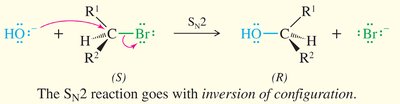
Alcohols can be synthesized by nucleophilic substitution of alkyl halides with hydroxide ion, typically via the SN2 mechanism.
Hydration of Alkenes
Alcohols are also prepared by the acid-catalyzed addition of water to alkenes, oxymercuration-demercuration, or hydroboration-oxidation.
Synthesis of Vicinal Diols
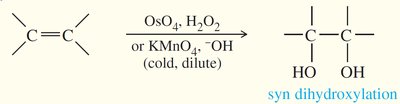
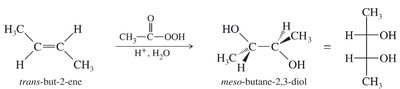
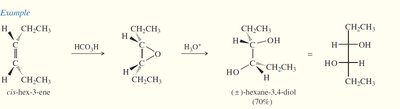
Vicinal diols (glycols) are synthesized by syn dihydroxylation of alkenes using osmium tetroxide or cold, dilute potassium permanganate, or by anti-hydroxylation with peroxy acids followed by hydrolysis.

Organometallic Reagents in Alcohol Synthesis
Grignard and Organolithium Reagents
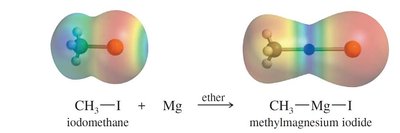
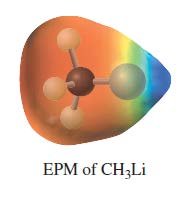
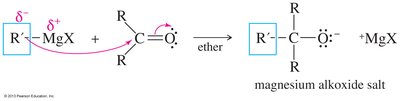
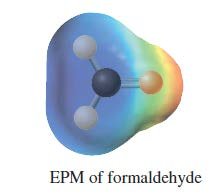
Grignard reagents (R–MgX) and organolithium reagents (R–Li) are powerful nucleophiles used to form carbon–carbon bonds by attacking electrophilic carbonyl groups.


Addition to Carbonyl Compounds
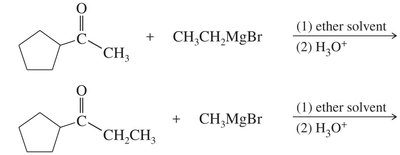
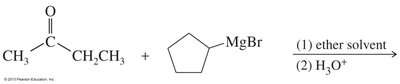
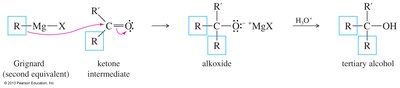
Grignard and organolithium reagents add to carbonyl compounds to form alcohols after hydrolysis. The type of alcohol formed depends on the carbonyl compound:
Formaldehyde: Primary alcohol
Aldehyde: Secondary alcohol
Ketone: Tertiary alcohol





Sodium Acetylides
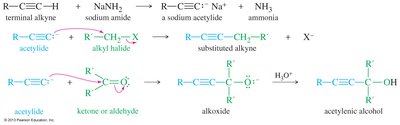
Terminal alkynes can be deprotonated with sodium amide to form acetylide ions, which react with alkyl halides or carbonyl compounds to form new C–C bonds and alcohols.
Synthesis Problems and Strategies
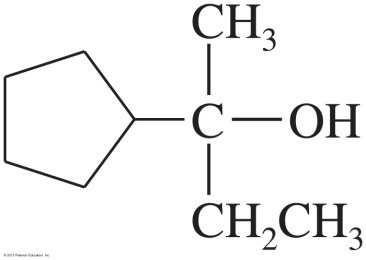
Complex alcohols can be synthesized by choosing appropriate combinations of Grignard reagents and carbonyl compounds, ensuring the starting materials do not exceed the required carbon count.
Reactions with Acid Chlorides and Esters
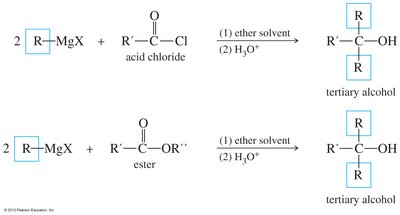
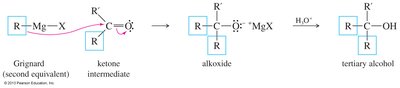
Grignard reagents react with acid chlorides and esters to give tertiary alcohols, requiring two equivalents of the organometallic reagent.
Reaction with Epoxides
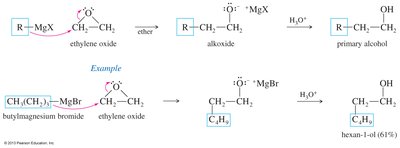
Grignard and organolithium reagents open epoxides (ethylene oxide), extending the carbon chain by two carbons and forming primary alcohols.

Limitations of Organometallic Reagents
Organometallic reagents are strong bases and react with acidic protons (O–H, N–H, S–H, terminal alkynes), so functional group compatibility must be considered.
Reduction of Carbonyl Compounds to Alcohols
Hydride Reducing Agents
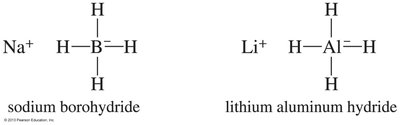
Hydride reagents such as sodium borohydride (NaBH4) and lithium aluminum hydride (LiAlH4) reduce carbonyl compounds to alcohols by nucleophilic addition of hydride (H–).
Mechanism of Hydride Reduction
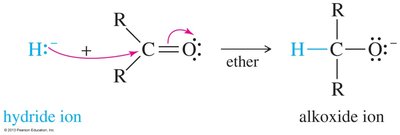
The hydride ion attacks the carbonyl carbon, forming an alkoxide, which is then protonated to yield the alcohol.
Comparison of Reducing Agents
NaBH4: Reduces aldehydes and ketones, but not esters or carboxylic acids.
LiAlH4: Stronger; reduces aldehydes, ketones, esters, and carboxylic acids.
Thiols (Mercaptans): Structure, Nomenclature, and Reactions
Structure and Nomenclature
Thiols are sulfur analogs of alcohols, containing an –SH group. They are named by adding –thiol to the parent alkane or using the common name with "mercaptan." Thiols are more acidic than alcohols.
Synthesis and Oxidation of Thiols
Thiols are typically synthesized by SN2 reactions of alkyl halides with sodium hydrosulfide. Thiols can be oxidized to disulfides, which can be reduced back to thiols.
Biological and Practical Importance
Thiols are known for their strong odors and are used by animals such as skunks for defense.
Additional info: This guide covers the structure, nomenclature, physical properties, synthesis, and reactivity of alcohols and thiols, with emphasis on mechanistic and synthetic strategies relevant to undergraduate organic chemistry.
