 Back
BackAlcohols, Phenols, and Their Reactions: Organic Chemistry Study Guide
Study Guide - Smart Notes
 Tailored notes based on your materials, expanded with key definitions, examples, and context.
Alcohols and Phenols: Structure, Properties, and Reactions
Structural Properties of Alcohols
Alcohols are organic compounds characterized by the presence of a hydroxyl group (-OH) attached to a saturated carbon atom. Their classification depends on the carbon to which the -OH group is attached:
Primary alcohol: -OH attached to a carbon bonded to one other carbon.
Secondary alcohol: -OH attached to a carbon bonded to two other carbons.
Tertiary alcohol: -OH attached to a carbon bonded to three other carbons.
Phenols are compounds where the hydroxyl group is directly attached to an aromatic ring.
Nomenclature of Alcohols and Diols
Alcohols are named by identifying the longest carbon chain containing the -OH group and replacing the terminal "-e" of the parent alkane with "-ol." For diols (compounds with two hydroxyl groups), the suffix "-diol" is added to the parent name. Numbering gives the lowest possible position to the -OH group(s).
Common names: methyl alcohol, ethyl alcohol, isopropyl alcohol, etc.
Diols: ethylene glycol, propylene glycol.
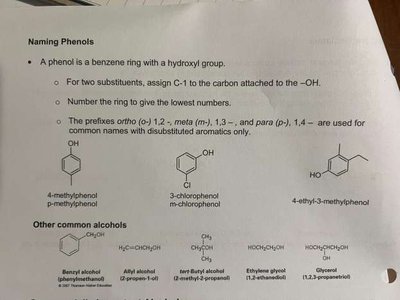
Naming Phenols
A phenol is a benzene ring with a hydroxyl group. For disubstituted phenols, assign C-1 to the carbon attached to the -OH and number the ring to give the lowest numbers. Prefixes ortho (1,2), meta (1,3), and para (1,4) are used for common names.
Examples: 4-methylphenol (p-methylphenol), 3-chlorophenol (m-chlorophenol), 4-ethyl-3-methylphenol.
Physical Properties of Alcohols
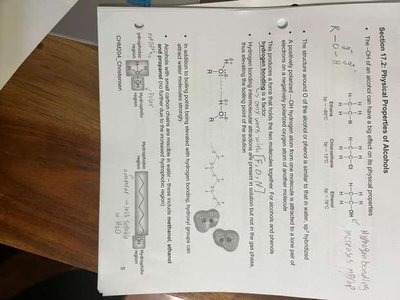
Hydrogen Bonding and Solubility
Alcohols exhibit hydrogen bonding due to the presence of the hydroxyl group, resulting in higher boiling points and solubility in water compared to similar alkanes. The extent of hydrogen bonding depends on the size and structure of the alcohol.
Boiling point increases with molecular weight and number of -OH groups.
Solubility decreases as the hydrocarbon chain length increases.
Acidity and Basicity of Alcohols and Phenols
Acidity of the Hydroxyl Functional Group
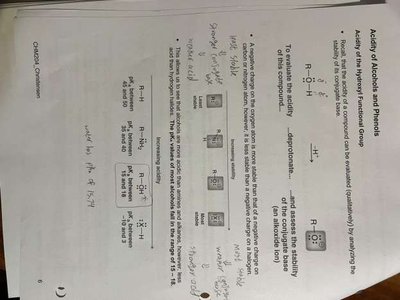
The acidity of alcohols and phenols is determined by the ability of the -OH group to donate a proton. Phenols are more acidic than alcohols due to resonance stabilization of the phenoxide ion.
Alcohols: weak acids, can react with strong bases to form alkoxides.
Phenols: stronger acids, react with weaker bases.
Acid and Base Properties
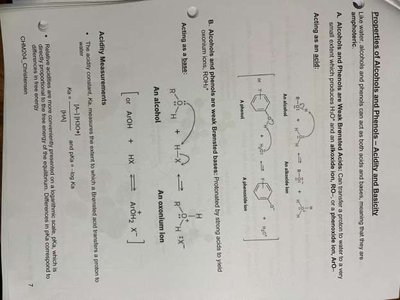
Alcohols and phenols can act as acids (donating a proton) or bases (accepting a proton). Their acidity is measured by pKa values.
Alcohols: pKa ~16-18
Phenols: pKa ~10
Relative Acidity of Alcohols
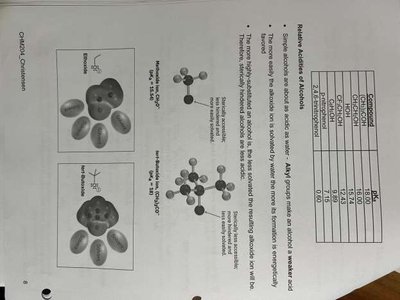
Alkyl groups make alcohols weaker acids compared to water. The acidity decreases as the number of alkyl groups increases.
Compound | pKa |
|---|---|
Water | 15.7 |
Ethanol | 16.0 |
Isopropanol | 17.0 |
Tert-butanol | 18.0 |
Phenol Acidity
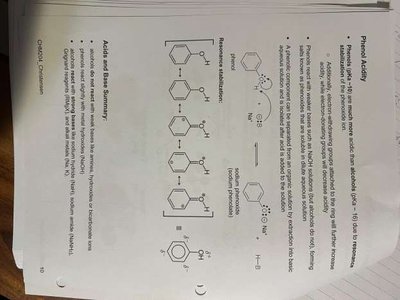
Phenols are more acidic than alcohols due to resonance stabilization. Substituents on the ring can further affect acidity.
Electron-withdrawing groups increase acidity.
Electron-donating groups decrease acidity.
Preparation of Alcohols
General Methods
Alcohols can be synthesized by substitution or addition reactions. Substitution involves replacing a leaving group with -OH, while addition involves adding -OH across a double bond.
Substitution: Alkyl halide + nucleophile (OH-) → alcohol
Addition: Alkene + water (acid-catalyzed) → alcohol
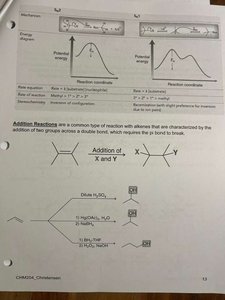
Addition Reactions
Addition reactions with alkenes involve the addition of two groups across a double bond. The reaction requires the π bond to break.
Hydration: Alkene + H2O (acid) → alcohol
Oxymercuration-demercuration: Alkene + Hg(OAc)2, NaBH4 → alcohol
Hydroboration-oxidation: Alkene + BH3, H2O2 → alcohol
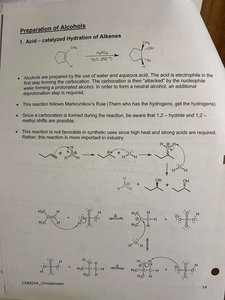
Acid-Catalyzed Hydration of Alkenes
Alcohols are prepared by the addition of water to alkenes in the presence of acid. The reaction follows Markovnikov's rule, where the -OH group attaches to the more substituted carbon.
Mechanism: Protonation, carbocation formation, nucleophilic attack, deprotonation.
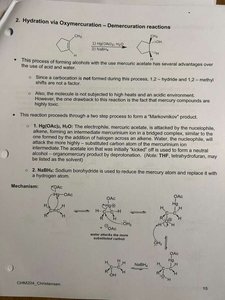
Oxymercuration-Demercuration
This method avoids carbocation rearrangement and provides Markovnikov alcohols. The reaction proceeds via a mercurinium ion intermediate, followed by reduction with NaBH4.
Advantages: No rearrangement, mild conditions.
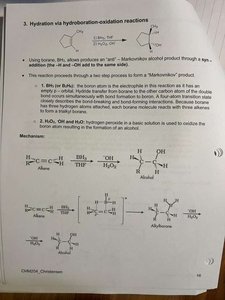
Hydroboration-Oxidation
Hydroboration-oxidation produces anti-Markovnikov alcohols. The boron atom adds to the less substituted carbon, followed by oxidation to replace boron with -OH.
Reagents: BH3, THF, H2O2, NaOH
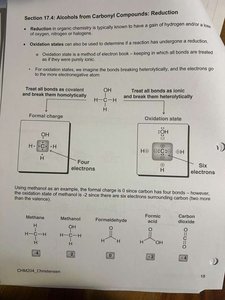
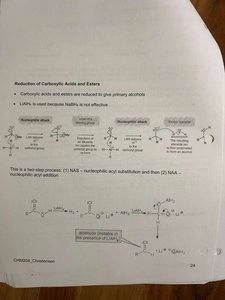
Alcohols from Carbonyl Compounds: Reduction
Reduction of Carbonyl Compounds
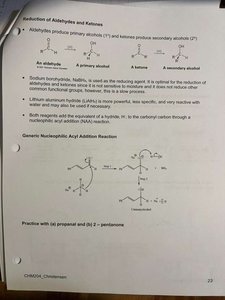
Alcohols can be synthesized by the reduction of carbonyl compounds (aldehydes, ketones, carboxylic acids, esters). Reduction involves the gain of hydrogen or loss of oxygen.
Oxidation state: Used to determine if a reaction is reduction or oxidation.
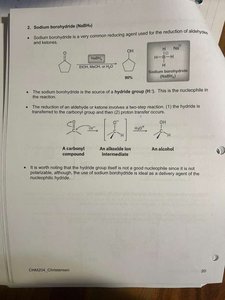
Sodium Borohydride (NaBH4)
NaBH4 is a common reducing agent for aldehydes and ketones. It delivers a hydride ion to the carbonyl carbon, forming an alcohol.
Mechanism: Hydride transfer, protonation.
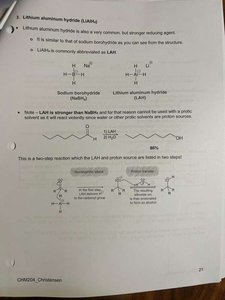
Lithium Aluminum Hydride (LiAlH4)
LiAlH4 is a stronger reducing agent than NaBH4 and can reduce esters and carboxylic acids in addition to aldehydes and ketones.
Mechanism: Hydride transfer, protonation.
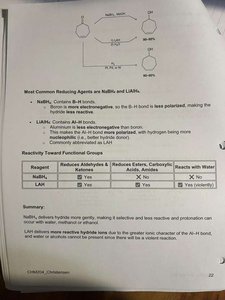
Reactivity Toward Functional Groups
NaBH4 and LiAlH4 differ in their reactivity toward various functional groups.
Reagent | Reduces Aldehydes & Ketones | Reduces Esters, Carboxylic Acids, Amides | Reacts with Water |
|---|---|---|---|
NaBH4 | Yes | No | No |
LiAlH4 | Yes | Yes | Yes |
Alcohols from Carbonyl Compounds: Grignard Reaction
Grignard Reagents
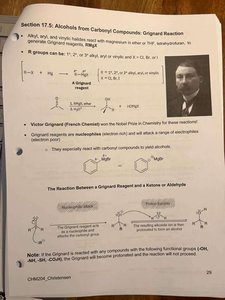
Grignard reagents (RMgX) are organomagnesium compounds that act as strong nucleophiles. They react with carbonyl compounds to form alcohols.
Preparation: Alkyl, aryl, or vinyl halide + Mg in ether.
Reactivity: Grignard reagents add to aldehydes, ketones, esters.
Reaction with Aldehydes and Ketones
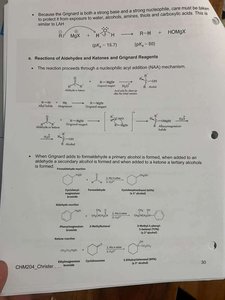
Grignard reagents add to aldehydes to form primary alcohols and to ketones to form secondary alcohols. The reaction proceeds via nucleophilic addition.
Mechanism: Nucleophilic attack, protonation.
Reaction with Esters
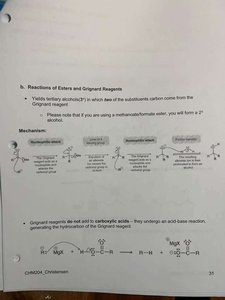
Grignard reagents react with esters to yield tertiary alcohols. Two equivalents of Grignard reagent are required.
Mechanism: Nucleophilic acyl substitution, followed by nucleophilic addition.
Conversion of Alcohols to Halides
SN2 Reactions
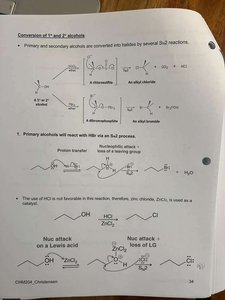
Primary and secondary alcohols can be converted to halides via SN2 reactions. Primary alcohols react with HX via a two-step process: proton transfer and nucleophilic attack.
Reagents: HX, ZnCl2 (for primary alcohols).
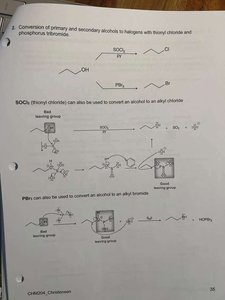
Thionyl Chloride and Phosphorus Tribromide
SOCl2 and PBr3 are used to convert alcohols to alkyl chlorides and bromides, respectively. The reactions proceed via nucleophilic substitution.
SOCl2: Alcohol + SOCl2 → alkyl chloride
PBr3: Alcohol + PBr3 → alkyl bromide
Dehydration of Alcohols to Yield Alkenes
E1 and E2 Reactions
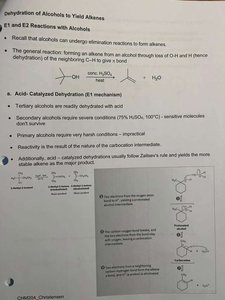
Alcohols can undergo elimination reactions to form alkenes. The general reaction involves loss of H-OH and formation of a double bond.
Acid-catalyzed dehydration (E1): Tertiary alcohols dehydrate easily; secondary alcohols require harsher conditions.
Regioselectivity: Follows Zaitsev's rule, yielding the more substituted alkene.
Oxidation of Alcohols
Oxidation States and Mechanism
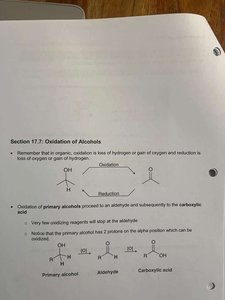
Oxidation of alcohols involves loss of hydrogen or gain of oxygen. Primary alcohols oxidize to aldehydes and then to carboxylic acids; secondary alcohols oxidize to ketones.
Oxidizing agents: Chromic acid, PCC, Swern oxidation.
Alternatives to Chromium Oxidation
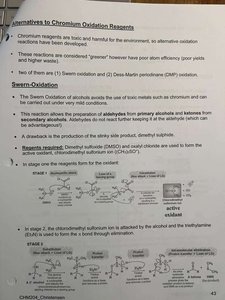
Chromium reagents are toxic; alternatives include Swern oxidation and Dess-Martin periodinane. Swern oxidation produces dimethyl sulfoxide as a byproduct.
Swern oxidation: Alcohol + DMSO + oxalyl chloride → aldehyde/ketone
Reactions of Phenols
Oxidation of Phenols
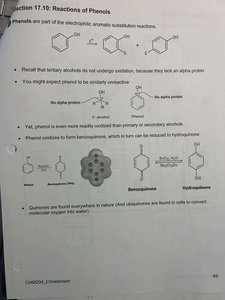
Phenols are more easily oxidized than tertiary alcohols. They oxidize to form quinones, which are important in biological systems.
Example: Phenol → benzoquinone → hydroquinone
Summary Flowcharts and Practice
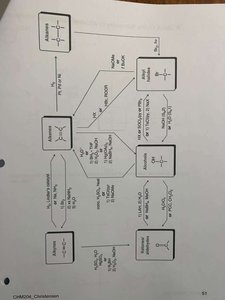
Alcohol Reaction Pathways
Alcohols can be converted to various functional groups via substitution, addition, oxidation, and reduction reactions. Flowcharts summarize these pathways.
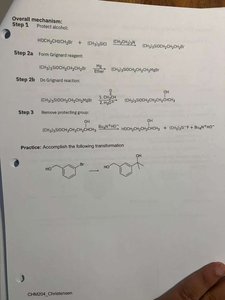
Practice Mechanisms
Mechanistic steps for multi-step transformations, including protection, Grignard formation, and deprotection, are illustrated for exam practice.
Additional info:
All reactions and mechanisms are supported by standard organic chemistry principles.
Tables and flowcharts are recreated for clarity and completeness.
