 Back
BackAldehydes and Ketones: Nomenclature, Reactivity, Synthesis, and Reactions
Study Guide - Smart Notes
 Tailored notes based on your materials, expanded with key definitions, examples, and context.
Naming Aldehydes and Ketones
Principles of Nomenclature
Aldehydes and ketones are named according to IUPAC rules, which prioritize the carbonyl group in the parent chain and assign suffixes based on the functional group present.
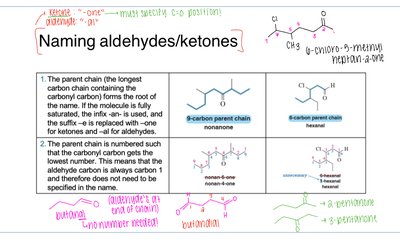
Parent Chain Selection: The longest carbon chain containing the carbonyl group forms the root of the name. For ketones, the suffix -one is used; for aldehydes, -al is used.
Numbering: The chain is numbered so that the carbonyl carbon receives the lowest possible number. For aldehydes, the carbonyl is always at position 1 and does not need to be specified.
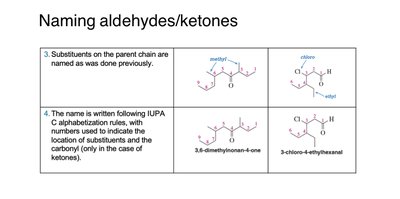
Substituents: Named and numbered as in other organic compounds, with their positions indicated.
Alphabetization: Substituents are listed alphabetically in the name, and numbers indicate their positions and the carbonyl location (for ketones).
Example:
Nonanone: 9-carbon parent chain with a ketone group.
3,6-dimethylnonan-4-one: Ketone at position 4, methyl groups at positions 3 and 6.
3-chloro-4-ethylhexanal: Aldehyde at position 1, chloro at 3, ethyl at 4.
Structure Interpretation from Names
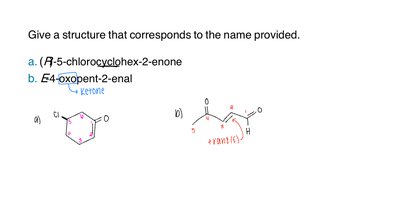
Given a systematic name, students should be able to draw the corresponding structure, including stereochemistry and functional group placement.
(R)-5-chlorocyclohex-2-enone: Chlorine at position 5, ketone at position 2, cyclohexene ring, R configuration.
E-4-oxopent-2-enal: Aldehyde at position 1, ketone at position 4, E configuration at the double bond.
Synthesis of Ketones
Common Synthetic Methods
Ketones can be synthesized via several organic reactions, each with distinct reagents and mechanisms.
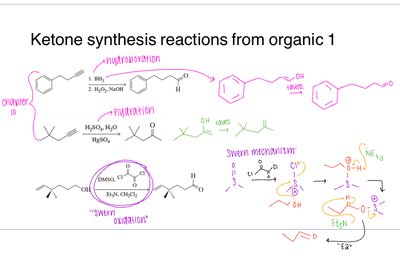
Hydroboration of Alkynes: Terminal alkynes yield aldehydes; internal alkynes yield ketones.
Hydration of Alkynes: Markovnikov addition produces methyl ketones from terminal alkynes.
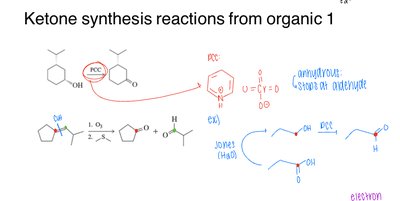
Oxidation of Alcohols: Secondary alcohols are oxidized to ketones using reagents like PCC, Jones reagent, or Swern oxidation.
Ozonolysis: Cleavage of alkenes produces ketones and/or aldehydes depending on the substrate.
Example:
Swern oxidation: Converts secondary alcohols to ketones under mild conditions.
PCC: Selectively oxidizes alcohols to aldehydes or ketones.
Reactivity of Aldehydes and Ketones
Molecular Orbital Structure and Electrophilicity
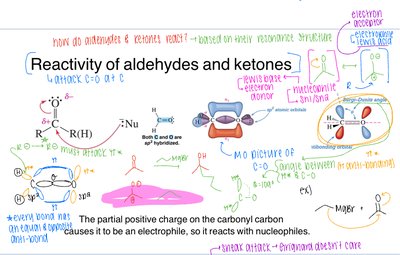
The carbonyl group (C=O) is highly polarized, making the carbonyl carbon electrophilic and susceptible to nucleophilic attack. The molecular orbital structure and resonance effects influence reactivity.
Electrophilicity: Aldehydes are more reactive than ketones due to less steric hindrance and greater polarization.
Resonance: Lone pair donation (as in esters and amides) decreases electrophilicity.
Orbital Overlap: Nucleophiles attack at an angle (~107°) to maximize overlap with the π* orbital.
Relative Electrophilicity
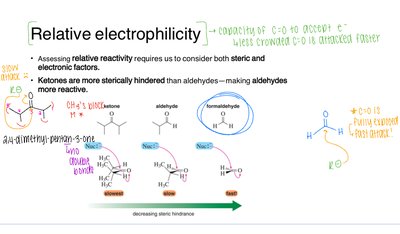
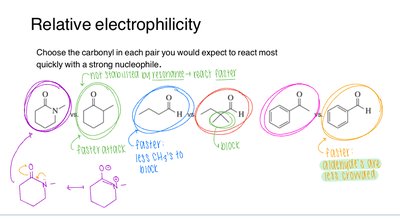
Electrophilicity is determined by both steric and electronic factors. Less crowded carbonyls are attacked faster by nucleophiles.
Ketones: More sterically hindered, less reactive.
Aldehydes: Less hindered, more reactive.
Resonance Effects: Electron donation decreases reactivity.
Reactions with Nucleophiles
Strong Nucleophiles
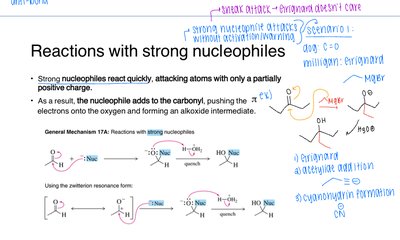
Strong nucleophiles (e.g., Grignard reagents, alkyl lithium, cyanide) attack the carbonyl carbon directly, forming alkoxide intermediates.
Mechanism: Direct nucleophilic addition to carbonyl, followed by protonation.
Examples: Grignard addition, acetylide addition, cyanohydrin formation.
Weak Nucleophiles
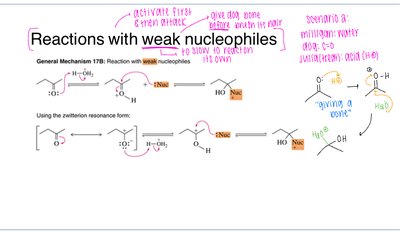
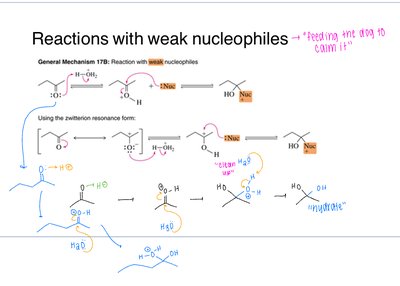
Weak nucleophiles (e.g., water, alcohols) require activation of the carbonyl (usually by acid) before addition occurs.
Mechanism: Protonation of carbonyl, nucleophilic attack, deprotonation.
Examples: Hydrate formation, hemiacetal/acetal formation.
Classification of Nucleophiles
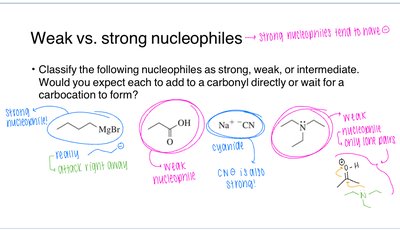
Nucleophiles are classified as strong, weak, or intermediate based on their charge, bonding, and reactivity.
Strong: Negative charge or carbon-metal bond (e.g., RMgBr).
Weak: Neutral molecules (e.g., water, alcohols).
Intermediate: Cyanide (Na+CN-) can act as both strong and weak.
Wittig Reaction and Ylide Selectivity
Wittig Mechanism
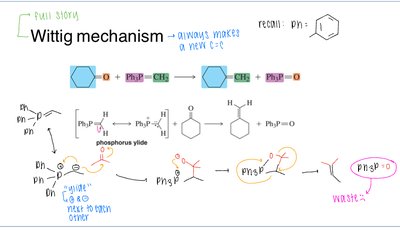
The Wittig reaction forms alkenes by reacting aldehydes or ketones with phosphorus ylides. The mechanism involves nucleophilic addition, formation of a betaine intermediate, and elimination to yield the alkene.
Phosphorus Ylide: Reacts with carbonyl to form a new C=C bond.
Product: Alkene and triphenylphosphine oxide.
Ylide Stability and Selectivity
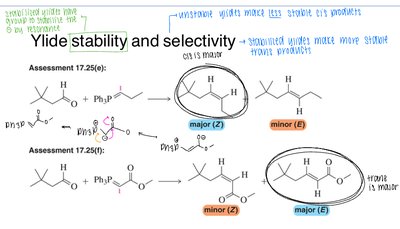
Ylide stability affects the stereochemistry of the alkene product. Stabilized ylides favor trans (E) isomers, while unstabilized ylides favor cis (Z) isomers.
Stabilized Ylides: Contain electron-withdrawing groups, produce E alkenes.
Unstabilized Ylides: Lack electron-withdrawing groups, produce Z alkenes.
Hydrates, Hemiacetals, and Acetals
Hydrate Formation
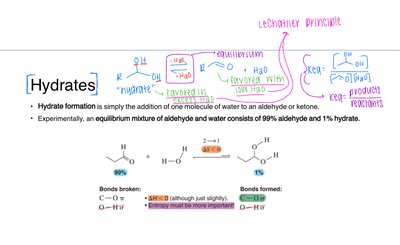
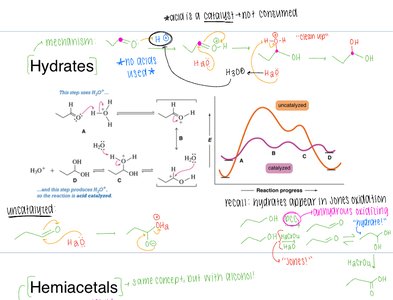
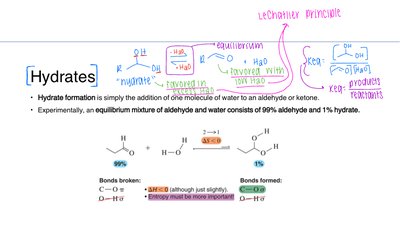
Hydrate formation is the addition of water to an aldehyde or ketone, producing a geminal diol. The equilibrium favors the carbonyl form, but can be shifted by Le Chatelier's principle.
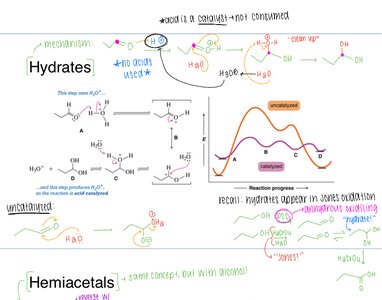
Mechanism: Acid-catalyzed or base-catalyzed addition of water.
Equilibrium: Most aldehydes/ketones exist primarily as carbonyls; hydrate formation is favored by excess water.
Hemiacetal Formation
Hemiacetals are formed by the addition of an alcohol to an aldehyde or ketone. This reaction is reversible and can proceed to acetal formation with excess alcohol.
Functional Group: Hemiacetal contains both an alcohol and ether group on the same carbon.
Mechanism: Acid-catalyzed addition of alcohol, followed by deprotonation.
Acetal Formation
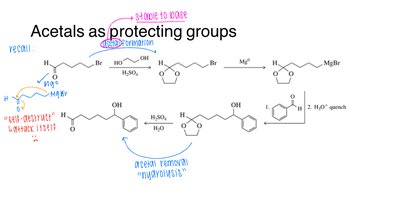
Acetals are formed from hemiacetals by reaction with a second equivalent of alcohol. Acetals are stable in neutral/basic conditions and can be used as protecting groups for carbonyls.
General Formula: Acetal contains two ether groups on the same carbon.
Mechanism: Acid-catalyzed conversion of hemiacetal to acetal.
Protecting Groups: Acetals protect aldehydes/ketones during multi-step synthesis and are removed by acid-catalyzed hydrolysis.
Reduction and Oxidation of Aldehydes and Ketones
General Concepts
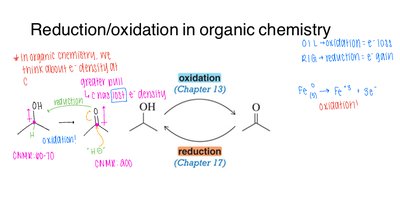
Oxidation increases the number of bonds to oxygen (or decreases bonds to hydrogen), while reduction increases bonds to hydrogen (or decreases bonds to oxygen).
Oxidation: Aldehydes can be oxidized to carboxylic acids; ketones are generally resistant to oxidation.
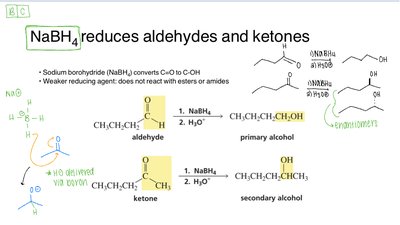
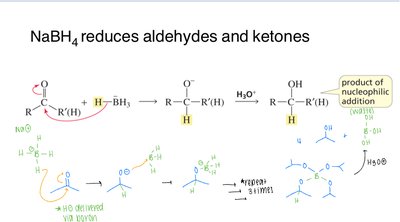
Reduction: Aldehydes and ketones can be reduced to alcohols using hydride reagents.
Reduction Reagents
Common reducing agents include sodium borohydride (NaBH4) and lithium aluminum hydride (LiAlH4).
NaBH4: Reduces aldehydes and ketones to alcohols; does not react with esters or amides.
LiAlH4: Stronger reducing agent; reduces aldehydes, ketones, esters, and carboxylic acids.
Common Mistakes in Carbonyl Chemistry
Predict-the-Product Errors
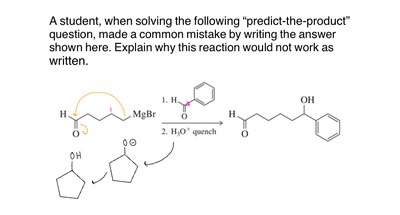
Students often make mistakes in multi-step synthesis, such as incorrect reagent selection or misunderstanding the mechanism. It is important to analyze the reactivity and compatibility of reagents with functional groups present.
Example: Grignard reagents react with carbonyls but are destroyed by protic solvents.
Summary Table: Nucleophile Strength and Carbonyl Reactivity
Nucleophile | Strength | Typical Reaction |
|---|---|---|
RMgBr | Strong | Direct addition to carbonyl |
H2O | Weak | Requires activation |
NaCN | Intermediate | Direct addition or activation |
Alcohols | Weak | Hemiacetal/acetal formation |
Summary Table: Electrophilicity of Carbonyl Compounds
Compound | Steric Hindrance | Electrophilicity |
|---|---|---|
Formaldehyde | Low | High |
Aldehyde | Medium | Medium |
Ketone | High | Low |
Amide/Ester | Variable | Lower (due to resonance) |
Key Equations
General Carbonyl Addition:
Reduction of Aldehyde:
Reduction of Ketone:
Wittig Reaction:
Additional info: Academic context was added to clarify mechanisms, nucleophile classification, and the role of protecting groups. Tables were inferred for summary and comparison purposes.
