 Back
BackAldehydes and Ketones: Structure, Nomenclature, and Reactivity
Study Guide - Smart Notes
 Tailored notes based on your materials, expanded with key definitions, examples, and context.
Aldehydes and Ketones: Structure and Reactivity
Structural Features of Carbonyls
Aldehydes and ketones are organic compounds containing the carbonyl group (C=O), which is central to their chemical behavior. The carbonyl group is planar due to sp2 hybridization, and the electronegativity of oxygen creates a polarized bond, making the carbon atom electrophilic and susceptible to nucleophilic attack.
Aldehydes: Have at least one hydrogen atom attached to the carbonyl carbon (general formula: RCHO).
Ketones: Have two carbon groups attached to the carbonyl carbon (general formula: RCOR').
Physical Properties:
Boiling points are intermediate between alcohols (higher, due to hydrogen bonding) and alkanes (lower, due to only van der Waals interactions).
Aldehydes and ketones are hydrogen bond acceptors but cannot hydrogen bond with themselves; they can hydrogen bond with water, making smaller members somewhat soluble.
Compound | Formula | Boiling Point (°C) | Solubility (in 100g H2O @ 20°C) |
|---|---|---|---|
Pentane | C5H12 | 28 | Insoluble |
1-Pentanal | C5H10O | 65 | Slightly soluble |
1-Pentanol | C5H12O | 110 | Soluble |
Nomenclature of Aldehydes and Ketones
Naming aldehydes and ketones follows IUPAC rules, focusing on the position and identity of the carbonyl group.
Aldehydes:
Identify the longest carbon chain containing the CHO group.
Replace the "-e" ending of the parent alkane with "-al" (e.g., butanal).
Number the chain starting from the carbonyl carbon.
Ketones:
Identify the longest chain containing the carbonyl group.
Replace the "-e" ending of the parent alkane with "-one" (e.g., hexanone).
Number the chain so the carbonyl carbon has the lowest possible number.
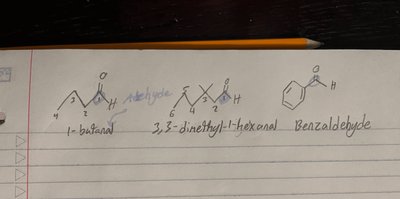
Example: The image above shows the structures and names of 1-butanal, 3,3-dimethyl-1-hexanal, and benzaldehyde, illustrating the application of IUPAC nomenclature for aldehydes.
Synthesis of Aldehydes and Ketones
Preparation Methods
Aldehydes and ketones can be synthesized by the controlled oxidation of alcohols or by Friedel-Crafts acylation for aromatic ketones.
Substrate | Reagent(s) | Product |
|---|---|---|
1° Alcohol | PCC/DCM or NaOCl/CH3COOH | Aldehyde |
2° Alcohol | CrO3, Na2Cr2O7, or K2Cr2O7 with H2SO4, H2O | Ketone |
Aromatic Compound | AlCl3 (Friedel-Crafts Acylation) | Aromatic Ketone |
Reactivity of Aldehydes and Ketones
The Carbonyl Group: Structure and Reactivity
The carbonyl group consists of a double bond between carbon and oxygen, both sp2-hybridized, resulting in a trigonal planar geometry.
The oxygen atom's high electronegativity polarizes the bond, making the carbonyl carbon electrophilic and susceptible to nucleophilic attack.
Resonance stabilization occurs, but the partial positive charge on carbon dominates reactivity.
Nucleophilic Addition to Carbonyls
Nucleophilic addition is the key reaction of aldehydes and ketones, where a nucleophile attacks the electrophilic carbonyl carbon, followed by protonation of the oxygen atom.
Charged Conditions: Nucleophile attacks first, then protonation occurs.
Neutral/Acidic Conditions: Protonation of the carbonyl oxygen increases electrophilicity, then nucleophilic attack follows.
Reactivity: Aldehydes are generally more reactive than ketones due to less steric hindrance and fewer electron-donating groups.
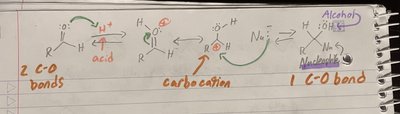
Example: The image above illustrates the acid-catalyzed nucleophilic addition mechanism, highlighting the formation of a carbocation intermediate and the conversion from a carbonyl to an alcohol group.
Reactions with Alcohols: Hemiacetals and Acetals
Aldehydes and ketones react with alcohols in the presence of acid catalysts to form hemiacetals and acetals. The reaction is acid-catalyzed because alcohols are weak nucleophiles.
With 1 equivalent of alcohol: Hemiacetal forms.
With excess alcohol: Acetal forms.
The mechanism resembles an SN1 reaction, involving carbocation intermediates.
Ketones react similarly but are less reactive than aldehydes.
Reactions with Amines: Imine Formation
Amines, due to their nucleophilic lone pair, react with carbonyl compounds to form imines (Schiff bases). This reaction is important in organic synthesis and biochemistry.
Primary amines react with aldehydes or ketones to form imines.
The reaction proceeds via nucleophilic addition followed by elimination of water.
Organometallic Reactions
Organometallic reagents, such as Grignard reagents (RMgX) and organolithium compounds (RLi), are strong nucleophiles that add to carbonyl groups, forming new carbon-carbon bonds.
Grignard Reaction: Aldehydes yield secondary alcohols; ketones yield tertiary alcohols.
These reactions are irreversible and crucial for building complex molecules.
Hydride Reduction Reactions
Aldehydes and ketones can be reduced to alcohols using hydride donors such as lithium aluminium hydride (LiAlH4) and sodium borohydride (NaBH4).
LiAlH4 is a strong, non-selective reducing agent (reacts violently with water).
NaBH4 is milder and can be used in alcohol solvents.
Both reagents act as hydride (H-) donors.
Selective for carbonyl groups; do not reduce C=C bonds under standard conditions.
General Mechanism:
Step 1: Hydride attacks the carbonyl carbon.
Step 2: Protonation yields the alcohol.
Additional Carbonyl Reduction Reactions
Clemmensen Reduction: Zn(Hg)/HCl reduces carbonyls to alkanes.
Catalytic Hydrogenation: H2 gas with a metal catalyst (e.g., Pd, Pt) reduces carbonyls to alcohols or alkanes, depending on conditions.
*Additional info: The mechanisms for hemiacetal/acetal and imine formation, as well as organometallic and hydride reductions, are fundamental for understanding synthetic transformations in organic chemistry. The provided images reinforce the mechanistic steps and nomenclature rules discussed above.*
