 Back
BackAlkanes and Cycloalkanes: Conformations, Stereochemistry, and Nomenclature
Study Guide - Smart Notes
 Tailored notes based on your materials, expanded with key definitions, examples, and context.
Organic Compounds: Alkanes and Their Stereochemistry
Conformations of Ethane
Stereochemistry examines the three-dimensional arrangement of atoms in molecules. In alkanes, different spatial arrangements arise from rotation around single (σ) bonds, resulting in conformations. These conformations are called conformational isomers or conformers.
Bond Rotation: Ethane's carbon–carbon single bond allows free rotation due to its cylindrical symmetry.
Sawhorse Representation: Shows the spatial orientation of all C–H bonds from an oblique angle.
Newman Projection: Views the bond end-on, with the front carbon's bonds radiating from the center and the rear carbon's bonds from the edge.
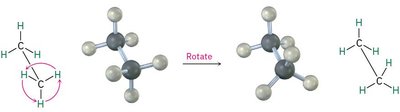
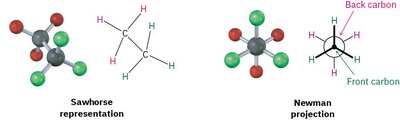
Staggered and Eclipsed Conformations
Ethane exhibits two main conformations:
Staggered Conformation: All C–H bonds are as far apart as possible, minimizing repulsion and energy.
Eclipsed Conformation: C–H bonds are aligned, maximizing repulsion and energy.
Torsional Strain: The energy difference (12 kJ/mol) between staggered and eclipsed conformations is due to torsional strain.
At room temperature, about 99% of ethane molecules are staggered, and only 1% are eclipsed.
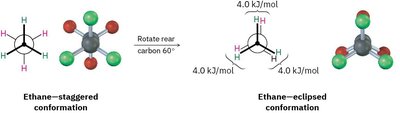
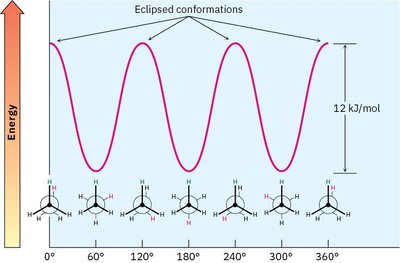
Example: The staggered conformation is energetically favored due to minimized electron repulsion between C–H bonds.
Conformations of Other Alkanes
Alkanes larger than ethane, such as propane and butane, exhibit more complex conformational behavior due to additional substituents.
Propane: The staggered conformer is lower in energy by 14 kJ/mol compared to the eclipsed conformer.
Butane: The lowest-energy arrangement is the anti conformation, where methyl groups are 180° apart. The eclipsed conformation is more strained due to both torsional and steric interactions.
Steric Strain: Repulsive interaction when atoms are forced closer than their atomic radii allow.
Gauche Conformation: Methyl groups are 60° apart, resulting in steric strain but less than the eclipsed conformation.
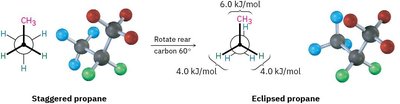
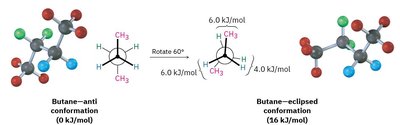
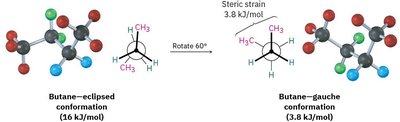
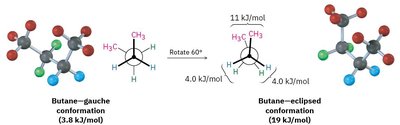
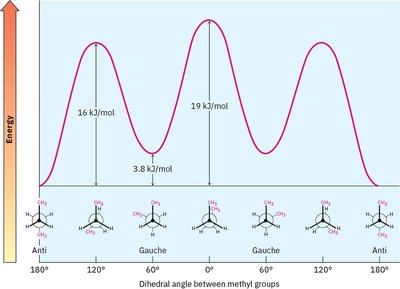
Energy Costs for Interactions in Alkane Conformers
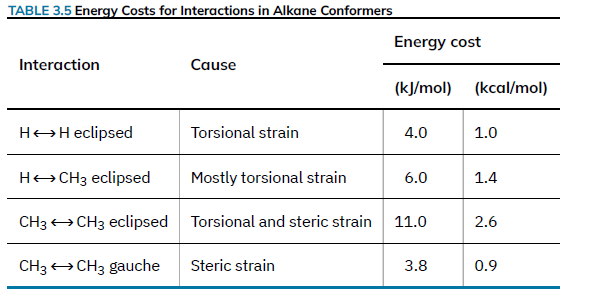
The energy cost of various interactions in alkane conformers is summarized below:
Interaction | Cause | Energy cost (kJ/mol) | Energy cost (kcal/mol) |
|---|---|---|---|
H⟷H eclipsed | Torsional strain | 4.0 | 1.0 |
H⟷CH3 eclipsed | Mostly torsional strain | 6.0 | 1.4 |
CH3⟷CH3 eclipsed | Torsional and steric strain | 11.0 | 2.6 |
CH3⟷CH3 gauche | Steric strain | 3.8 | 0.9 |
Organic Compounds: Cycloalkanes and Their Stereochemistry
Introduction to Cycloalkanes
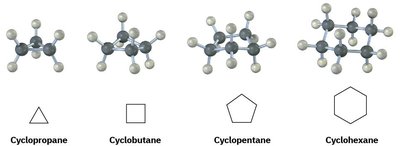
Cycloalkanes are saturated cyclic hydrocarbons, also known as alicyclic compounds. They consist of rings of −CH2− units and have the general formula CnH2n.
Common Cycloalkanes: Cyclopropane, cyclobutane, cyclopentane, and cyclohexane.
Ring Strain: Smaller rings (cyclopropane, cyclobutane) experience significant ring strain due to bond angle deviations.
Naming Cycloalkanes
Step 1: Find the Parent
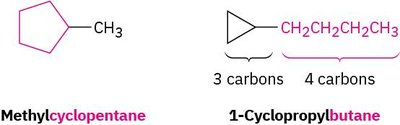
Identify the largest ring structure as the parent cycloalkane. Substituents attached to the ring are named accordingly.
Step 2: Number the Substituents and Write the Name
Number the ring to give substituents the lowest possible numbers.
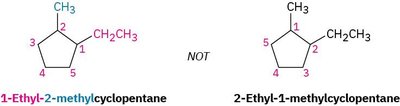
List substituents alphabetically in the name.
Use prefixes (di-, tri-, etc.) for multiple identical substituents.
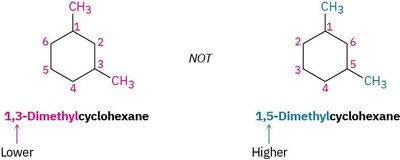
Examples of Cycloalkane Nomenclature
Methylcyclopentane and 1-cyclopropylbutane illustrate naming with substituents.
Numbering rules ensure the lowest set of locants for substituents.
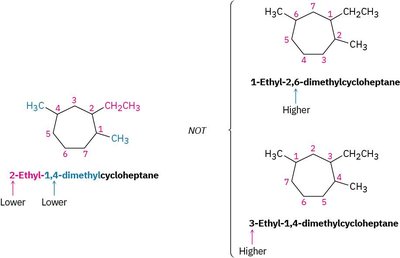
Numbering and Naming Conventions
Numbering should always provide the lowest possible numbers to substituents.
Incorrect numbering can lead to non-systematic names.
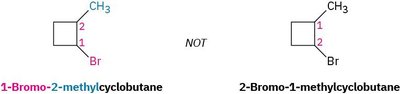
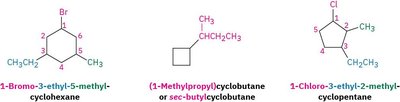
Example: 1-Bromo-2-methylcyclobutane is correct, not 2-bromo-1-methylcyclobutane.
Additional info: Cycloalkane nomenclature follows IUPAC rules, prioritizing the lowest set of locants and alphabetical order for substituents.
----------------------------------------
