 Back
BackAlkanes and Cycloalkanes: Structure, Nomenclature, and Conformations
Study Guide - Smart Notes
 Tailored notes based on your materials, expanded with key definitions, examples, and context.
Alkanes and Cycloalkanes
Hydrocarbons and Alkanes
Alkanes are a class of hydrocarbons composed solely of hydrogen and carbon atoms. They are considered saturated hydrocarbons because all carbon-carbon bonds are single bonds, and each carbon is bonded to the maximum number of hydrogens possible.
Saturated hydrocarbons: Only single bonds between carbons (alkanes).
Unsaturated hydrocarbons: Contain double or triple bonds (alkenes, alkynes).
IUPAC Nomenclature of Alkanes
The International Union of Pure and Applied Chemistry (IUPAC) system provides a systematic method for naming organic compounds, ensuring each compound has a unique name.
Parent name: Indicates the longest continuous carbon chain.
Substituents: Groups attached to the parent chain, named as alkyl groups (ending in -yl).
Locants: Numbers assigned to the carbon atoms in the parent chain to indicate the position of substituents.
For cyclic compounds, the prefix "cyclo" is added to the parent name.
Rules for Naming Alkanes
Identify the longest continuous carbon chain (parent chain).
Identify and name all substituents.
Number the parent chain to give the substituents the lowest possible numbers.
List substituents in alphabetical order, using prefixes (di-, tri-, tetra-) for multiples of the same group (prefixes are not considered in alphabetizing).
For complex substituents, number the longest chain within the substituent starting from the point of attachment.
Naming Cycloalkanes and Bicyclic Compounds
Cycloalkanes are named by identifying the ring as the parent chain. For bicyclic compounds, the prefix "bicyclo" is used, and the number of carbons in each bridge is specified in brackets.
Bridgehead carbons: The two carbons where the rings are fused.
Count the number of carbons in each path connecting the bridgeheads to complete the name.
Constitutional Isomers
Constitutional isomers are compounds with the same molecular formula but different connectivity of atoms. The number of possible isomers increases with the number of carbon atoms.
Isomers can be distinguished by naming or by visualizing their structures in 3D space.
Physical Properties and Industrial Uses of Alkanes
Alkanes are major components of petroleum and natural gas. They are separated by distillation and used as fuels and raw materials for chemical synthesis.
Gasoline is a mixture of straight, branched, and aromatic hydrocarbons (5–12 carbons).
Large alkanes can be broken down (cracking) or reformed into branched/aromatic compounds to increase gasoline yield.
Conformations and Strain in Alkanes and Cycloalkanes
Newman Projections and Conformational Analysis
Single bonds in alkanes can rotate, leading to different spatial arrangements called conformations. Newman projections are used to visualize these conformations by looking straight down a carbon-carbon bond.
Staggered conformation: Substituents are as far apart as possible; lowest energy.
Eclipsed conformation: Substituents overlap; highest energy due to torsional strain.
Torsional strain: Repulsion between electron clouds in eclipsed bonds.
Conformational Analysis of Ethane, Propane, and Butane
For ethane, the energy difference between staggered and eclipsed conformations is about 12 kJ/mol.
For propane, the barrier to rotation is 14 kJ/mol due to additional CH3–H interactions.
For butane, there are multiple staggered and eclipsed conformations. The gauche conformation (methyl groups 60° apart) is higher in energy than the anti conformation (methyl groups 180° apart) due to steric strain.
Cycloalkanes: Ring Strain and Conformations
Cycloalkanes experience angle strain (deviation from ideal bond angles) and torsional strain (eclipsing interactions). The most stable cycloalkane is cyclohexane, which adopts a chair conformation to minimize strain.
Cyclobutane: Significant angle and torsional strain; adopts a puckered conformation.
Cyclopentane: Minimal angle strain; adopts an envelope conformation to reduce torsional strain.
Cyclohexane: Chair conformation is strain-free; other conformations (boat, twist-boat) have higher energy.
Drawing Chair Conformations of Cyclohexane
To draw a chair conformation, follow these steps:
Draw three sets of parallel lines to form the backbone.
Each carbon has two substituents: one axial (up/down) and one equatorial (off the ring, parallel to the chair lines).

Monosubstituted Cyclohexane: Axial vs. Equatorial
When a single substituent is present, it can occupy either an axial or equatorial position. The equatorial position is more stable due to reduced steric interactions (1,3-diaxial interactions).
Ring flipping interconverts axial and equatorial positions.
Larger substituents prefer the equatorial position to minimize steric strain.
Disubstituted Cyclohexane: Conformational Analysis
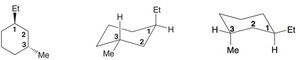
For cyclohexanes with two substituents, the relative positions (cis or trans) and their axial/equatorial orientation affect stability. Solid or dashed wedges indicate the orientation of groups on the ring.
Draw both possible chair conformations to determine which is more stable (usually the one with larger groups equatorial).
cis-trans Stereoisomerism in Cycloalkanes
Disubstituted cycloalkanes can exist as cis (substituents on the same side) or trans (opposite sides) isomers. These are stereoisomers and can be represented using chair conformations.
Each isomer exists as two interconverting chair conformations, favoring the more stable arrangement.
Polycyclic Systems
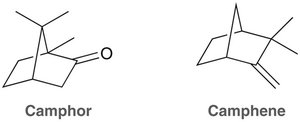
Polycyclic compounds contain multiple fused rings. Decalin is an example of two fused cyclohexane rings. Many natural products, such as steroids, contain polycyclic structures.
Examples include camphor and camphene, which are naturally occurring and have characteristic odors.
Diamond Structure
Diamond consists of a network of fused six-membered rings, forming a rigid three-dimensional lattice.
Additional info: This summary expands on the provided notes with definitions, examples, and explanations of key concepts in alkane and cycloalkane chemistry, including conformational analysis and stereochemistry.
