 Back
BackAlkanes and Cycloalkanes: Structure, Properties, and Nomenclature
Study Guide - Smart Notes
 Tailored notes based on your materials, expanded with key definitions, examples, and context.
Alkanes and Cycloalkanes
Introduction to Alkanes
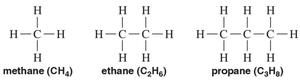
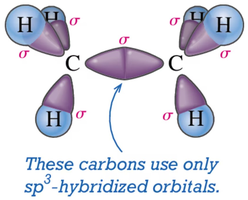
Alkanes are the simplest class of organic molecules, consisting only of carbon and hydrogen atoms connected by single bonds. They are considered saturated hydrocarbons because each carbon atom forms four single bonds, maximizing the number of hydrogen atoms attached. The general molecular formula for an alkane is , where n is the number of carbon atoms.
Saturated hydrocarbons: Only single bonds between carbons; no double or triple bonds.
Non-polar compounds: Alkanes have low electronegativity differences and do not form dipoles.
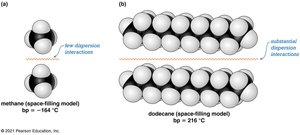
Intermolecular forces: Only London dispersion forces are present, leading to relatively low boiling and melting points.
Physical Properties of Alkanes
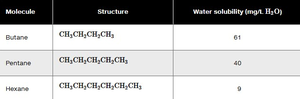
The physical properties of alkanes, such as melting point, boiling point, and solubility, are influenced by molecular size and shape. As the number of carbons increases, so do the melting and boiling points, while water solubility decreases.
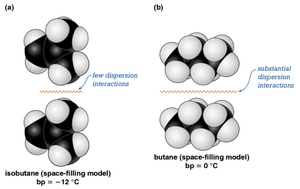
Boiling and melting points: Increase with molecular size due to greater surface area and stronger dispersion forces.
Solubility: Alkanes are insoluble in water and become less soluble as chain length increases.
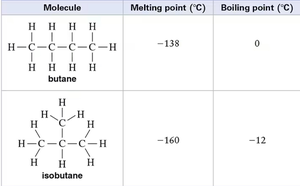
Shape: Branched alkanes have lower boiling points than their straight-chain isomers due to decreased surface area.
Drawing Organic Molecules
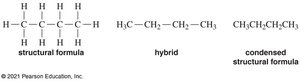
Organic molecules can be represented in several ways, including structural formulas, hybrid forms, and condensed formulas. The line-angle (skeletal) drawing is the most efficient for complex molecules, focusing on the carbon framework and assuming hydrogens are present to complete four bonds for each carbon.
Structural formula: Shows all atoms and bonds explicitly.
Hybrid formula: A simplified version, omitting some hydrogens for clarity.
Condensed formula: Groups atoms together, showing connectivity without explicit bonds.
Line-angle (skeletal) formula: Each vertex or line end represents a carbon; hydrogens are implied.

Isomerism in Alkanes
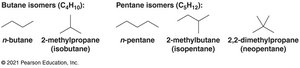
Isomers are compounds with the same molecular formula but different structures. Alkanes with four or more carbons can have multiple isomers, including constitutional isomers (different connectivity), stereoisomers (same connectivity, different spatial arrangement), and conformational isomers (different rotations about single bonds).
Constitutional isomers: Differ in the order of atom connectivity.
Stereoisomers: Same connectivity, different spatial arrangement (e.g., cis/trans in cycloalkanes).
Conformational isomers: Differ by rotation around single bonds.

Nomenclature of Alkanes (IUPAC System)
Basic Rules for Naming Alkanes
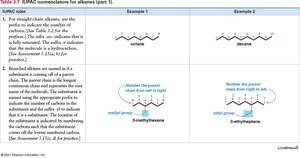
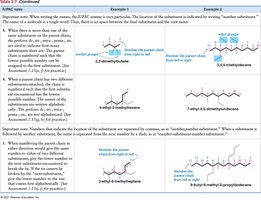
The International Union of Pure and Applied Chemistry (IUPAC) system provides a standardized method for naming alkanes. The main steps are:
Identify the longest continuous carbon chain (parent chain).
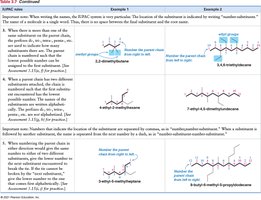
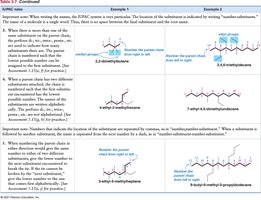
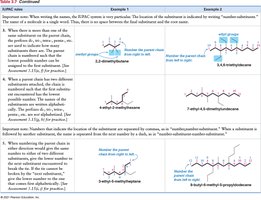
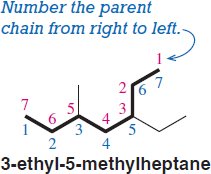
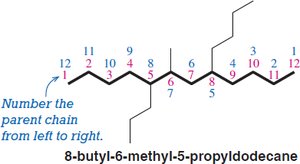
Number the chain from the end nearest a substituent.
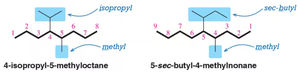
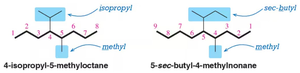
Name and number substituents (alkyl groups) attached to the parent chain.
Use prefixes (di-, tri-, tetra-) for multiple identical substituents.
List substituents alphabetically, ignoring multiplicative prefixes.
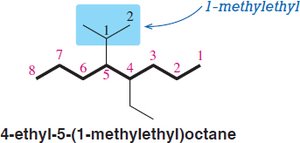
For branched substituents, use parentheses and number appropriately.
Special Cases in Alkane Nomenclature
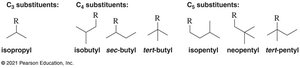
Some alkyl groups have common names, especially those with three to five carbons. These include isopropyl, sec-butyl, tert-butyl, and neopentyl. The 'i' of iso and 'n' of neo are alphabetized, but 's' of sec and 't' of tert are not.
Conformational Analysis of Alkanes
Bond Rotation and Conformations
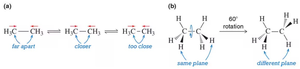
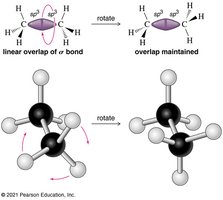
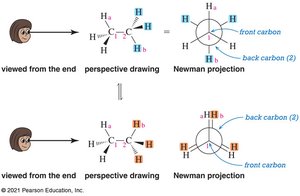
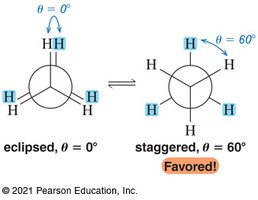
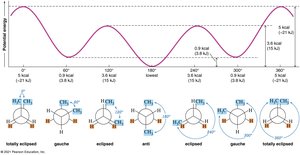
Alkanes can rotate freely around their single (σ) bonds, leading to different spatial arrangements called conformations. The most important conformations are staggered (more stable) and eclipsed (less stable), which can be visualized using Newman projections.
Staggered conformation: Atoms are as far apart as possible, minimizing repulsion.
Eclipsed conformation: Atoms are aligned, increasing electron repulsion (torsional strain).
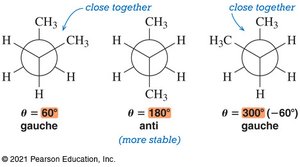
Gauche and anti conformations: In staggered forms, anti is most stable (large groups opposite), gauche is less stable (large groups 60° apart).
Cycloalkanes
Introduction to Cycloalkanes
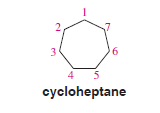
Cycloalkanes are saturated hydrocarbons with carbon atoms arranged in a ring. Their general formula is . The prefix 'cyclo-' is added to the alkane name to indicate a ring structure.
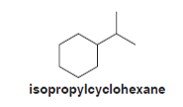
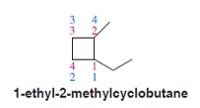
Naming: For monosubstituted cycloalkanes, name as 'cycloalkane.' For multiple substituents, number the ring to give the lowest possible numbers, and list substituents alphabetically.
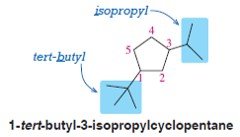
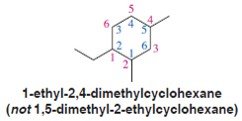
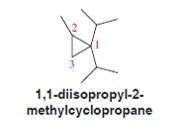
Cis-Trans Isomerism in Cycloalkanes
Cycloalkanes can exhibit cis-trans (geometric) isomerism when there are two or more substituents on the ring. 'Cis' indicates substituents on the same side of the ring, while 'trans' indicates they are on opposite sides. This is a type of stereoisomerism unique to ring systems due to restricted rotation.
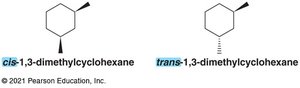
Ring Strain and Stability
Cycloalkanes experience ring strain due to deviations from ideal bond angles (109.5° for sp3 carbons) and torsional strain from eclipsed hydrogens. Smaller rings (e.g., cyclopropane, cyclobutane) are more strained and less stable, while cyclohexane is nearly strain-free in its chair conformation.
Angular strain: Deviation from ideal tetrahedral bond angles.
Torsional strain: Eclipsing interactions between adjacent hydrogens.
Conformations: Cyclopentane adopts an envelope conformation; cyclohexane adopts a chair conformation for maximum stability.
*Additional info: The chair conformation of cyclohexane allows for minimal torsional and angular strain, making it the most stable cycloalkane conformation.*
