 Back
BackAlkanes: Structure, Properties, and Reactivity
Study Guide - Smart Notes
 Tailored notes based on your materials, expanded with key definitions, examples, and context.
Alkanes and Cycloalkanes
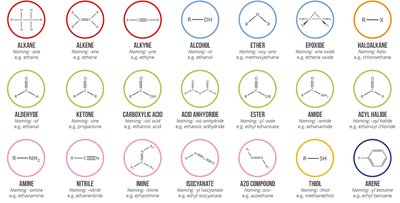
Functional Groups in Organic Chemistry
Functional groups are specific groups of atoms within molecules that are responsible for the characteristic chemical reactions of those molecules. Understanding functional groups is fundamental in organic chemistry, as they define the reactivity and properties of organic compounds.
Definition: Functional groups are groups of atoms in organic molecules which determine the molecule's chemical behavior.
Examples: Alkanes, alkenes, alkynes, alcohols, ethers, epoxides, halides, aldehydes, ketones, carboxylic acids, esters, amines, nitriles, and others.
Application: The presence and type of functional group dictate the nomenclature and reactivity of organic compounds.
Hydrocarbons: Alkanes
Alkanes are the simplest class of hydrocarbons, containing only carbon and hydrogen atoms. They are saturated compounds, meaning each carbon atom is bonded to the maximum number of hydrogen atoms possible, with only single bonds present.
General Formula: , where n is the number of carbon atoms.
Bonding: Alkanes have only C–C and C–H single bonds formed by the σ-overlap of sp3 hybrid orbitals.
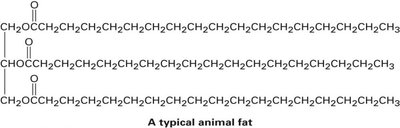
Aliphatic Compounds: Alkanes are sometimes referred to as aliphatic compounds, derived from the Greek word for "fat."

Cycloalkanes and Alkyl Groups
Cycloalkanes are a subclass of alkanes where carbon atoms form a ring structure. Removing a hydrogen atom from an alkane yields an alkyl group, which acts as a substituent in organic molecules.
Cycloalkanes: Examples include cyclopropane, cyclobutane, cyclopentane, and cyclohexane.
Alkyl Groups: Formed by removing a hydrogen atom from an alkane, denoted as R–.
Classification of Carbon Atoms
Carbon atoms in alkanes are classified based on the number of other carbon atoms attached to them. This classification is important for understanding reactivity and nomenclature.
Primary (1°): Bonded to one other carbon.
Secondary (2°): Bonded to two other carbons.
Tertiary (3°): Bonded to three other carbons.
Quaternary (4°): Bonded to four other carbons.

Nomenclature of Alkanes
IUPAC Naming Rules
The International Union of Pure and Applied Chemistry (IUPAC) system provides a standardized method for naming alkanes and their derivatives. The name consists of three parts: prefix, parent, and suffix.
Parent: Indicates the longest continuous carbon chain.
Suffix: Identifies the principal functional group (for alkanes, "-ane").
Prefix: Identifies substituents attached to the main chain.
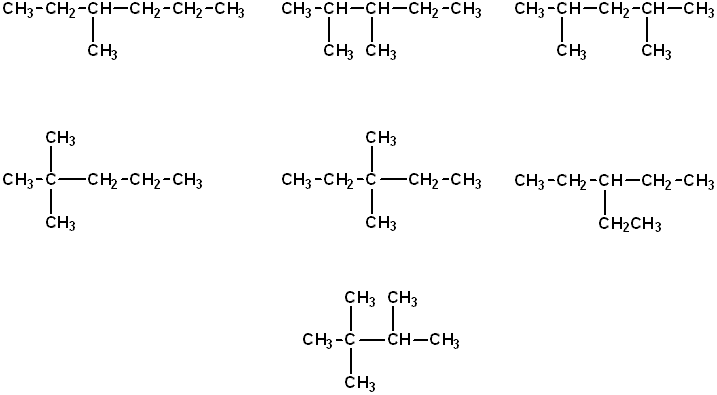
Find the parent hydrocarbon (longest chain).
Number the chain to give substituents the lowest possible numbers.
Identify and number substituents (e.g., methyl, ethyl, propyl).
List substituents alphabetically, using prefixes (di-, tri-, tetra-) for multiples.
Write the name as a single word.
Naming Cycloalkanes
Cycloalkanes are named similarly to open-chain alkanes, with the ring as the parent hydrocarbon. Numbering starts at the point of attachment and proceeds to give substituents the lowest numbers, prioritizing alphabetical order.
Example: 1-Ethyl-2-methylcyclopentane
Conformations of Alkanes
Conformations of Ethane
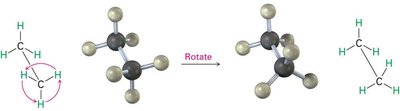
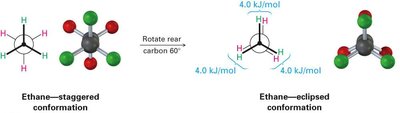
Alkanes can rotate around their C–C single bonds, resulting in different spatial arrangements called conformers. Ethane is a classic example for studying conformational analysis.
Staggered Conformation: Lowest energy, most stable; C–H bonds are as far apart as possible.
Eclipsed Conformation: Highest energy, least stable; C–H bonds are closest together.
Conformations of Cyclohexane
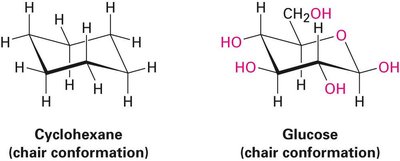
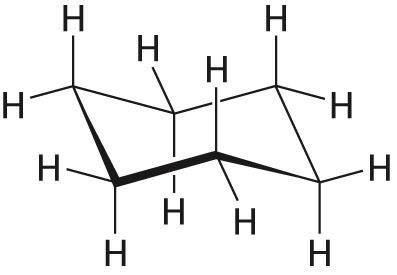
Cyclohexane adopts a three-dimensional chair conformation to minimize strain. This conformation features two types of hydrogen positions: axial (perpendicular to the ring) and equatorial (in the plane of the ring).
Chair Conformation: Strain-free, most stable form of cyclohexane.
Axial Hydrogens: Six hydrogens perpendicular to the ring.
Equatorial Hydrogens: Six hydrogens in the plane of the ring.
Physico-Chemical Properties of Alkanes
Solubility and Biological Relevance
Alkanes are hydrophobic and insoluble in water due to the absence of polar groups. However, they are highly soluble in lipids, which is significant in biological systems.
Hydrophobic: Do not dissolve in water.
Lipophilic: Dissolve well in fats and lipids.
Biological Application: Alkanes can partition into lipid-rich areas, such as the brain, affecting drug absorption and distribution.
Effect of Alkyl Chain Length and Branching
Alterations in alkyl chain length, branching, and ring size can significantly affect the potency and pharmacological activity of drug molecules. Branching generally decreases lipophilicity and can alter biological effects.
Chain Length: Longer chains increase lipophilicity and affect absorption, distribution, and excretion.
Branching: Decreases lipophilicity and can change pharmacological activity, especially if the hydrocarbon chain interacts with receptors.
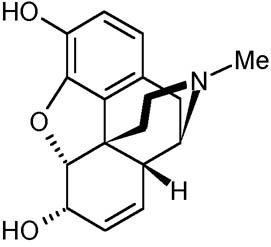
Example: Promethazine (antihistamine) vs. Promazine (antipsychotic) demonstrates how branching affects biological activity.
Chemical Properties of Alkanes
Inertness and Combustion
Alkanes are generally inert due to strong sigma bonds and lack of polar groups. Their primary reaction is combustion, which is highly exothermic and forms the basis for their use as fuels.
Combustion Reaction:
Exothermic: Releases energy, making alkanes valuable as fuels (natural gas, LPG, diesel, petrol).
Halogenation of Alkanes
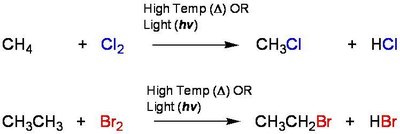
Alkanes undergo halogenation reactions in the presence of UV light or high temperatures via a free radical mechanism. This process can lead to multiple substitutions depending on the amount of halogen present.
Free Radical Mechanism: Initiated by photolysis of halogen molecules (e.g., Cl2).
Products: Mono-, di-, tri-, and tetra-halogenated alkanes (e.g., chloromethane, dichloromethane, chloroform, carbon tetrachloride).
Example Reactions:
Reactants | Conditions | Products |
|---|---|---|
CH4 + Cl2 | High Temp or Light (hv) | CH3Cl + HCl |
C2H6 + Br2 | High Temp or Light (hv) | C2H5Br + HBr |
Radicals: Species with an unpaired electron, highly reactive.
Photolysis: UV light breaks Cl–Cl bond to form chlorine radicals.
Additional info: Excess halogen can lead to further substitution, producing compounds such as dichloromethane, chloroform, and carbon tetrachloride.
----------------------------------------
