 Back
BackAlkenes and Alkynes: Nomenclature, Stability, and Reactions
Study Guide - Smart Notes
 Tailored notes based on your materials, expanded with key definitions, examples, and context.
Alkenes: Structure, Nomenclature, and Stability
Nomenclature and Stereochemistry of Alkenes
Alkenes are hydrocarbons containing at least one carbon-carbon double bond. Their nomenclature follows IUPAC rules, with the longest chain containing the double bond as the parent structure. Stereochemistry is important for alkenes, as they can exhibit geometric (cis/trans or E/Z) isomerism due to restricted rotation around the double bond.
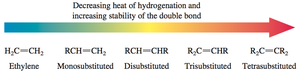
Substitution Pattern: Alkenes are classified as monosubstituted, disubstituted, trisubstituted, or tetrasubstituted based on the number of alkyl groups attached to the double-bonded carbons.
E/Z Notation: Used when there are different substituents on each carbon of the double bond. E (entgegen) means higher priority groups are on opposite sides; Z (zusammen) means they are on the same side.
R/S Notation: Used to specify absolute configuration at stereocenters, which can be combined with E/Z for full stereochemical description.
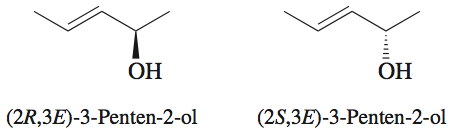
Example: (2R,3E)-3-Penten-2-ol and (2S,3E)-3-Penten-2-ol show both stereocenter and double bond configuration.
Stability of Alkenes
The stability of alkenes increases with the degree of substitution and the trans (E) configuration. This is reflected in their heats of combustion: more stable alkenes have lower heats of combustion.
Order of Stability: Tetrasubstituted > Trisubstituted > Disubstituted > Monosubstituted > Unsubstituted
Trans Isomers: More stable than cis due to less steric hindrance.
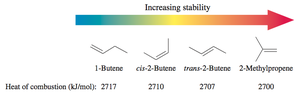
Example: 2-Methylpropene is more stable than trans-2-butene, which is more stable than cis-2-butene and 1-butene.
Elimination Reactions: Synthesis of Alkenes
E2 and E1 Mechanisms
Alkenes are commonly synthesized via elimination reactions from alcohols or alkyl halides. The two main mechanisms are E2 (bimolecular elimination) and E1 (unimolecular elimination).
E2 Mechanism: A strong base abstracts a proton anti to the leaving group, forming the double bond in a single concerted step. Favored for tertiary alkyl halides and strong bases.
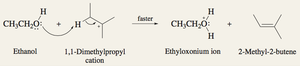
E1 Mechanism: The leaving group departs first, forming a carbocation intermediate, followed by deprotonation. Favored for tertiary alcohols/halides with weak bases.

Dehydration of Alcohols
Alcohols can be dehydrated to alkenes using strong acids (e.g., H2SO4, H3PO4) and heat. The reaction proceeds via an E1 mechanism for secondary and tertiary alcohols.
Mechanism: Protonation of –OH to form a good leaving group (H2O), loss of water to form a carbocation, then deprotonation to yield the alkene.
Zaitsev's Rule: The more substituted (and thus more stable) alkene is the major product.

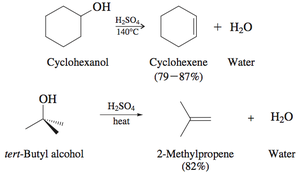
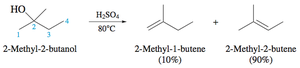
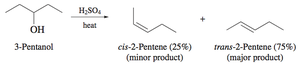
Example: Dehydration of 3-pentanol yields both cis- and trans-2-pentene, with the trans isomer as the major product.
Dehydrohalogenation of Alkyl Halides
Alkyl halides undergo elimination (dehydrohalogenation) with strong bases to form alkenes, typically via the E2 mechanism.
Base: Commonly sodium ethoxide or potassium tert-butoxide.
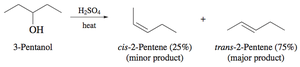
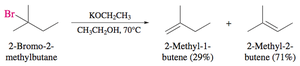
Regioselectivity: Zaitsev's rule applies; the more substituted alkene is favored.
Factors Affecting Elimination Reactions
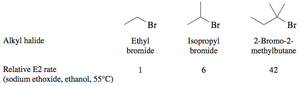
Substrate Structure: Tertiary > Secondary > Primary for E2 reactivity.
Leaving Group: Iodide > Bromide > Chloride > Fluoride (based on bond strength).
Base Strength and Steric Hindrance: Strong, bulky bases favor E2 over SN2, especially for primary alkyl halides.
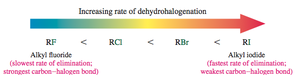
E1 Mechanism and Carbocation Rearrangement
The E1 mechanism involves carbocation intermediates, which can rearrange to form more stable carbocations, affecting product distribution.
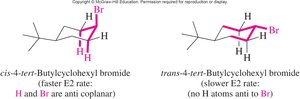

Addition Reactions of Alkenes
Hydrogenation
Hydrogenation is the addition of H2 across the double bond of an alkene, producing an alkane. This reaction requires a metal catalyst (Pt, Pd, Ni, or Rh) and proceeds via syn addition.
Heats of Hydrogenation: Used to compare alkene stabilities; lower heat indicates greater stability.
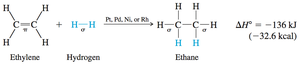
Alkynes: Structure, Nomenclature, and Reactions
Preparation and Nomenclature of Alkynes
Alkynes are hydrocarbons with at least one carbon-carbon triple bond. They are named similarly to alkenes, with the suffix –yne. The parent chain is numbered to give the triple bond the lowest possible number.
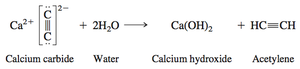
Preparation: Acetylene (ethyne) can be prepared from calcium carbide and water.
Preparation from Dihalides
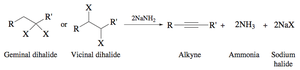
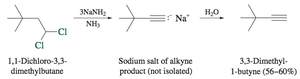
Alkynes can be synthesized by double dehydrohalogenation of vicinal or geminal dihalides using strong bases such as sodium amide (NaNH2).

Reactions of Alkynes
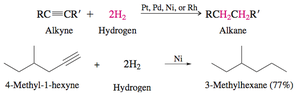
Hydrogenation: Complete hydrogenation yields alkanes; partial hydrogenation (with Lindlar's catalyst) yields cis-alkenes.
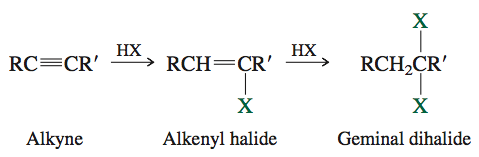
Addition of HX: Markovnikov addition forms geminal dihalides.
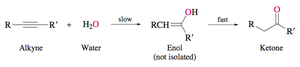
Hydration: Acid-catalyzed hydration yields ketones via enol intermediates.
Ozonolysis: Cleavage of the triple bond yields carboxylic acids.

Summary Table: Elimination vs. Substitution
Substrate | Reagent | Major Reaction |
|---|---|---|
Primary alkyl halide | Strong, unhindered nucleophile | SN2 |
Primary alkyl halide | Strong, hindered base | E2 |
Tertiary alkyl halide | Strong base | E2 |
Tertiary alkyl halide/alcohol | Weak base | Mixture of SN1/E1 |
Tertiary alkyl halide | Good nucleophile, weak base | SN1 |
Key Concepts and Mechanisms
Zaitsev's Rule: The most substituted alkene is the major product in elimination reactions.
Anti-coplanar Geometry: Required for E2 elimination; the proton and leaving group must be anti to each other.
Carbocation Rearrangement: Possible in E1 reactions, leading to more stable carbocation intermediates and products.
