 Back
BackAlkyl Halides: Nucleophilic Substitution and Elimination Reactions (Chapter 7 Study Notes)
Study Guide - Smart Notes
 Tailored notes based on your materials, expanded with key definitions, examples, and context.
Alkyl Halides: Nucleophilic Substitution and Elimination Reactions
Introduction to Alkyl Halides
Alkyl halides are organic compounds in which a halogen atom (F, Cl, Br, or I) is bonded to an sp3-hybridized carbon atom. These compounds are central to many substitution and elimination reactions in organic chemistry due to the unique properties of the carbon-halogen bond.
Hybridization: The carbon bonded to the halogen is typically sp3-hybridized.
Reactivity: Alkyl halides can undergo substitution (with nucleophiles) or elimination (with bases) reactions.
Key Features: The halogen is electron-withdrawing, creating a partial positive charge on the α-carbon, making it susceptible to nucleophilic attack. The halogen also acts as a leaving group.
Nomenclature of Alkyl Halides
Alkyl halides are named by identifying the parent chain, naming the halide as a substituent, assigning locants, and assembling the name alphabetically. Some simple alkyl halides also have common names (e.g., methyl chloride, methylene chloride).
Greek Letters: The carbons attached to the halide are often labeled as α, β, γ, etc. Substitution and elimination reactions typically occur at the α-carbon.
Classification: Alkyl halides are classified as primary (1º), secondary (2º), or tertiary (3º) based on the number of alkyl groups attached to the α-carbon.
Substitution and Elimination Reactions: Overview
Alkyl halides can react with nucleophiles (substitution) or bases (elimination). When a reagent can act as both, substitution and elimination compete.
Substitution: The nucleophile replaces the halogen.
Elimination: The base removes a β-hydrogen, forming an alkene.
Leaving Groups: Good leaving groups are conjugate bases of strong acids (e.g., halides, sulfonates).
Mechanisms of Substitution Reactions
SN2 (Bimolecular Nucleophilic Substitution): Concerted mechanism; nucleophile attacks as the leaving group departs. Stereochemistry is inverted at the reactive center.
SN1 (Unimolecular Nucleophilic Substitution): Stepwise mechanism; leaving group departs first, forming a carbocation intermediate, followed by nucleophilic attack. Can lead to racemization if the α-carbon is chiral.
Mechanisms of Elimination Reactions
E2 (Bimolecular Elimination): Concerted removal of a β-hydrogen and leaving group, forming a double bond. Stereochemistry and regioselectivity are important (Zaitsev vs. Hofmann products).
E1 (Unimolecular Elimination): Stepwise mechanism; leaving group departs first, forming a carbocation, then a base removes a β-hydrogen. Major product is the most substituted (Zaitsev) alkene.
Factors Affecting Reaction Pathways
Substrate Structure: Primary alkyl halides favor SN2/E2; tertiary favor SN1/E1.
Reagent Strength: Strong nucleophiles favor SN2; strong bases favor E2.
Solvent Effects: Polar aprotic solvents favor SN2; polar protic solvents favor SN1/E1.
Leaving Group Ability: Better leaving groups increase reaction rates for all mechanisms.
Solvent Effects on Reaction Rates
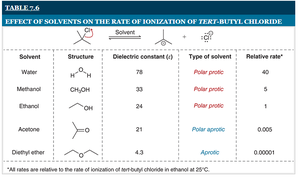
The rate of ionization of alkyl halides (especially in SN1/E1 reactions) is strongly influenced by the solvent. Polar protic solvents stabilize carbocations and anions, increasing the rate of ionization, while polar aprotic solvents stabilize cations and anions differently, affecting nucleophilicity and reaction rates.
Solvent | Structure | Dielectric Constant (ε) | Type of Solvent | Relative Rate* |
|---|---|---|---|---|
Water | H2O | 78 | Polar protic | 40 |
Methanol | CH3OH | 33 | Polar protic | 5 |
Ethanol | CH3CH2OH | 24 | Polar protic | 1 |
Acetone | 21 | Polar aprotic | 0.005 | |
Diethyl ether | 4.3 | Aprotic | 0.0001 |
*All rates are relative to the rate of ionization of tert-butyl chloride in ethanol at 25°C.
Regioselectivity and Stereoselectivity
Regioselectivity: E2 and E1 reactions can yield multiple alkene isomers. Zaitsev's rule predicts the most substituted alkene as the major product, unless a bulky base is used (Hofmann product favored).
Stereoselectivity: E2 reactions are stereospecific when both α and β carbons are stereocenters; otherwise, they are stereoselective. SN2 reactions always proceed with inversion of configuration.
Predicting Reaction Products
To predict the outcome of reactions involving alkyl halides, follow these steps:
Determine the function of the reagent (nucleophile, base, or both).
Analyze the substrate (primary, secondary, tertiary).
Consider regiochemical and stereochemical requirements to predict major and minor products.
Other Leaving Groups: Sulfonates and Alcohols
Sulfonates (e.g., tosylates, mesylates, triflates): Excellent leaving groups, often used as alternatives to halides.
Alcohols: Can be converted to alkyl halides or undergo elimination under acidic conditions. 1º alcohols react via SN2, while 2º and 3º alcohols react via SN1/E1.
Synthetic Strategies and Retrosynthesis
Organic synthesis involves planning the construction of complex molecules from simpler starting materials. Retrosynthetic analysis is a key tool, where the target molecule is broken down into simpler precursors using known reactions (e.g., SN2, E2).
Identify bonds that can be formed using known reactions.
Draw the necessary substrates and reagents.
Verify the feasibility of the proposed synthesis.
Summary Table: Mechanisms and Conditions
Mechanism | Substrate Preference | Reagent | Solvent | Product Stereochemistry |
|---|---|---|---|---|
SN2 | 1º & 2º | Strong nucleophile | Polar aprotic | Inversion |
SN1 | 3º, allylic, benzylic | Weak/neutral nucleophile | Polar protic | Racemization (slight inversion favored) |
E2 | 1º, 2º, 3º | Strong base | Polar aprotic | Anti-periplanar requirement |
E1 | 3º, allylic, benzylic | Weak base | Polar protic | Most stable alkene (Zaitsev) |
Additional info: This summary integrates key concepts from Chapter 7, including nomenclature, mechanisms, solvent effects, and synthetic strategies, providing a comprehensive study guide for exam preparation.
