 Back
BackAlkyl Halides: Structure, Properties, and Nucleophilic Substitution Mechanisms (SN1 & SN2)
Study Guide - Smart Notes
 Tailored notes based on your materials, expanded with key definitions, examples, and context.
Alkyl Halides: Structure and Importance
Definition and Functional Group
Alkyl halides, also known as haloalkanes, are organic compounds in which a halogen atom (F, Cl, Br, or I) is bonded to a saturated, sp3-hybridized carbon atom. The general functional group is C–X, where X is a halogen. Functional groups are crucial in organic chemistry as they determine the chemical behavior and reactivity of molecules.
Functional Group: A specific group of atoms within a molecule responsible for characteristic chemical reactions.
Applications: Alkyl halides are used as anesthetics, refrigerants, pesticides, solvents, and as intermediates in the synthesis of pharmaceuticals.
Biological and Industrial Relevance: Some alkyl halides are naturally occurring (e.g., chloromethane from ocean kelp) and serve as leads for drug discovery.
Nomenclature and Examples
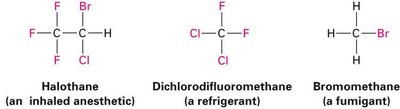
Alkyl halides are named as substituted alkanes, with the position of the halogen indicated by numbering the carbon chain. Examples include halothane (an inhaled anesthetic), 2-bromopentane, and 4-bromo-2-methylhexane.
Example: Halothane (2-bromo-2-chloro-1,1,1-trifluoroethane) is used as an inhaled anesthetic.
Preparation of Alkyl Halides
From Alkenes
Alkyl halides can be synthesized by the reaction of alkenes with hydrogen halides (HX) or halogens (X2) via electrophilic addition. The addition follows Markovnikov's rule, where the halogen attaches to the more substituted carbon.
From Alcohols
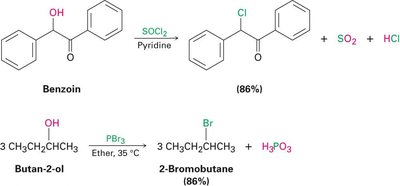
Alcohols are converted to alkyl halides by treatment with reagents such as thionyl chloride (SOCl2) or phosphorus tribromide (PBr3).
General Reaction: R–OH + SOCl2 → R–Cl + SO2 + HCl
General Reaction: 3 R–OH + PBr3 → 3 R–Br + H3PO3
Physical and Chemical Properties of Alkyl Halides
Bond Polarity and Reactivity
The C–X bond in alkyl halides is polar due to the difference in electronegativity between carbon and the halogen. This polarity makes the carbon atom electron-deficient (electrophilic), making alkyl halides susceptible to attack by nucleophiles and bases.
Electrophilicity: The electron-poor carbon in C–X is the site of nucleophilic attack.
Reactions of Alkyl Halides
Overview
Alkyl halides primarily undergo two types of reactions: nucleophilic substitution and elimination. These reactions are fundamental models for understanding more complex organic transformations.
Nucleophilic Substitution (SN1 and SN2): Replacement of the halogen atom by a nucleophile.
Elimination: Removal of a halogen and a hydrogen atom to form an alkene.
Nucleophilic Substitution Mechanisms
General Mechanism
In nucleophilic substitution, a nucleophile (Nu) replaces the leaving group (X) in the substrate (R–X):
Substrate: R–X (alkyl halide)
Nucleophile: Nu (e.g., OH–, Cl–)
Leaving Group: X– (halide ion)
There are two main mechanisms: SN2 (bimolecular) and SN1 (unimolecular).
SN2 Mechanism (Bimolecular Nucleophilic Substitution)
The SN2 reaction occurs in a single concerted step, where the nucleophile attacks the electrophilic carbon from the side opposite the leaving group, resulting in inversion of configuration if the carbon is chiral.
Rate Law:
Second-order kinetics: The rate depends on both the substrate and nucleophile concentrations.
Stereochemistry: Inversion of configuration (Walden inversion).
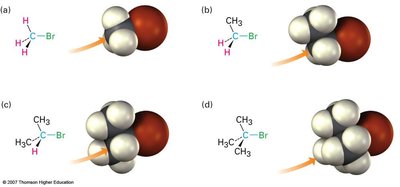
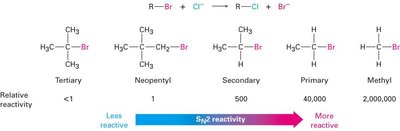
Substrate Reactivity: Less hindered (methyl > primary > secondary > tertiary).
Solvent Effects: Polar aprotic solvents (e.g., acetone, DMF, DMSO) enhance SN2 rates; polar protic solvents slow them down.
Nucleophile Strength: Negatively charged nucleophiles are more reactive than neutral ones.
Factors Affecting SN2 Reactions
Steric Hindrance: Bulky groups around the reactive center slow down SN2 reactions.
Nucleophile: Nucleophilicity increases down a group in the periodic table (I– > Br– > Cl–).
Leaving Group: Good leaving groups stabilize the negative charge well (I–, Br–, tosylate).

SN1 Mechanism (Unimolecular Nucleophilic Substitution)
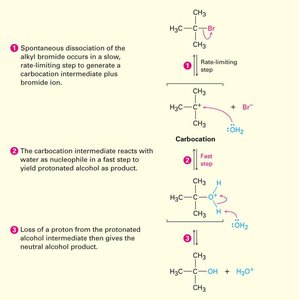
The SN1 reaction proceeds via a two-step mechanism. First, the alkyl halide undergoes slow, unimolecular dissociation to form a carbocation intermediate. Second, the nucleophile rapidly attacks the carbocation. The rate-determining step is the formation of the carbocation.
Rate Law:
First-order kinetics: The rate depends only on the concentration of the alkyl halide.
Stereochemistry: Racemization occurs if the carbon is chiral, due to planar carbocation intermediate.
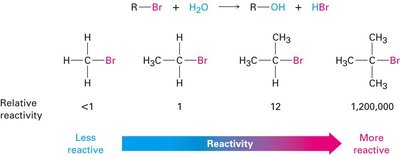
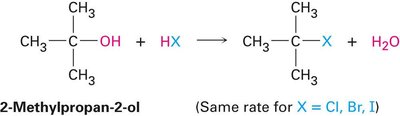
Substrate Reactivity: More substituted alkyl halides react faster (tertiary > secondary > primary).
Solvent Effects: Polar protic solvents (e.g., water, alcohols) stabilize the carbocation and enhance SN1 rates.
Nucleophile Strength: Does not affect the rate; nucleophile attacks after the rate-limiting step.
Factors Affecting SN1 Reactions
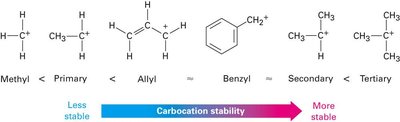
Carbocation Stability: Stability increases with substitution and resonance stabilization (tertiary > secondary > primary > methyl; allyl and benzyl carbocations are especially stable).
Leaving Group: Good leaving groups (I–, Br–, tosylate) facilitate SN1 reactions.

Nucleophile: The nucleophile does not participate in the rate-determining step.
Summary Table: Comparison of SN1 and SN2 Mechanisms
Feature | SN1 | SN2 |
|---|---|---|
Order of Reaction | First-order (unimolecular) | Second-order (bimolecular) |
Rate Law | ||
Intermediate | Carbocation | None (concerted) |
Stereochemistry | Racemization | Inversion |
Substrate Reactivity | 3° > 2° > 1° | 1° > 2° > 3° |
Solvent | Polar protic | Polar aprotic |
Nucleophile Effect | No effect | Strong nucleophile required |
Leaving Group | Good leaving group required | Good leaving group required |
Applications and Examples
Medicinal Chemistry: Many drugs and natural products contain alkyl halide functional groups, which can be key to their biological activity (e.g., chlorambucil, epibatidine).
Industrial Uses: Alkyl halides are used as anesthetics (halothane), refrigerants (dichlorodifluoromethane), and fumigants (bromomethane).
Additional info: The notes above integrate textbook-level explanations and context for all major points in the provided lecture slides, including definitions, mechanisms, and applications relevant to college-level organic chemistry.
