 Back
BackAlkyl Halides: Substitution and Elimination Mechanisms
Study Guide - Smart Notes
 Tailored notes based on your materials, expanded with key definitions, examples, and context.
Alkyl Halides: Structure, Nomenclature, and Classification
Nomenclature of Alkyl Halides
Alkyl halides, also known as haloalkanes, are organic compounds in which a halogen atom (F, Cl, Br, I) is bonded to an sp3-hybridized carbon atom. The nomenclature follows IUPAC rules, naming the halogen as a prefix and the parent alkane as the main chain. Stereochemistry should be indicated where relevant.
Haloalkanes: Halogen as a subordinate functional group.
Alkyl halides: Simpler molecules, named as alkyl group + halide (e.g., methyl chloride).
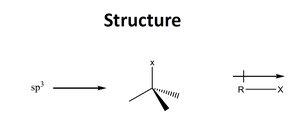
Structure of Alkyl Halides
Alkyl halides have a tetrahedral geometry around the carbon atom bonded to the halogen, reflecting sp3 hybridization. The general structure is represented as R–X, where R is an alkyl group and X is a halogen.
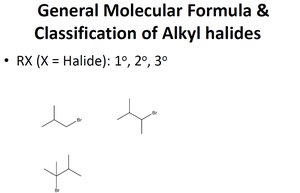
General Molecular Formula & Classification
The general formula for alkyl halides is RX. They are classified based on the carbon to which the halogen is attached:
Primary (1°): Halogen attached to a carbon bonded to one other carbon.
Secondary (2°): Halogen attached to a carbon bonded to two other carbons.
Tertiary (3°): Halogen attached to a carbon bonded to three other carbons.
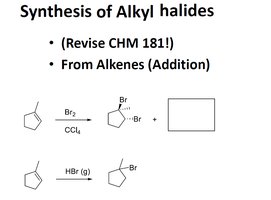
Synthesis of Alkyl Halides
From Alkenes (Addition)
Alkyl halides can be synthesized by the addition of halogens (e.g., Br2) or hydrogen halides (e.g., HBr) to alkenes. The reaction proceeds via electrophilic addition, often with regioselectivity and stereochemistry considerations.
From Alcohols (Substitution)
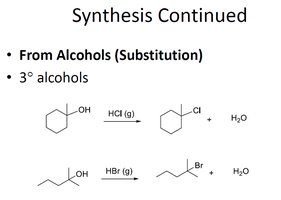
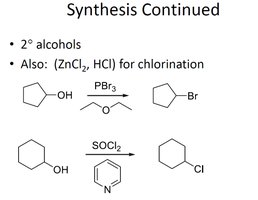
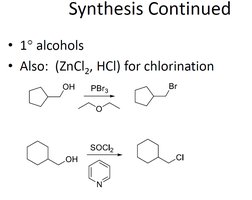
Alcohols can be converted to alkyl halides via substitution reactions using reagents such as HCl, HBr, PBr3, or SOCl2. The mechanism depends on the degree of the alcohol (1°, 2°, or 3°).
3° alcohols: React with HCl or HBr to give alkyl halides and water.
2° alcohols: React with PBr3 or SOCl2 for halogenation.
1° alcohols: Similar reagents as 2° alcohols, but often require milder conditions.
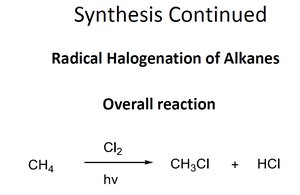
From Alkanes (Radical Halogenation)
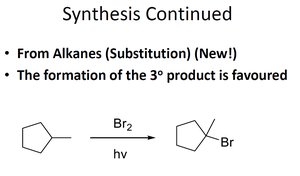
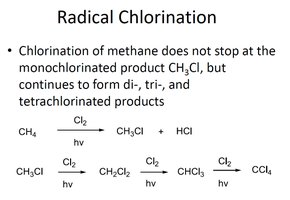
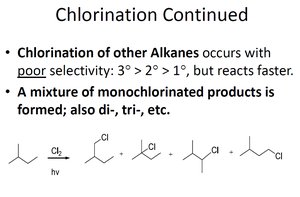
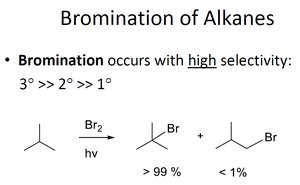
Alkanes can be converted to alkyl halides via radical halogenation, typically using Br2 or Cl2 under UV light. Bromination is more selective for tertiary hydrogens, while chlorination is less selective but faster.
Mechanism of Radical Halogenation
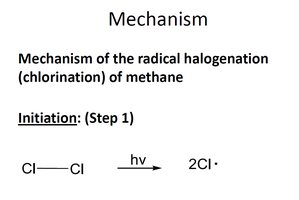
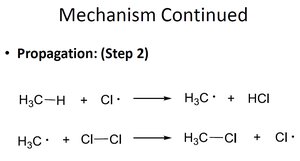
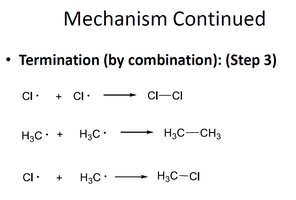
The radical halogenation of alkanes proceeds via a chain mechanism with three main steps:
Initiation: Homolytic cleavage of Cl2 to form two Cl• radicals.
Propagation: Radicals react with substrate to form new radicals and products.
Termination: Combination of two radicals to form a stable molecule.
Chlorination and Bromination of Alkanes
Chlorination is less selective and produces a mixture of products, while bromination is highly selective for tertiary hydrogens.
Reactions of Alkyl Halides
Formation of Grignard Reagents
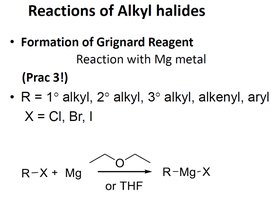
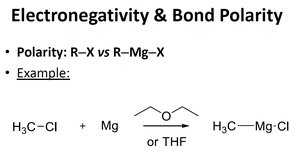
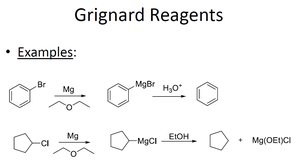
Alkyl halides react with magnesium metal in dry ether or THF to form Grignard reagents (R–Mg–X), which are important organometallic nucleophiles in organic synthesis.
Electronegativity and Bond Polarity
The polarity of the R–X bond influences reactivity. Grignard reagents have a polar carbon–magnesium bond, making the carbon nucleophilic.
Properties and Limitations of Grignard Reagents
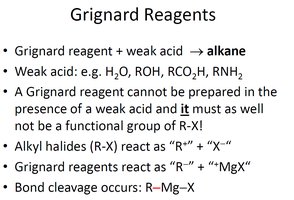
Grignard reagents react with weak acids to form alkanes.
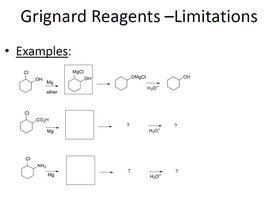
They cannot be prepared in the presence of weak acids (e.g., H2O, ROH, RCO2H, RNH2).
They act as strong nucleophiles and bases.
Substitution and Elimination Reactions
Overview
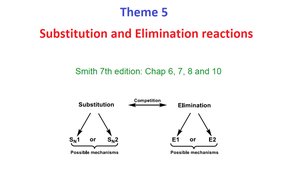
Alkyl halides undergo two main types of reactions: nucleophilic substitution (SN1 and SN2) and elimination (E1 and E2). The competition between these pathways depends on the substrate, nucleophile/base, solvent, and temperature.
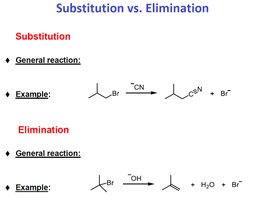
Substitution vs. Elimination
Substitution replaces the halogen with a nucleophile, while elimination removes the halogen and a hydrogen to form an alkene.
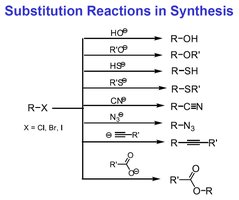
Substitution Reactions in Synthesis
Alkyl halides can be converted to a variety of functional groups via nucleophilic substitution, making them versatile intermediates in organic synthesis.
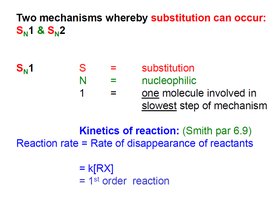
Mechanisms of Nucleophilic Substitution: SN1 and SN2
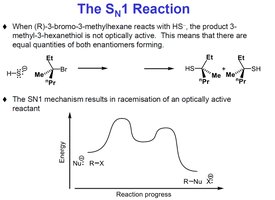
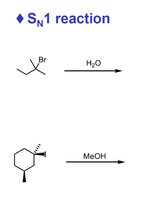
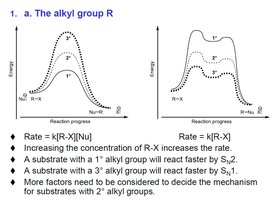
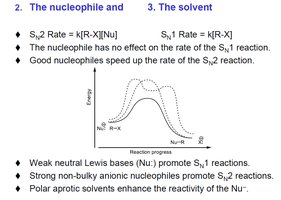
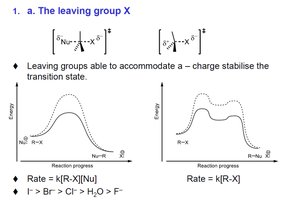
SN1: Unimolecular, two-step mechanism with a carbocation intermediate. Rate depends only on [RX].
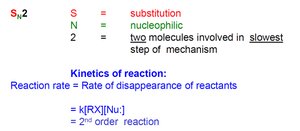
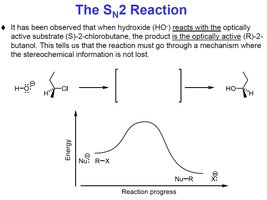
SN2: Bimolecular, one-step mechanism with a concerted transition state. Rate depends on [RX][Nu].
SN2 Reaction: Stereochemistry and Examples
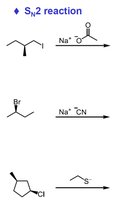
The SN2 reaction proceeds with inversion of configuration at the stereocenter (Walden inversion). It is favored by primary alkyl halides and strong nucleophiles.
SN1 Reaction: Stereochemistry and Examples
The SN1 reaction leads to racemization at the stereocenter due to the planar carbocation intermediate. It is favored by tertiary alkyl halides and weak nucleophiles.
Competition: SN1 vs SN2
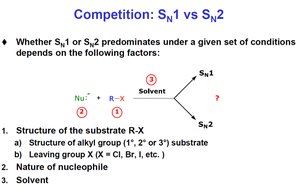
The dominant mechanism depends on substrate structure, nucleophile strength, leaving group ability, and solvent type.
Factors Affecting Nucleophilic Substitution
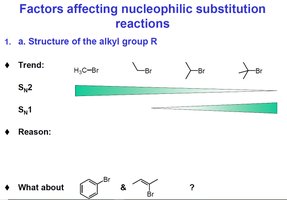
Structure of Alkyl Group: SN2 favored by methyl/primary, SN1 by tertiary.
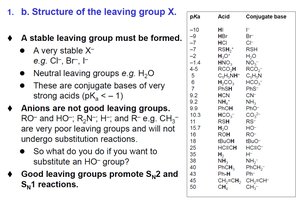
Leaving Group: Good leaving groups (I− > Br− > Cl− > F−) stabilize the transition state.
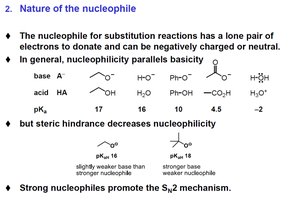
Nucleophile: Strong, small nucleophiles favor SN2; weak, neutral nucleophiles favor SN1.
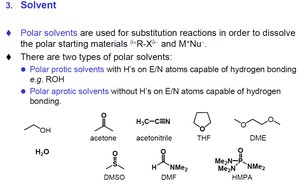
Solvent: Polar aprotic solvents favor SN2; polar protic solvents favor SN1.
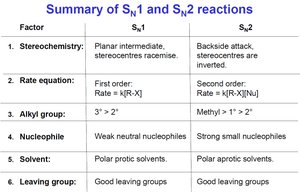
Summary Table: SN1 vs SN2
Factor | SN1 | SN2 |
|---|---|---|
Stereochemistry | Racemization | Inversion |
Rate equation | Rate = k[RX] | Rate = k[RX][Nu] |
Alkyl group | 3° > 2° | Methyl > 1° > 2° |
Nucleophile | Weak, neutral | Strong, small |
Solvent | Polar protic | Polar aprotic |
Leaving group | Good | Good |
Competition: Substitution vs Elimination
Whether substitution or elimination predominates depends on the nucleophile/base, substrate structure, solvent, and temperature. Elimination is favored by strong bases, higher temperatures, and more substituted substrates.
The E1 Elimination Mechanism
The E1 mechanism is a two-step process involving carbocation formation, similar to SN1. The major product follows Zaitsev's rule (more substituted alkene favored). Only weak bases react by E1; strong bases result in E2 elimination.
Summary Table: Substitution and Elimination
Alkyl Group | Mechanism | Other Factors |
|---|---|---|
Methyl, 1° | SN2 | Strong nucleophiles, polar aprotic solvents |
3° | SN1 | Weak nucleophiles, polar protic solvents |
2° | SN1 or SN2 | Strong nucleophiles favor SN2; protic solvents favor SN1 |
Additional info: The notes above are structured to provide a comprehensive overview of alkyl halides, their synthesis, and their reactivity in substitution and elimination reactions, with emphasis on mechanistic details, factors affecting reactivity, and practical synthetic applications.
